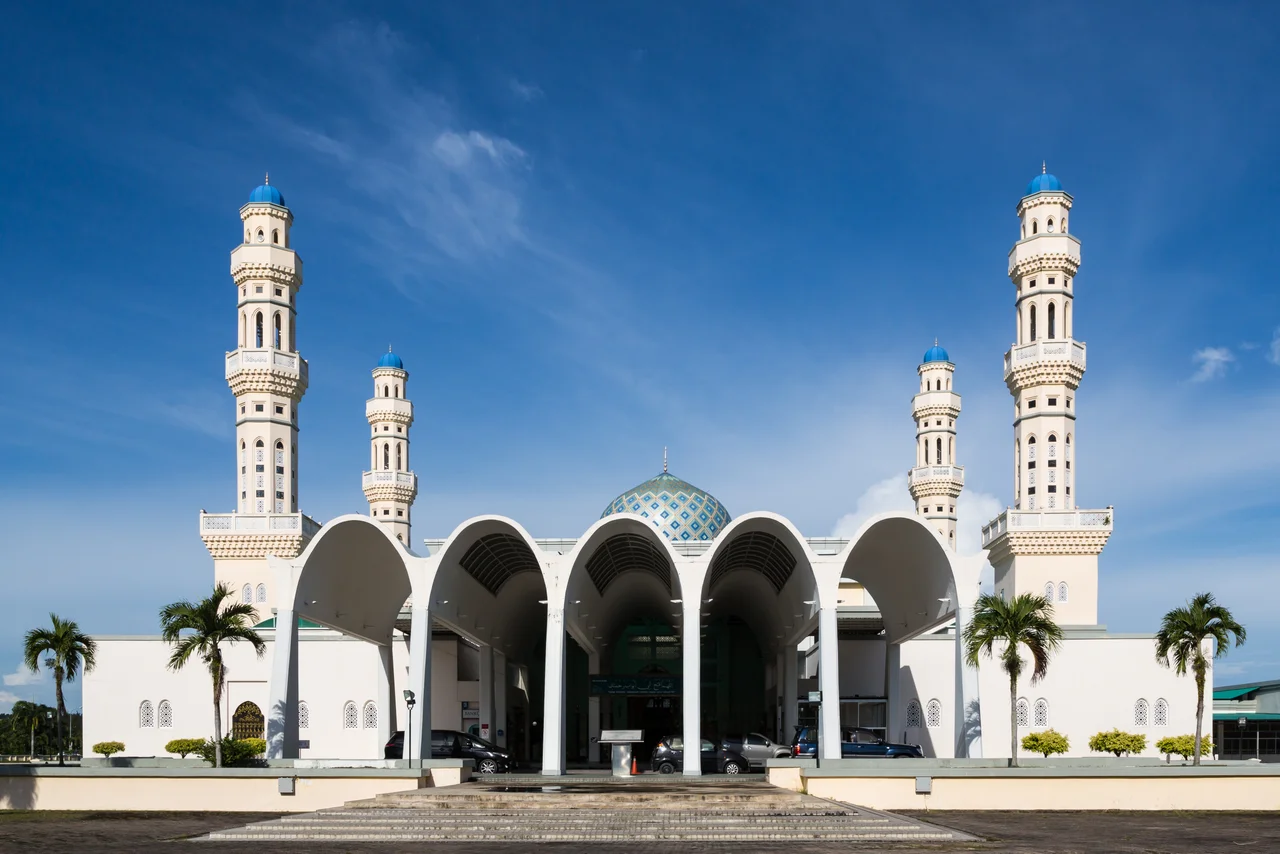

Kota Kinabalu City Mosque
It took more than a decade to build, and at one point the money ran out entirely. When the Kota Kinabalu City Mosque finally opened on 2 February 2000, the ceremony doubled as a celebration of something else: Kota Kinabalu's freshly proclaimed city status. The timing was deliberate. This was not just a place of worship -- it was a statement of civic identity for the capital of Sabah, Malaysia's easternmost state on the island of Borneo. Built in the district of Likas, the mosque rises from the edge of a lagoon, and when the water is still, its white walls and blue-tinted dome appear to float. Photographers discovered this illusion early, and it became one of the most reproduced images in all of Malaysian Borneo.
A Decade in the Making
Preparations for the mosque began in 1989, when Kota Kinabalu was still technically a town rather than a city. Foundation piles went into the ground in 1992, but between 1993 and 1994, construction stalled -- the funds had dried up. The project eventually secured the 34 million Malaysian ringgit needed to complete it, and the mosque opened six years later. That cost figure reflected an ambition that went well beyond a neighborhood prayer hall. The architectural design draws directly from Al-Masjid al-Nabawi, the Prophet's Mosque in Medina, Saudi Arabia -- the second holiest site in Islam. The visual reference is unmistakable: the clean geometric lines, the proportions of the dome, the minarets flanking the central structure. But the setting could not be more different from the arid Hejaz. Here, tropical humidity softens every edge, and the surrounding lagoon gives the building a quality of lightness that Medina's desert architecture never achieves.
The Floating Mosque
What draws most visitors to the City Mosque is not its interior -- handsome though it is -- but the view from across the water. The mosque sits on the edge of a man-made lagoon in Likas Bay, and at high tide, the reflection creates the optical effect of a building suspended between sky and sea. This quality has made it a fixture on travel photography sites and Malaysian tourism campaigns. The building's white exterior walls and blue-toned dome shift color throughout the day, from the warm gold of early morning to the cool blue of twilight. At night, illumination turns the reflection into a glowing double image. The mosque stands as the second main mosque in Kota Kinabalu, after the Sabah State Mosque in Sembulan, but it is the City Mosque that visitors photograph, that appears on postcards, and that defines the city's waterfront profile.
A Mosque on the Water
In 2008, the mosque committee introduced something unexpected: paddle boat rides. Visitors could rent small boats and see the mosque from the water, paddling around its perimeter for a perspective impossible to achieve from shore. A committee member explained that the goal was to make the mosque "more relevant to the community's life encompassing religion, economy and social aspects." The move reflected a broader philosophy about the role of a mosque in modern Malaysian society -- not merely a destination for the five daily prayers, but a gathering place woven into the rhythms of daily life. Tour operators in Kota Kinabalu routinely include the mosque on their itineraries, and it draws visitors of all faiths. The building serves as both a working mosque and a civic landmark, a place where the practical and the sacred share the same address.
From the Air
Located at approximately 5.996°N, 116.108°E in the Likas district of Kota Kinabalu. The mosque's white structure and blue dome are visible from low altitude against the lagoon, especially distinctive at the waterfront. Kota Kinabalu International Airport (WBKK) is approximately 7 km to the southwest. Best viewed from 1,500-3,000 feet on approach or departure from the city.
Nearby Stories
- Quailey's Hill Memorial 15 km away
- Nunuk Ragang 18 km away
- De Fontaine Memorial 20 km away
- The Chimney of Labuan 66 km away
- Tip of Borneo 79 km away
- The Battle of Labuan 97 km away
- Balambangan Island 129 km away
- Tango Maru 160 km away