
The Battle of Labuan
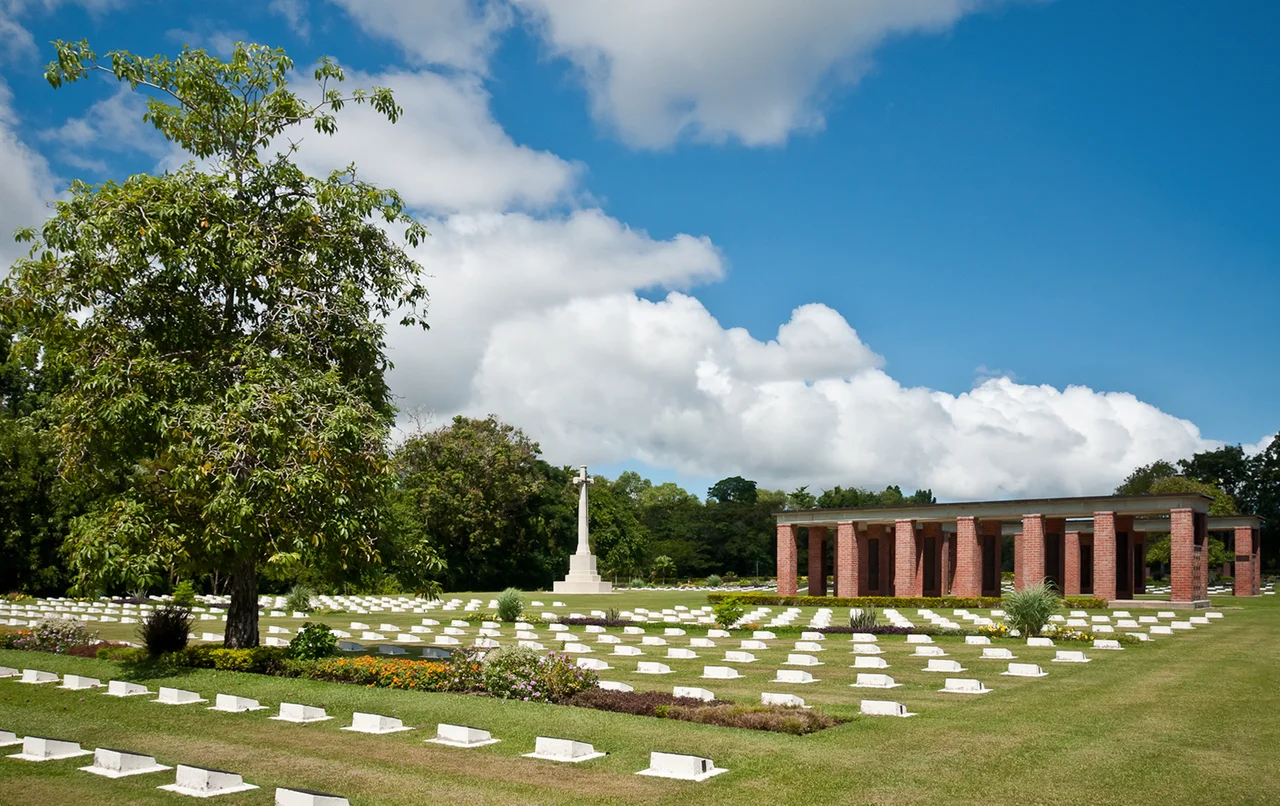
Two Victoria Cross recipients lie buried on Labuan, a 35-square-mile island most people could not find on a map. Jack Mackey and Tom Derrick both died here in June 1945, fighting in one of the last contested landings of the Pacific War. Their graves are among 3,922 headstones in the Labuan War Cemetery, more than half of them marking soldiers who were never identified. The battle that brought the Australians to this island was, in strategic terms, almost unnecessary. The British Chiefs of Staff opposed it. The base it was meant to secure was never fully built. But for the soldiers of the 24th Brigade and the 550 Japanese defenders dug into the island's jungle ridges, the fighting was as real and lethal as anything the war produced.
A Small Island in the Mouth of a Bay
Before the war, Labuan belonged to the British-administered Straits Settlements. Its capital, Victoria, sat on the south coast facing a harbour of the same name, home to 8,500 people and limited port facilities. Coral reefs ringed most of the coastline, leaving only a 1,500-yard beach east of town where a landing force could come ashore. Japan captured the island unopposed on 3 January 1942 and immediately put it to work, building two airfields with laborers conscripted from the Lawas and Terusan regions of mainland Borneo. The occupation was harsh. When Chinese-ethnic civilians led a revolt in the town of Jesselton in late 1943, the Japanese transferred 131 rebels to Labuan. Only nine survived to see liberation. By 1945, Labuan had been assigned a role in Allied planning that exceeded its size: it would anchor a chain of strategic positions controlling the seas between Singapore and Shanghai.
Operation Oboe Six
The plan to take Labuan changed shape repeatedly during April 1945. Initially, it was not even part of the Borneo campaign. Only after a proposed invasion of Java was cancelled did General Douglas MacArthur's headquarters add Brunei Bay to the target list. The 9th Division drew the assignment, a veteran formation hardened by combat in North Africa and New Guinea but out of action since early 1944, its morale fraying. Shipping shortages pushed the landing date from 23 May to 10 June. Soldiers endured ten days crammed into hot, overloaded transports sailing from Morotai. The Australian official historian Gavin Long later wrote that for many troops, those conditions 'were as uncomfortable as any of the experiences that followed.' The 24th Brigade Group, commanded by Brigadier Selwyn Porter, included two infantry battalions, a commando squadron, Matilda II tanks, and a party of 13 British civil affairs officers tasked with restoring colonial governance the moment the shooting stopped.
Brown Beach
At 8:15 on the morning of 10 June, Allied warships opened fire on the landing area. Seven Australian B-24 Liberators dropped anti-personnel bombs behind the beach. Then the assault waves came ashore in amphibious tractors, the coral reefs making conventional landing craft impossible. No Japanese soldiers opposed them. The 2/43rd Battalion pushed north and seized the main airfield by evening. The 2/28th Battalion took Victoria almost immediately, then ran into resistance at Flagstaff Hill by mid-morning. As the day wore on, opposition stiffened to the west, where tanks and mortars joined the infantry in clearing Japanese positions. Eighteen Japanese dead were counted by nightfall. Among the visitors that afternoon was MacArthur himself, who insisted on seeing Australians in action and arrived at a position where fighting was still underway. The process of unloading supplies proceeded so quickly that ships began departing for Morotai the next day.
The Pocket
Within days, the Australians identified the core of the Japanese defense: a fortified position roughly 1,200 yards long and 600 yards wide, threaded through jungle-covered ridges bordered by swamps. They called it 'the Pocket.' Around 250 Japanese soldiers held three areas of high ground, both approach tracks heavily mined. Brigadier Porter, under standing orders to minimize casualties, chose bombardment over direct assault. Between 15 and 20 June, his artillery fired thousands of rounds into the position, supplemented by air strikes and naval gunfire. On 21 June, a Japanese raiding party attacked Allied positions, including the civil affairs compound, killing a British soldier, three local police, and two civilians before being driven off. That same day, the Australians launched their final assault into the Pocket. By 25 June, organized resistance had ended. Patrols spent the following days hunting the last holdouts. When the count was complete, 389 Japanese personnel had been killed on Labuan. Eleven were captured. The Australians lost 34 dead.
What Remains
After the battle, the Allies repaired the airfield and developed Labuan into the base they had planned. But the humanitarian cost was immediate. Allied bombing had destroyed almost every building on the island, and within days of the invasion, some 3,000 homeless civilians crowded into a compound within the beachhead. The civil affairs officers, overwhelmed, needed soldiers reassigned from combat duties just to distribute supplies. The war ended weeks later. In 1949, the Commonwealth War Graves Commission began consolidating the dead from across Borneo into a single cemetery on Labuan. Graves arrived from Sandakan, where more than 2,700 prisoners of war had perished, and from Kuching, where another large camp had operated. Today, 3,922 headstones stand in orderly rows, 2,156 of them bearing no name. A memorial at Brown Beach marks the landing site. A Japanese peace park stands nearby. The island that was fought over and bombed flat has become a place of remembrance, holding the largest Commonwealth war cemetery in Malaysia.
From the Air
The battle took place on Labuan island (5.32N, 115.21E), a small island in the mouth of Brunei Bay off the northwest coast of Borneo. From the air, the island's flat terrain and two airfield sites are visible. Victoria Harbour sits on the south coast. The Labuan War Cemetery is located near the town center, its white headstones visible from low altitude. Brown Beach, the 1945 landing site, lies just east of Victoria. Nearest airport is Labuan Airport (WBKL). Brunei International Airport (WBSB) is approximately 20 nautical miles to the southwest across Brunei Bay.
Nearby Stories
- Pelumpong Island: Brunei's Accidental Eden 6.7 km away
- Battle of Beaufort (1945) 9.1 km away
- Where the River Meets the Sea 36 km away
- De Fontaine Memorial 42 km away
- Brunei's Billion-Dollar Bet on Urea 78 km away
- Kinarut Mansion 98 km away
- Maliau Basin 140 km away
- Luconia Shoals 230 km away