.jpg)
Brunei's Billion-Dollar Bet on Urea
For decades, Brunei's wealth came out of the ground as crude oil and natural gas, shipped to refineries and consumers elsewhere. The country sat at the beginning of the value chain, selling raw hydrocarbons and watching other nations turn them into the products the world actually uses. Brunei Fertilizer Industries represents a deliberate attempt to change that equation. Founded in 2013 and built at a cost of B$1.8 billion, BFI is a state-owned plant that takes Brunei's natural gas and converts it into ammonia and urea -- the nitrogen-rich granules that feed crops across Asia and beyond.
Downstream Ambitions
BFI sits within the Sungai Liang Industrial Park, known locally as SPARK, in Brunei's Belait District. It is one of two major downstream developments that signal the country's shift from simply extracting resources to processing them. The other is the PMB Refinery and Petrochemical Plant on Pulau Muara Besar island. Together, these facilities represent Brunei's most significant industrial diversification in a generation. The logic is straightforward: natural gas is abundant, global demand for fertilizer is rising as agricultural production intensifies, and downstream manufacturing captures far more value than raw export. The plant is divided into three sections -- onsite utilities, ammonia production, and urea production -- and when running at full capacity, it produces 3,900 tonnes of urea and 2,200 tonnes of ammonia per day.
A Plant Built at Speed
The construction timeline was aggressive by any standard. On 26 August 2017, BFI signed its engineering, procurement, and construction contract with ThyssenKrupp, and ground-breaking followed quickly. Five hundred steel pipe piles had to be driven for the Urea Export Jetty alone, all conforming to oil and gas safety standards under a fast-tracked schedule. The final piece of heavy equipment was delivered by Jasra Logistics on 18 February 2020. By April 2021, the facility was 98.6 percent complete. The plant's urea melt facility, built with technology licensed from Stamicarbon, is reported to be the largest the Dutch firm has ever permitted. BFI eventually produced its first commercial batch of urea and began recording daily production volumes exceeding 3,000 tonnes as it ramped toward nameplate capacity.
A Jetty into the South China Sea
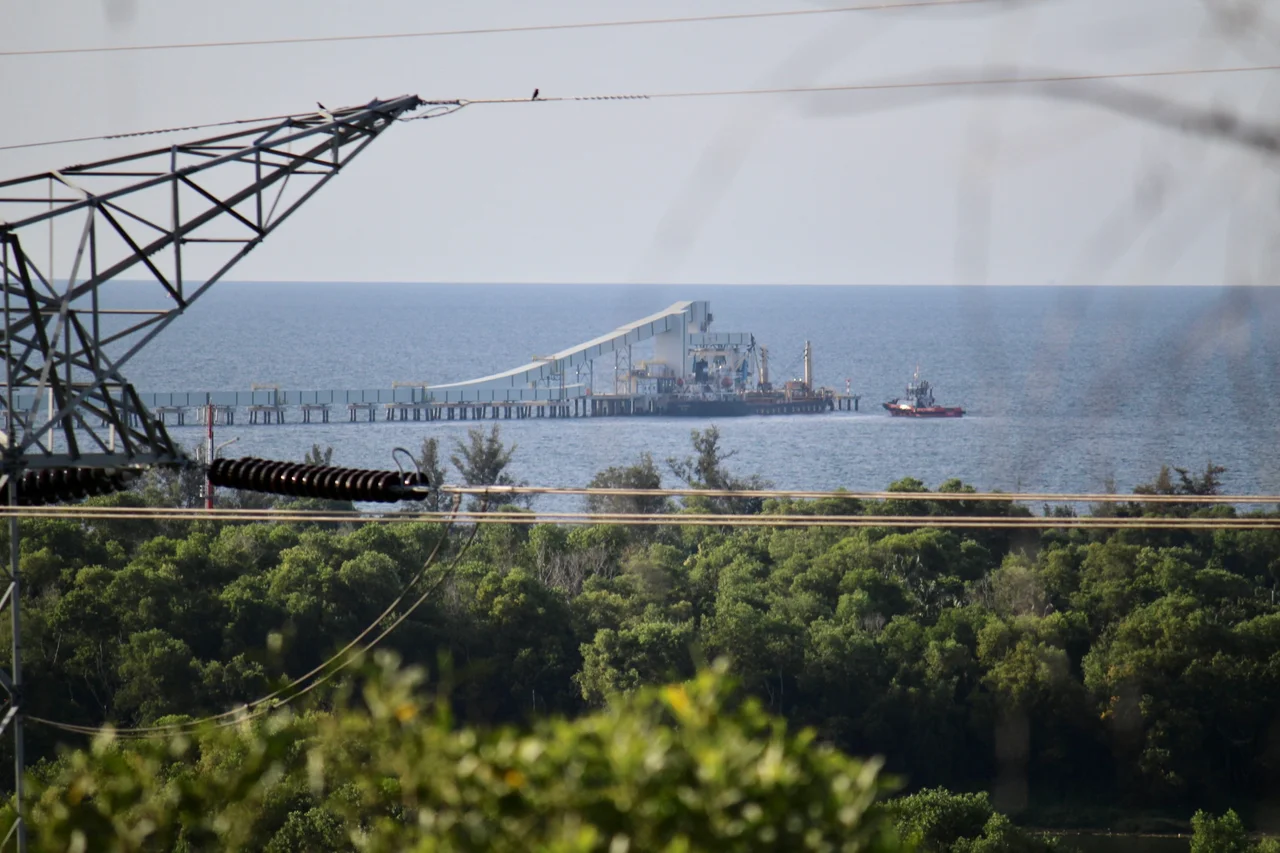
Getting fertilizer out of the jungle requires infrastructure on a different scale. The Urea Export Jetty stretches 3.3 kilometers from shore, with 2.5 kilometers classified as offshore. During construction, the Maritime and Port Authority of Brunei Darussalam issued navigation warnings to mariners, and yellow marker buoys ringed the construction zone to protect ship traffic. The jetty is the physical link between BFI's landlocked production lines and the global market -- bulk carriers dock at its end to load urea bound for agricultural regions across Asia. For a country whose exports have historically been dominated by oil tankers and LNG carriers, a jetty dedicated to fertilizer represents something genuinely new.
The Diversification Imperative
Brunei's dependence on oil and gas revenue has long been both a blessing and a vulnerability. When prices are high, the sultanate prospers. When they fall, as they did sharply in 2014, government budgets tighten and the fragility of a single-commodity economy becomes impossible to ignore. BFI is part of a broader national strategy called Wawasan 2035, Brunei's vision for economic diversification. The plant was expected to create 500 jobs when fully operational -- a significant number in a country of roughly 450,000 people. With a production capacity of approximately 1.29 million tonnes of urea per year, the facility positions Brunei as a meaningful player in Southeast Asia's fertilizer market. Whether the bet pays off in the long run depends on natural gas prices, global food demand, and Brunei's ability to compete with larger producers. But the plant stands as physical proof that the country is trying to build something beyond the oil wells that made it rich.
From the Air
Located at 4.68N, 114.48E in Brunei's Belait District. From the air, the BFI complex is visible as a large industrial facility at Sungai Liang Industrial Park (SPARK), with the Urea Export Jetty extending 3.3 km into the South China Sea as a prominent coastal feature. Look for storage tanks, processing towers, and the long jetty structure along the coast. Nearest airport: Brunei International Airport (WBSB) approximately 90 km northeast. Recommended viewing altitude: 5,000-8,000 feet for full plant and jetty visibility.
Nearby Stories
- The Sultan's Gurkhas 2.4 km away
- The Town That Splits a Nation 12 km away
- Kelabit Highlands 20 km away
- The Billion-Dollar Playground That Michael Jackson Opened 45 km away
- The Ants of Borneo 56 km away
- Niah National Park 66 km away
- Similajau National Park 156 km away
- Luconia Shoals 185 km away