
Niah National Park
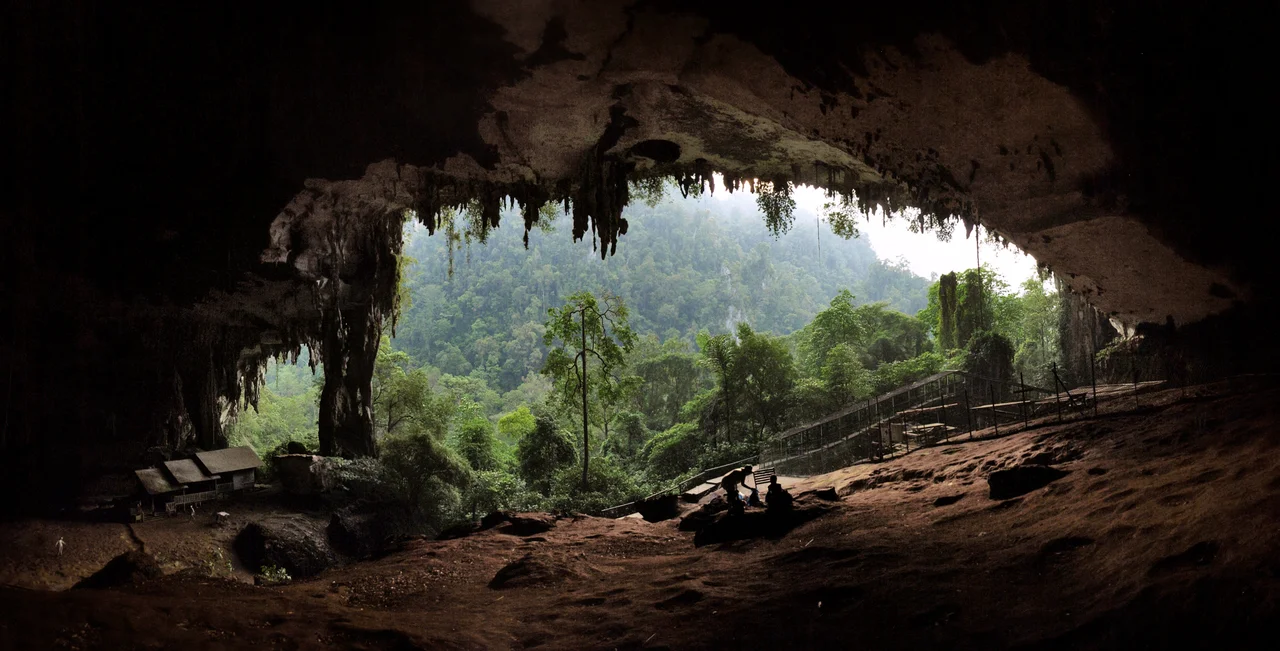
Forty thousand years ago, someone died in a cave on the edge of Borneo. Their skull would wait in the dark until 1958, when a maverick British curator named Tom Harrisson dug it from the floor of what he called the Great Cave -- a limestone cathedral 150 meters wide and 75 meters high, carved into the flank of Gunung Subis. That skull, known simply as the Deep Skull, became one of the most debated fossils in Southeast Asian archaeology. It pushed the timeline of human habitation on Borneo back tens of thousands of years and forced researchers to rethink how early humans moved through the tropical lowlands of the region. Today, the cave complex at Niah National Park holds UNESCO World Heritage status, granted in July 2024 after more than a decade of nominations. But the caves have never been merely academic. They are still a workplace.
The Curator's Hunch
Tom Harrisson was not a conventional archaeologist. The curator of the Sarawak State Museum arrived at Niah in October 1954 with two friends, Michael Tweedie and Hugh Gibb, and a theory built on observation rather than evidence. The cave showed no obvious signs of ancient habitation. But Harrisson noticed it was cool, dry, and swarming with millions of bats and swiftlets -- reliable protein sources for any hunter-gatherer community. If ancient humans had passed through Borneo, he reasoned, they would have stopped here. Two weeks of digging proved him right. He found evidence of long-term occupation, habitation debris, and burial sites. A larger expedition followed in 1957, backed by Brunei Shell Petroleum and Sarawak Oilfields, uncovering earthenware, shell scrapers, bone tools, and food remains. Then, in February 1958, came the Deep Skull itself. Subsequent expeditions in 1959, 1965, and 1972 pushed deeper into the sediment layers, revealing Neolithic burial sites dating from 2,500 to 5,000 years ago.
Bones That Rewrote History
The Deep Skull triggered decades of controversy. In 1960, anthropologist Don Brothwell concluded it belonged to an adolescent male possibly related to indigenous Tasmanians, a finding that raised as many questions as it answered about migration patterns across ancient land bridges. Critics pointed to gaps in Harrisson's documentation -- insufficient paleogeography, unclear stratigraphy, ambiguous archaeological context. A redating effort in 2000 helped clarify the timeline, and studies published in 2006 confirmed human activity at Niah spanning from roughly 46,000 to 34,000 years ago. The cave's archaeological record runs remarkably deep: Pleistocene chopping tools and flakes, Neolithic axes and adzes, pottery, shell jewelry, boats, mats, and eventually iron tools, ceramics, and glass beads from the Iron Age. Nearby, the Painted Cave holds rock art dated to approximately 1,200 years ago, including depictions of what archaeologists interpret as death ships. In 2020, all 122 pieces of Niah human remains were repatriated to Sarawak from overseas collections.
A Mountain at the Edge of the Sea
Gunung Subis rises from the coastal lowlands of Miri Division, its limestone flanks pocked with caves and furred with vegetation. The park sits just 15 kilometers from the South China Sea and only 50 meters above sea level, placing it within a landscape of six distinct vegetation types identified by botanist Pearce in 2004: limestone karst scrub, mixed dipterocarp forest, seasonal swamp forest on both clay and peat soils, riparian corridors along waterways, and regenerating forest where older growth has been disturbed. The biodiversity is dense enough to earn Niah designation as an Important Bird Area. Walking the plankwalk trail from park headquarters to the cave mouth takes roughly 45 minutes through lowland rainforest that hums with insects and drips with humidity. The trail itself has become part of the experience -- the slow approach through dense canopy making the sudden scale of the Great Cave's entrance all the more dramatic when it finally appears.
The Nest Collectors
Long before archaeologists arrived, the caves at Niah had an economy. Swiftlets build their nests from hardened saliva on the cave ceilings, and those nests -- the key ingredient in bird's nest soup -- command extraordinary prices across East Asia. Every section of ceiling where swiftlets roost is privately owned, and only the owner may harvest. Collection happens twice a year, typically in January and June. The method has barely changed: a collector climbs a single bamboo or belian pole, sometimes hundreds of feet, to scrape nests from the rock by flickering candlelight. It is dangerous, physically demanding work, performed in near-darkness at heights that would give most people vertigo. The nest trade predates European contact in Borneo by centuries and remains a significant source of income for local communities. Niah is a place where the deep past and the working present occupy the same physical space -- the same cave ceiling that sheltered human ancestors now feeds their distant descendants.
From the Air
Located at 3.81°N, 113.78°E in the Miri Division of Sarawak, Malaysian Borneo. Gunung Subis is visible as a limestone massif rising from flat coastal lowlands about 15 km inland from the South China Sea. Recommended viewing altitude: 3,000-5,000 ft to appreciate the contrast between the karst formation and surrounding rainforest. Nearest major airport is Miri Airport (WBGR), approximately 65 km to the northeast. The park is accessible via a turn-off from the road between Miri and Bintulu.
Nearby Stories
- The Fort That Ended the Feuds 17 km away
- Twenty-Nine Minutes Over Borneo 31 km away
- Baram Dam 37 km away
- Marudi 45 km away
- Similajau National Park 56 km away
- Fort Sylvia 169 km away
- Luconia Shoals 219 km away
- Fort Alice 342 km away