.jpg)
Marudi
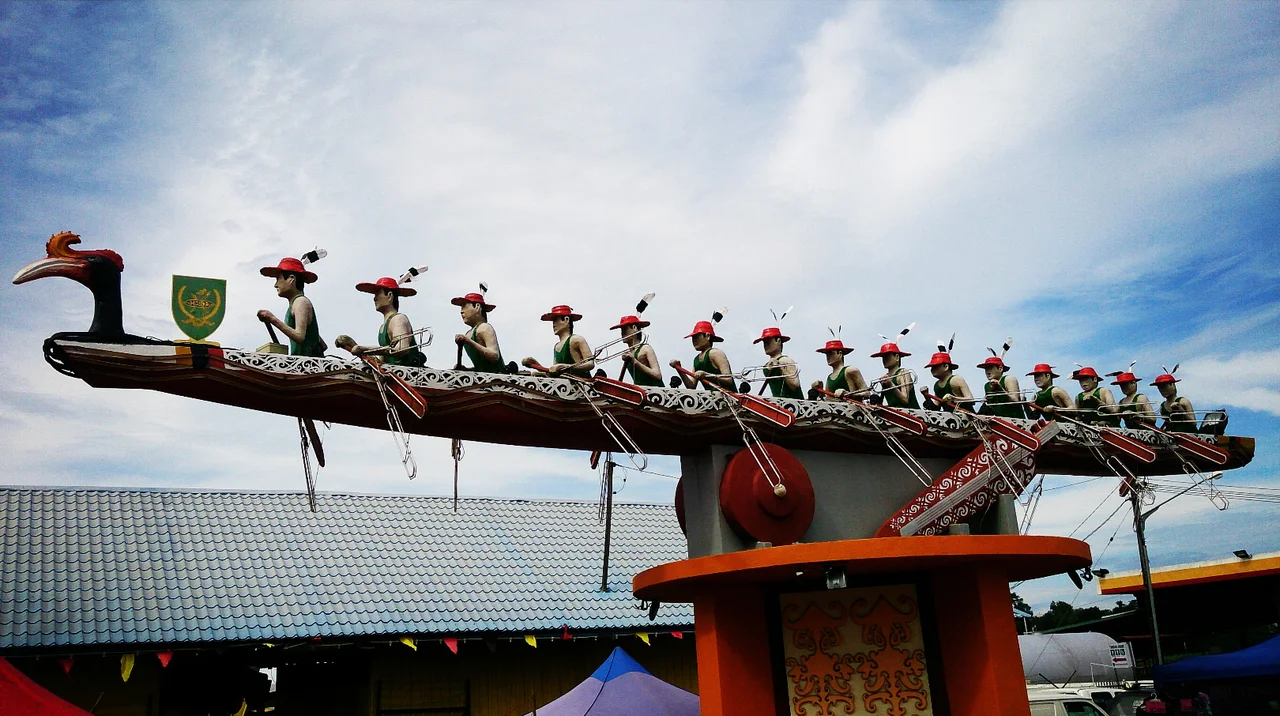
The solution to headhunting, it turned out, was a regatta. In the 1890s, the highland tribes of Borneo's Baram region were locked in blood feuds that had persisted for generations, and the White Rajah's colonial administrators needed a way to channel that ferocity into something less lethal. Cockfighting was tried first -- but the losing tribes took their defeats poorly, and the violence resumed. Then someone suggested longboat racing. The tribes agreed, and the Baram Regatta was born in Marudi, the small river town that had become the unlikely capital of peace negotiations. More than a century later, the regatta still runs, and Marudi still sits on the banks of the Baram River, 100 kilometers upstream from the sea, quietly serving as the cultural heart of Sarawak's highland peoples.
The Sultan's Bargain
Until 1882, the Baram region belonged to the Sultan of Brunei -- at least on paper. In practice, the Sultan's authority had never penetrated the interior. The Kayan and other tribes controlled roughly 10,000 square miles of dense rainforest, and the Malay lowlanders avoided the region entirely out of fear. By the late 1800s, tribal territories were expanding dangerously close to the Sultan's capital, and he found himself governing a domain he could neither enter nor control. When James Brooke's dynasty offered to take the problem off his hands in exchange for an annual payment of six thousand dollars, the Sultan accepted. The British Foreign Office approved the transfer, considering it a reasonable price. The fourth division of Sarawak was created immediately, and Mamerto George Gueritz became its first Resident. A fort was built at Marudi, 43 kilometers east of the coast, and the settlement was named Claudetown in honor of Claude Champion de Crespigny, a colonial officer who had died in 1884.
Fort Hose and the Peace Races
Charles Hose arrived as Resident of the Baram District in 1891, and the fort was renamed in his honor. Hose inherited a volatile situation: Rajah Charles Brooke was determined to end headhunting permanently, but decades of colonial edicts had failed to stop the practice. Force had not worked. Persuasion had not worked. So Hose tried competition. He gathered the tribes and organized cockfights, hoping that ritualized rivalry would replace the real thing. It did not -- the losing sides simply resumed fighting with sharper weapons. Boat racing proved the breakthrough. The Baram's indigenous peoples were already superb river navigators, and longboat races channeled inter-tribal competition into something the colonial administration could manage. Marudi became the permanent venue, and the Baram Regatta evolved into an annual celebration that persists today, drawing communities from across the highlands for days of racing, music, and trade.
Gateway to the Highlands
Marudi was the administrative center of northern Sarawak before Miri was established in 1910, and it remains the cultural capital of the Orang Ulu, the collective name for Sarawak's highland tribes. The town serves as a transit gateway to two of Borneo's most remarkable destinations: the Kelabit Highlands, a cool plateau of rice paddies and longhouse communities, and Gunung Mulu National Park, a UNESCO World Heritage Site whose caves and limestone pinnacles draw visitors from around the world. Twin Otter turboprops operated by MASwings connect Marudi's small airport to Miri up to nine times daily, and from there to remote highland strips at Bario, Long Banga, and Long Seridan. The airport sits just a kilometer from the town center -- a ten-minute walk along a covered pedestrian path that runs beside the main road.
Where the Crocodiles Returned
The Baram River was once packed with express boats, sampans, and longboats ferrying passengers and goods between Marudi and the coast. Road improvements -- particularly the 43.2-kilometer highway connecting Miri and Marudi, under expansion since 2016 -- have shifted traffic from water to land. The river has grown quieter, and into that silence, saltwater crocodiles have moved. By 2023, residents of riverfront settlements and longhouses were reporting increasing encounters with crocodiles that had grown bold in the absence of boat traffic. The animals had always been present in the Baram, but the constant noise and disturbance of river commerce had kept them at a distance. Now they patrol the shallows near villages, a reminder that in Borneo, nature reclaims space quickly when humans vacate it.
Shophouses and Temples
Marudi's compact town center follows a grid plan lined with multi-story shophouses, a style of Malaysian urban planning that predates the shift toward suburban sprawl. Fort Hose still overlooks the Baram River from its hilltop perch near the town center, though the original wooden structure burned in 1994 and the current building is a 1997 reconstruction that houses the Baram District Museum. Nearby stands the Tua Pek Kong temple, built in 1891 by Chinese merchants who had come to trade in the interior. It is the only Chinese temple in Marudi -- small compared to those in larger cities, but central to the town's identity. The Chung Hua School, founded in 1926 in the temple's back rooms with just fifteen students and a single headmaster, Goh Jing Chew, grew into a permanent schoolhouse on a nearby hilltop by 1936. Marudi is a town built by overlapping communities: Orang Ulu, Malay, Chinese, and colonial British, each leaving their mark on a few blocks beside the river.
From the Air
Located at 4.18N, 114.32E on the Baram River in Sarawak, Malaysian Borneo. Marudi Airport (ICAO: WBGM, IATA: MUR) has a short runway visible from approach. Best viewed at 3,000-5,000 feet to see the river and grid-plan town center. Nearby airports include Miri (WBGR), approximately 43 km west. Tropical rainforest climate with heavy rainfall year-round; expect reduced visibility during monsoon season.
Nearby Stories
- Belait Swamp Forest 2 km away
- Niah National Park 15 km away
- The Green Jewel You Can Only Reach by River 29 km away
- The Ants of Borneo 47 km away
- The Mountain You Must Not Name 47 km away
- Baram Dam 56 km away
- Similajau National Park 108 km away
- Luconia Shoals 225 km away