
The Green Jewel You Can Only Reach by River
There is no road into Ulu Temburong. To reach Brunei's first and largest national park, you board a longboat and ride upriver through narrows where the canopy closes overhead and the sound of the outboard motor bounces off walls of green. This inaccessibility is not an oversight -- it is the point. Since its protection in 1991, the 550 square kilometers of lowland and montane rainforest that make up Ulu Temburong have remained essentially untouched, earning the park its nickname: the Green Jewel of Brunei.
A Kingdom's Quiet Commitment
Brunei is one of the smallest countries in Southeast Asia, yet it has set aside a remarkable proportion of its territory as protected forest. Ulu Temburong alone covers roughly 40 percent of the Temburong District, an exclave separated from the rest of Brunei by a wedge of Malaysian Sarawak. The park sits within the larger Batu Apoi Forest Reserve and forms part of the Heart of Borneo initiative, a tri-national agreement between Brunei, Malaysia, and Indonesia to conserve the island's interior rainforests. For a petroleum-rich sultanate that could have logged its forests for additional revenue, the decision to preserve this wilderness speaks to a conservation philosophy that predates the environmental movement's global rise.
Fifty Meters Above the Forest Floor
The park's signature experience is the Belalong Canopy Walkway, a series of steel towers connected by suspended walkways that rise approximately 50 meters above the ground. Reaching it requires an hour-long trek from park headquarters along a network of boardwalks and stairways stretching 7 kilometers through the forest. The climb up the final tower is steep and exposed, and the walkway sways underfoot. But the reward is a view that few places on earth can match: an unbroken carpet of green stretching to the horizon, punctuated by the silver thread of the Temburong River and its tributary, the Belalong. From this height, the forest reveals its layered architecture -- emergent dipterocarp crowns rising above the main canopy, with epiphytes, ferns, and orchids colonizing every available branch.
Wings and Voices in the Canopy
Four hundred species of butterfly inhabit the park, and the most celebrated is the Rajah Brooke's birdwing, named for James Brooke, the British adventurer who once ruled Sarawak as his personal kingdom. The males are unmistakable: jet-black wings banded with vivid emerald green, gliding through the understory like fragments of stained glass. The tree nymph, Idea stolli, drifts more languidly, its white-and-black spotted wings giving it the look of animated tissue paper. Above, rhinoceros hornbills announce themselves with heavy wingbeats and raucous calls, their casqued bills slicing through gaps in the canopy. Eastern grey gibbons move through the treetops with fluid, arm-over-arm swings, their whooping territorial songs carrying across the valley at dawn.
Life at the River's Edge
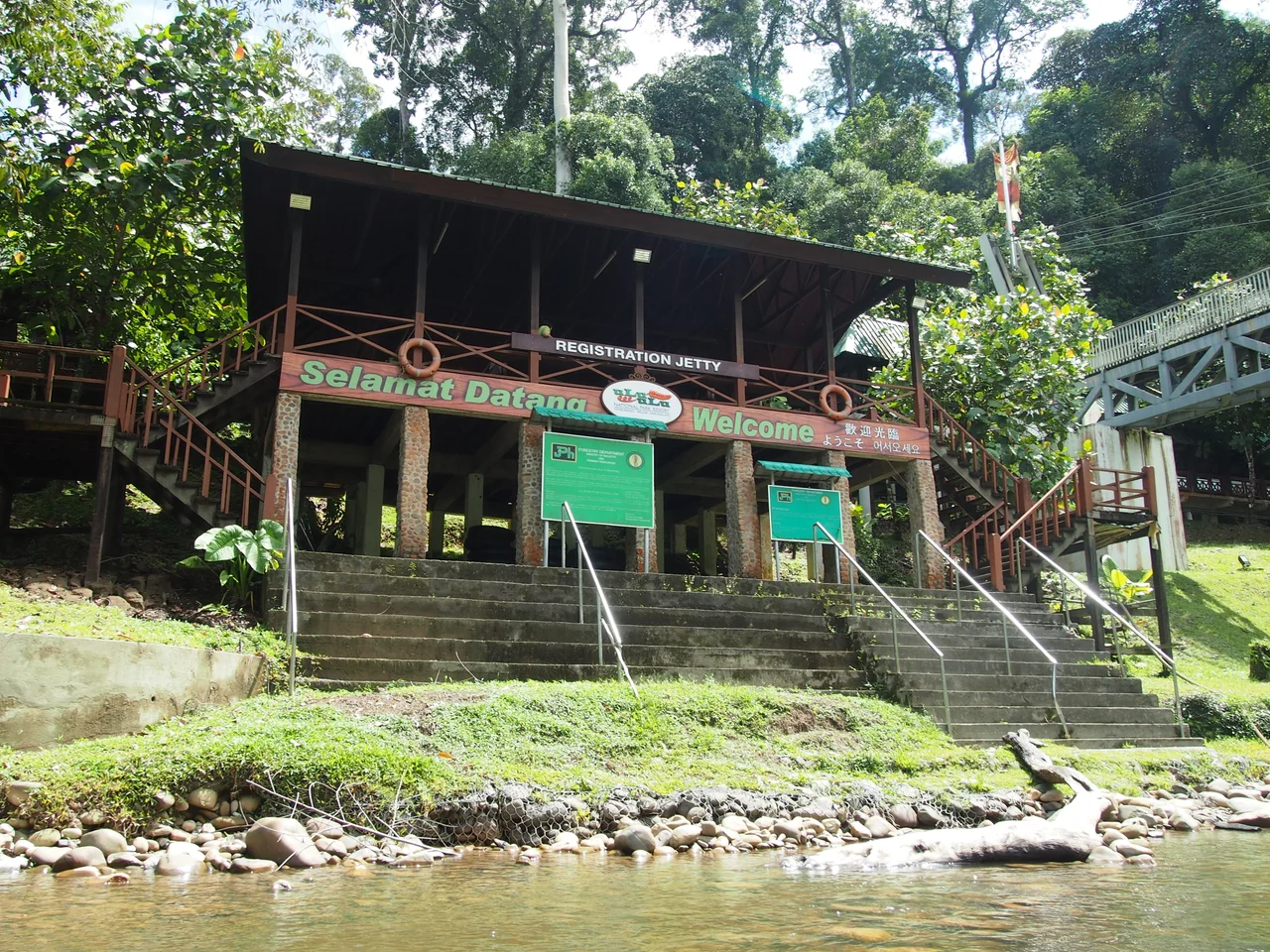
The Temburong and Belalong Rivers are more than transport corridors; they are the park's circulatory system. Their confluences create microhabitats where giant forest ants, Camponotus gigas, patrol trails the width of a human finger. Lantern bugs cling to bark with their improbable, elongated heads. Centipedes the length of a forearm hunt through the leaf litter. The rivers themselves are startlingly clear in their upper reaches, running over beds of smooth stone where visitors can swim during guided excursions. Park headquarters sits near the confluence of the Belalong and Temburong, and the 17-room Ulu Ulu Resort -- Brunei's first public-private partnership in tourism, opened in November 2008 -- provides low-impact accommodation. Visitors must book a package tour from Bandar Seri Begawan, the capital, ensuring the park never receives more people than it can absorb.
Fragile and Irreplaceable
Ulu Temburong's remoteness is its greatest protection, but remoteness alone is not a conservation strategy. The park sits within one of the most biodiverse regions on the planet -- Borneo's lowland and montane rainforests host more tree species per hectare than anywhere else on earth. BirdLife International has designated it an Important Bird Area, with bushy-crested hornbills, black-and-yellow broadbills, and swiftlets among its notable residents. The Covid-19 pandemic forced the Ulu Ulu Resort to suspend operations in June 2020, a reminder of how fragile even well-managed ecotourism can be. But the forest itself continued as it has for millennia: indifferent to human schedules, growing and decaying and regenerating in the equatorial heat, waiting for the next longboat to round the bend.
From the Air
Located at 4.478N, 115.208E in Brunei's Temburong District. The park covers 550 km2 of dense rainforest with mountains rising to 1,800 m in the south. From altitude, the unbroken canopy and silver river corridors of the Temburong and Belalong are clearly visible against the surrounding logged areas of Malaysian Sarawak. Nearest airport is Brunei International Airport (WBSB), approximately 80 km northwest. The Temburong River system provides excellent visual navigation references. Best viewed at 3,000-5,000 ft to appreciate the canopy texture and river network.
Nearby Stories
- Where the River Meets the Sea 3.4 km away
- The Abode of Peace on Borrowed Coastline 10 km away
- The Town That Splits a Nation 15 km away
- The Ants of Borneo 29 km away
- The Fort That Ended the Feuds 32 km away
- Sabah State Railway 67 km away
- Starcevich Monument 96 km away
- Battle of Tarakan (1942) 232 km away