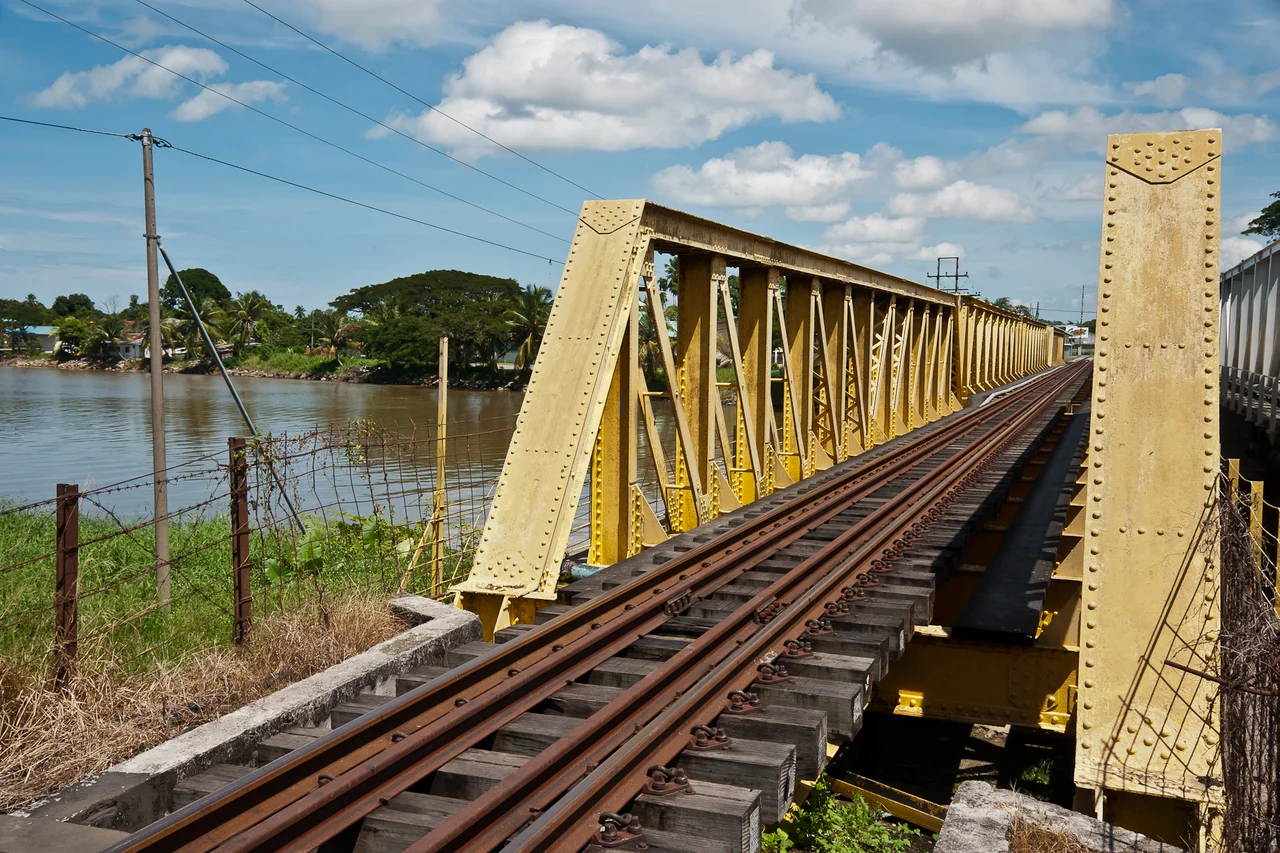

Sabah State Railway
The train takes four hours to cover 134 kilometres. It is not fast, it is not air-conditioned, and on rainy days mudslides can shut it down entirely. But the Sabah State Railway is something no other railway in the world can claim: it is the only rail system operating on the island of Borneo. From Tanjung Aru, near Kota Kinabalu on the west coast, the single track winds through coastal plains and plunges into the interior mountains to reach the small town of Tenom, following a route that was laid more than a century ago to haul tobacco out of the jungle.
Tobacco, Rails, and a Murut Engineer
The railway owes its existence to the tobacco boom of the 1880s. Plantations in North Borneo's interior were producing export-quality leaf, but getting it to the coast was punishingly difficult without roads. In 1894, William Clark Cowie's appointment to the North Borneo Chartered Company brought the momentum needed to build a railway. Construction began in 1896 under engineer Arthur Joseph West, assisted by Gounon Lulus, a member of the Murut people from Keningau. The first 32-kilometre track ran from Bukau River north to Beaufort and south to the port of Weston. By 1903, a second line connected Beaufort to Jesselton, today's Kota Kinabalu, running near the coast. At its peak, the network covered 193 kilometres.
Destruction and Diminishment
World War II left the railway almost entirely destroyed. In the desperate postwar years, motive power on the reconstructed line came from converted jeeps hauling carriages along battered track. A rehabilitation program launched in 1949 brought some normalcy, but the network's golden age never returned. The Weston branch closed in 1963, and the Melalap extension from Tenom shut down in 1970. New roads siphoned passengers and freight. By 1974, the main line had been cut back from Kota Kinabalu to Tanjung Aru. What remained was a stripped-down survivor, a single-track, metre-gauge, non-electrified line threading through some of the most challenging terrain in Southeast Asia.
Threading the Padas Valley
The journey between Beaufort and Tenom is the railway's crown jewel. The track follows the Padas River valley, passing through tunnels carved into mountainsides and over bridges spanning gorges where the river churns below. Passengers at Halogilat must change to smaller carriages and lighter locomotives because track conditions beyond that point cannot support the heavier stock. On Wednesdays and Saturdays, early-morning Tamu trains carry villagers and their produce between Tenom and Rayoh, keeping alive a tradition of market-day rail service that predates independence. Hitachi and Kawasaki diesel locomotives, introduced in the 1970s to replace steam engines, still haul freight along the route, rated at a modest 320 to 580 horsepower.
A Railway Dreaming Forward
Despite its age, the railway has not stopped dreaming. In 2011, the Tanjung Aru to Beaufort section reopened after years of maintenance, with new concrete sleepers and trains capable of 80 kilometres per hour. The state government allocated nearly RM28 million in 2015 for new diesel multiple units from Japan and India. Plans have been announced to extend the line to Kudat, Sandakan, and Tawau, and a visionary proposal called the Trans-Borneo Railway would eventually connect Sabah's tracks with Sarawak and Indonesia's Kalimantan rail network. For now, though, the Sabah State Railway remains what it has been for over a century: a determined little line rattling through the mountains, carrying passengers and goods where no other train on the world's third-largest island dares to go.
From the Air
The Sabah State Railway (centered at 5.34°N, 115.75°E) follows a 134 km corridor from Tanjung Aru near Kota Kinabalu to Tenom in the interior. The coastal section is visible paralleling the shoreline, while the Beaufort-Tenom stretch follows the dramatic Padas River valley. Look for the railway threading through the Crocker Range. Nearest airport: Kota Kinabalu International Airport (WBKK). Best viewed at 3,000-8,000 feet to trace the rail corridor through the landscape.
Nearby Stories
- The Chimney of Labuan 7.4 km away
- Crocker Mountains 20 km away
- Pelumpong Island: Brunei's Accidental Eden 24 km away
- De Fontaine Memorial 26 km away
- Mount Trusmadi 27 km away
- Maliau Basin 66 km away
- The Forests That Burn Underground 74 km away
- Tango Maru 229 km away