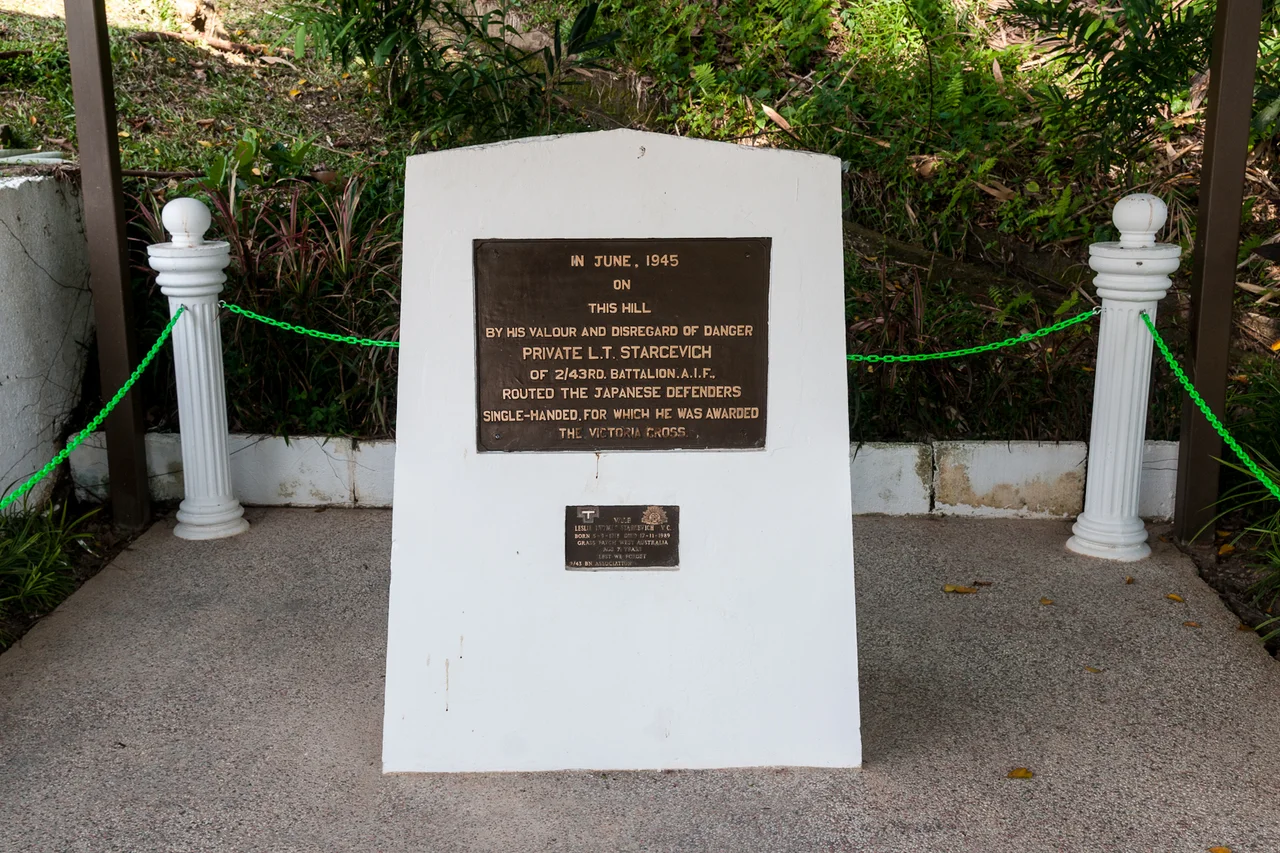

Starcevich Monument
It is barely a metre tall, a plain stone stele with a metal plaque, standing in the town that a young soldier helped liberate. The Starcevich Monument in Beaufort, Sabah, would be easy to walk past without understanding what it represents. But the citizens of this small Malaysian town built it with purpose. They raised it not for a general or a politician, but for Private Tom Starcevich of Australia's 2/43rd Battalion, a man who charged Japanese machine-gun positions with a Bren gun on the morning of 28 June 1945 and changed the course of the battle for their home.
The Morning Everything Changed
By late June 1945, Australian forces were closing in on Beaufort as part of the broader Borneo campaign. The town sat at the junction of two railway lines along the Padas River, making it strategically vital. On 27 June, the 2/32nd and 2/43rd Battalions launched their attack against the 386th Japanese Independent Infantry Battalion under Major Kimura Jiro. By evening, most of the 2/43rd had fought their way into town, while other units positioned themselves to cut off Japanese escape routes. The next morning, during a patrol near the jungle perimeter, Australian soldiers came under withering machine-gun fire. It was then that Starcevich acted, leading two counter-attacks against the fortified positions, silencing them with his Bren gun.
A Cross for Valor
For his actions at Beaufort, Tom Starcevich was awarded the Victoria Cross, the highest decoration for bravery in the face of the enemy in the Commonwealth military system. He was one of only twenty Australians to receive the award during World War II. Starcevich was born in 1918, the son of Croatian immigrants who had settled in Western Australia. He was not a career soldier but a man who found himself in extraordinary circumstances and responded with extraordinary courage. The battle he helped win proved to be the last significant engagement in North Borneo. Within weeks, the war in the Pacific would end entirely.
Gratitude in Stone
The monument was erected by the citizens of Beaufort themselves, a gesture of gratitude to the Australian forces who had liberated their town from Japanese occupation. Originally placed in front of the police station, it takes the form of a rectangular stele that tapers slightly upward, topped by a flat cap. A metal sheet on the front face carries an inscription in English honoring the Australian troops and their sacrifice. The monument is modest by any standard, but its significance lies in who built it: not a distant government, not a military command, but the people of Beaufort, who remembered what liberation felt like.
A Second Plaque, a Final Honor
Tom Starcevich returned to Western Australia after the war and lived quietly until his death in November 1989, at the age of 71. The following year, at the suggestion of his wartime comrade Stanley Toomey, a second metal plaque was added to the monument. Beneath the regimental character 'T' and the coat of arms of the Australian Imperial Force, the new inscription honored Starcevich specifically, ensuring that future visitors to this small-town memorial would know the name of the man who earned the Victoria Cross in their streets. In Beaufort, halfway around the world from where he grew up, a soldier's courage is preserved in stone by a community that never forgot.
From the Air
The Starcevich Monument is located in the town of Beaufort (5.34°N, 115.75°E) along the Padas River in Sabah's western interior. The monument itself is not visible from altitude, but the town of Beaufort is identifiable by its position at the river junction and railway line crossing. Nearest major airport: Kota Kinabalu International Airport (WBKK), approximately 90 km to the northwest. The Padas River valley serves as a clear visual reference for navigation.
Nearby Stories
- The Chimney of Labuan 7.4 km away
- Crocker Mountains 20 km away
- Pelumpong Island: Brunei's Accidental Eden 24 km away
- De Fontaine Memorial 26 km away
- Mount Trusmadi 27 km away
- Maliau Basin 66 km away
- The Forests That Burn Underground 74 km away
- Tango Maru 229 km away