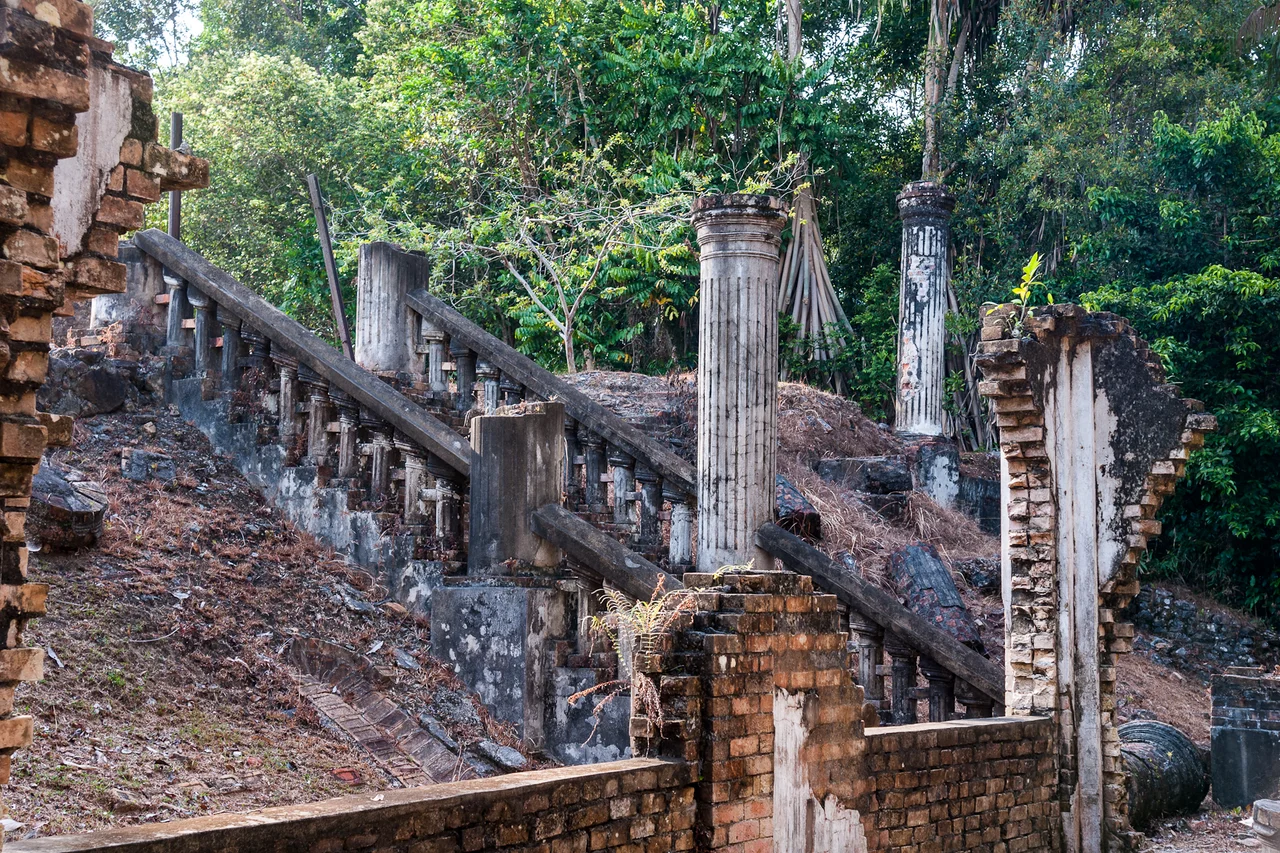

Kinarut Mansion
Forty-five doors, 152 windows, and 42 chandeliers. Those are the numbers that survive from a manor house that no longer does. On a wooded hill above the Kawang River near Kinarut, in the Malaysian state of Sabah, Graeco-Roman columns rise from the undergrowth like bones from a burial. This was the Kinarut Mansion, Rumah Besar Kinarut, built between 1910 and 1914 by a German named W.F.C. Asimont. It was one of the few stone houses that ever existed in North Borneo, and it lasted barely a decade before the authorities tore it down.
A Plantation King's Folly
Asimont was the first manager of the Kinarut Rubber Estate, operated by the British Society for Manchester North Borneo Ltd. The plantation was the second largest on Sabah's west coast after Sapong Estate, established across more than ten square kilometres between 1910 and 1911. In this remote corner of Borneo, where most buildings were timber and thatch, Asimont commissioned something astonishing: a brick manor house with white walls, designed by an Indian architect and constructed by 200 to 300 workers brought from Java. A 200-metre-long avenue of Graeco-Roman columns led to the main entrance. Inside, those 42 chandeliers illuminated rooms that opened through more doors and windows than most villages possessed. The house and its outdoor facilities spread across roughly two acres of hilltop overlooking the river. It was European grandeur transplanted wholesale into the tropics.
Abandoned and Demolished
Asimont did not enjoy his creation for long. He died in 1919 in Surabaya, in the Dutch East Indies, and was buried in Singapore. Without its builder, the mansion stood empty on its jungle hilltop. The North Borneo Chartered Company authorities demolished the abandoned house in 1923, perhaps viewing it as an unnecessary relic of foreign extravagance in a colony they were trying to administer practically. The jungle moved in with characteristic speed. Tropical vegetation consumed the ruins, wrapping vines around the columns and pushing roots through the foundation stones. What remains today are fragments: broken columns, crumbling staircases, inscriptions weathered by a century of monsoons. On 22 August 1994, the site was designated one of Sabah's historical landmarks, and by 2015, plans were underway to develop it as a tourism attraction.
Ghosts Among the Columns
The locals who live near the ruins have their own explanations for the unease the place provokes. They speak of a Hantu Tinggi, a Malay ghost that takes the form of a tall tree, disguising itself among the dense forest that has reclaimed the estate. Passersby report seeing fast-moving apparitions and hearing the eerie voice of a pontianak -- a female ghost from Malay folklore -- after dark. Media crews who have visited the site to document its history have reported the feeling that "something" was following them as they walked through the ruins. Whether these stories spring from the unsettling atmosphere of a grand house consumed by jungle, or from something harder to explain, they have become part of the mansion's identity. The ghosts are as much a draw as the architecture.
Columns in the Canopy
What makes Kinarut Mansion remarkable is not its architectural distinction -- Graeco-Roman columns in colonial Southeast Asia were hardly unique -- but its sheer incongruity. A German rubber plantation manager, working for a British company, hired an Indian architect and Javanese laborers to build a European manor house on a Bornean hilltop. The building existed for perhaps thirteen years before being deliberately destroyed. Its afterlife has lasted a century. The ruins sit in a landscape that erases human ambition with quiet efficiency: tropical rainfall, root systems, and the patient work of decay. Yet the columns persist. They stand as evidence of a particular kind of colonial confidence, the belief that stone walls and chandeliers could domesticate a place that had no interest in being domesticated. The jungle's answer has been thorough and ongoing.
From the Air
Coordinates: 5.80N, 116.01E. Kinarut is located approximately 25 km south of Kota Kinabalu on the west coast of Sabah, Borneo. The nearest major airport is Kota Kinabalu International Airport (ICAO: WBKK). The mansion ruins sit on a wooded hill above the Kawang River, largely obscured by dense tropical forest. The Crocker Range rises to the east. The coastline and Kinarut village are visible nearby.
Nearby Stories
- The Chimney of Labuan 10 km away
- Crocker Mountains 15 km away
- Battle of Beaufort (1945) 16 km away
- North Borneo War Monument 20 km away
- Kundasang War Memorial 23 km away
- The Battle of Labuan 45 km away
- North Borneo 74 km away
- Tango Maru 191 km away