
Kundasang War Memorial
Of the 2,500 Australian and British prisoners of war held at the Sandakan camp in North Borneo during World War II, six survived. Six Australians. Every one of the British prisoners died. They perished in the camp itself, on the forced marches to Ranau, or in the jungle between the two. The Kundasang War Memorial, set on a hillside in a small town behind the vegetable wholesale stalls, does not let you forget these numbers. It does not let you forget, either, that the indigenous people of Sabah who risked everything to help the prisoners -- smuggling food, offering shelter, passing information -- were themselves killed for their acts of mercy. The memorial is divided into four gardens, each carrying its own grief, connected by a trail that visitors walk from beginning to end.
The Man from Shell Oil
The memorial exists because of Major Gordon Senior 'Toby' Carter, a New Zealander who held the Distinguished Service Order and worked for Shell Oil in Borneo after the war. In 1962, Carter proposed a memorial to honor the 2,428 Australian and British prisoners who had died at the Sandakan POW Camp and during the three death marches that followed. The marches covered roughly 260 kilometers of jungle terrain between Sandakan on the northeast coast and Ranau in the interior highlands. Weakened by starvation, disease, and systematic brutality, the prisoners were forced to walk. Those who could not keep up were killed. Local architect J.C. Robinson led the construction, and the memorial opened in 1962. It was a deeply personal project -- Carter had witnessed the aftermath of the camps, and he wanted the dead to have a place where their names could be spoken and their suffering acknowledged.
Four Gardens, Four Griefs
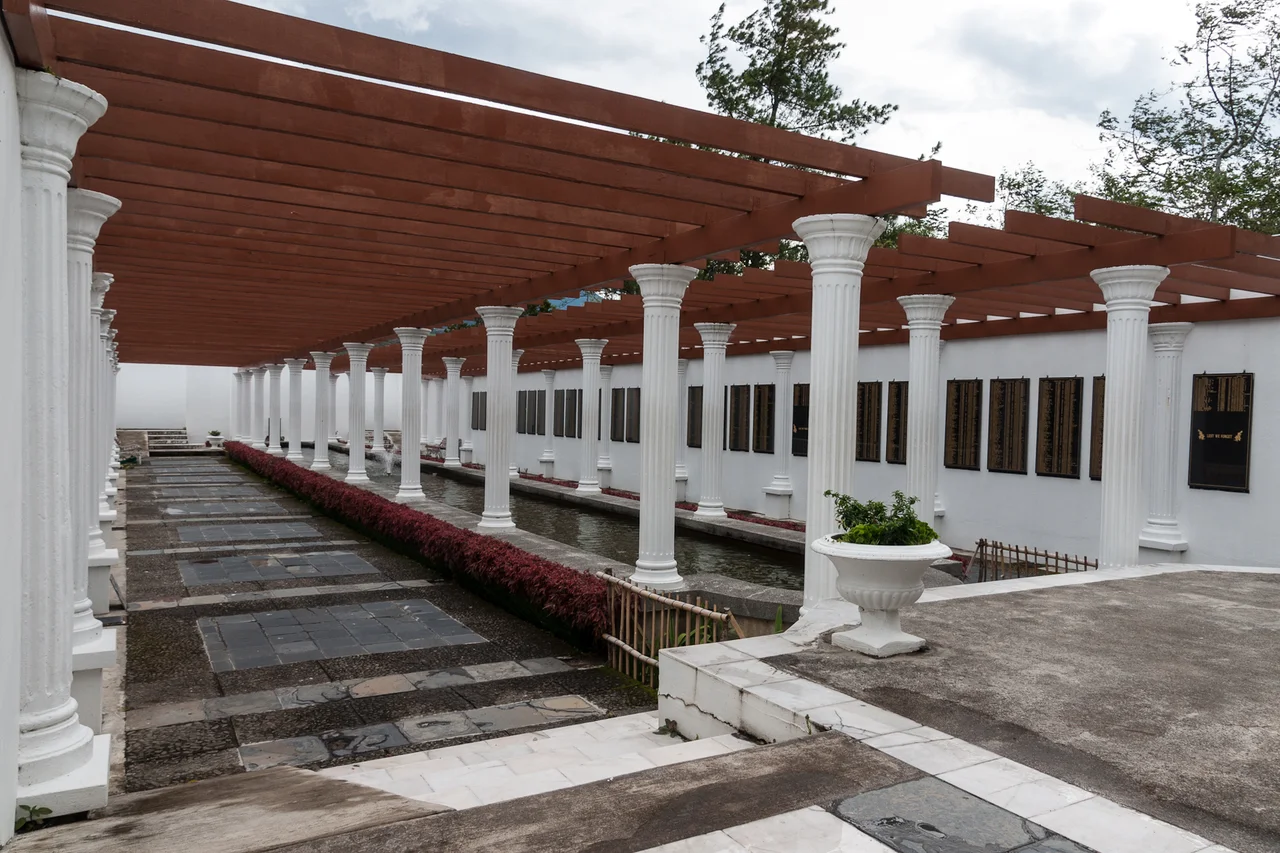
The memorial is organized into four interconnecting gardens, each with its own character and purpose. The Australian Garden centers on the Australian flag and a bronze plaque; a relief panel created by artist Ross J. Bastiaan in 1998 documents the history of the prisoners and includes a graphical roadmap of the death marches. The English Rose Garden, dedicated to the British POWs, is laid out with roses and features a black marble slab bearing the United Kingdom's flag. The Borneo Garden honors the local people -- the ethnic communities of Sabah who tried to help the prisoners and were killed for it. Native plants grow here, including rare orchid species like Paphiopedilum rothschildianum, Rothschild's slipper orchid, a species found only in the wild on Mount Kinabalu. The Contemplation Garden leads visitors through a columned passage to a reflection pond and pergola. In 2011, marble panels bearing the names of all the victims were installed here.
The Route Remembered
The final element of the memorial is the POW Route, which traces the stations of the three death marches across the Sabah landscape. The route begins in Sandakan and ends at the memorial in Kundasang, with each station marked by a sign board. Walking the route -- or even reading the station markers in sequence -- forces a reckoning with distance. The marches covered terrain that would challenge a healthy, well-fed person with modern gear. The prisoners had none of these advantages. They were skeletal, sick, and marching under the threat of execution for any pause. The memorial sits in the shadow of Mount Kinabalu, Borneo's highest peak, and the juxtaposition is not accidental. The mountain is sacred to the Kadazan-Dusun people as the resting place of the dead. The prisoners who died on the marches never reached the mountain, but their memorial looks up at it, permanently.
Recognition Across Borders
The memorial's creation and maintenance have drawn recognition from multiple governments. Sevee Charuruks, who contributed significantly to the memorial's upkeep, received the Member of the Most Excellent Order of the British Empire from the British government and an honorary Member of the Order of Australia from Australia. The dual recognition reflected the transnational nature of the tragedy itself: British and Australian prisoners, local Bornean helpers, a New Zealand veteran who conceived the memorial, and the Malaysian state that has maintained it. The Australian Department of Veterans' Affairs has supported the site through its Overseas Privately-Constructed Memorial Restoration Program. Kundasang itself is a quiet town, known more for its vegetable markets and its proximity to Kinabalu Park than for the horrors that passed through here eighty years ago. The memorial ensures that the two realities -- the everyday and the unimaginable -- continue to occupy the same ground.
From the Air
Located at approximately 5.987°N, 116.577°E in the town of Kundasang, in the highlands east of Mount Kinabalu. The memorial is situated on a hillside and is not individually visible from altitude, but Kundasang's position in the Kinabalu foothills is identifiable by its cleared agricultural land against the mountain backdrop. Kota Kinabalu International Airport (WBKK) is approximately 90 km west. The area is often clouded in the afternoon. Mount Kinabalu (4,095 m / 13,435 ft) dominates the northwest horizon.
Nearby Stories
- Kinarut Mansion 0.8 km away
- Crocker Mountains 7.4 km away
- Tunku Abdul Rahman National Park 11 km away
- Jambongan Island 55 km away
- Tip of Borneo 82 km away
- Operation Agas 97 km away
- Agop Batu Tulug Caves 106 km away
- Tango Maru 177 km away