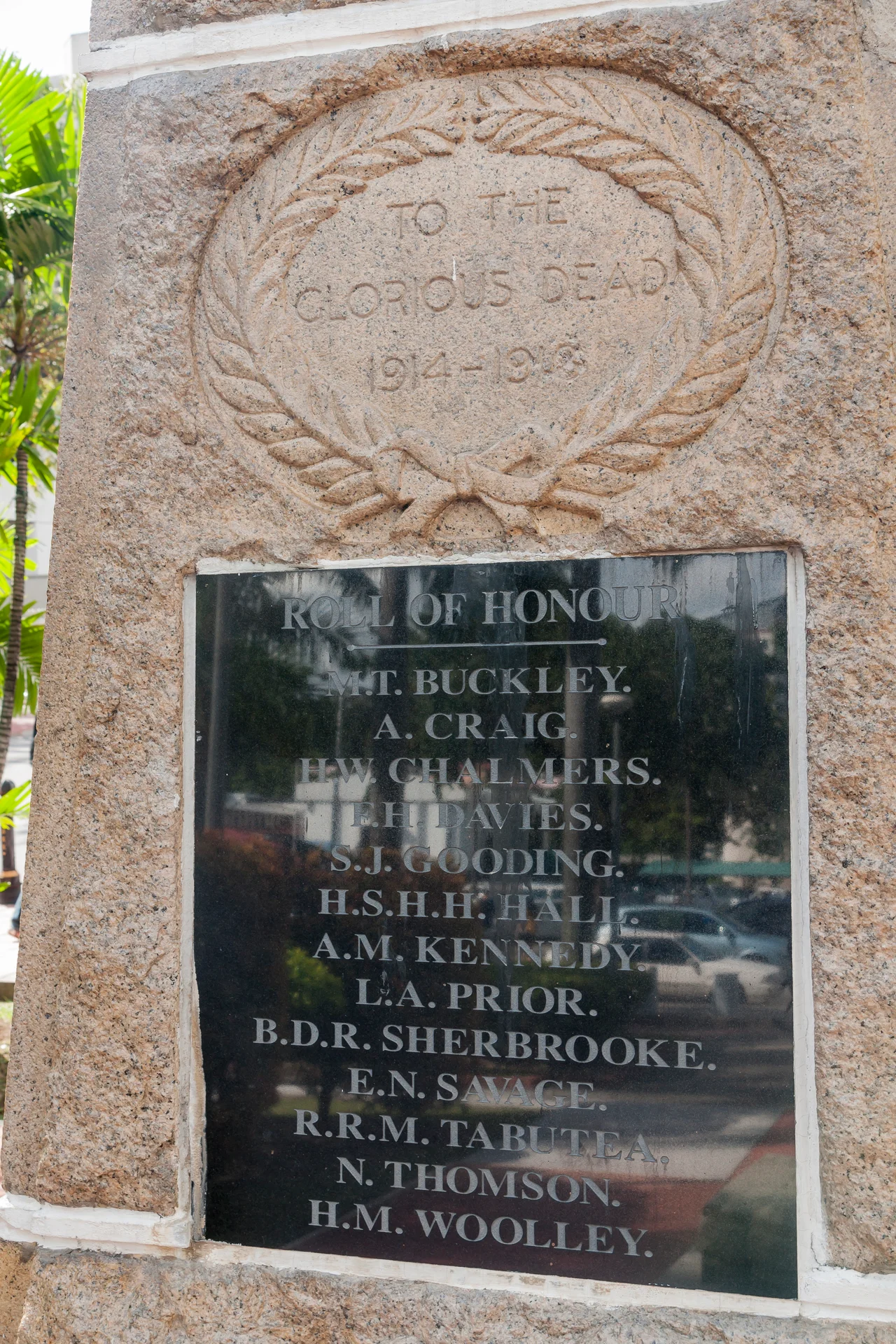

North Borneo War Monument
At ten o'clock on the morning of 8 May 1923, Major-General Sir Neill Malcolm stepped forward to inaugurate a granite obelisk on Bond Street in Jesselton, British North Borneo. A guard of honor from the Royal Navy stood at attention beside veterans of the Great War and members of the British North Borneo Constabulary. Bishop Danson offered a dedication, with greetings from representatives of the Catholic, Muslim, and Sikh communities. Governor Sir William Rycroft and Admiral Arthur Leveson looked on. The monument was carved with a laurel wreath and the words "To The Glorious Dead 1914-1918." A marble slab listed thirteen names -- the British soldiers of North Borneo who did not come home from the First World War. It was, at the time, a memorial to one war and one empire. A century later, it commemorates three conflicts and three nations' sacrifices, and it is the oldest standing monument in all of Sabah.
Thirteen Names on Marble
The North Borneo Chartered Company erected the monument to honor the 51 British soldiers who died during the First World War. Of those, thirteen names were carved into a marble plaque -- the men with direct ties to the territory. The obelisk itself stood approximately 2.5 meters tall, made of granite, and was paired with a cannon on its own base. Both sat on a shared rectangular platform with semicircular ends. The monument occupied a prominent position on Bond Street -- now known as Gaya Street -- in the heart of Jesselton. It was a formal, measured expression of imperial grief, designed in the style of war memorials across the British Empire. The carved laurel wreath, the restrained dimensions, the careful lettering: everything spoke of protocol observed and decorum maintained. But the monument would not remain so tidy for long.
Layers of Loss
The Second World War brought a new burden of commemoration. After the fighting ended, a bronze plaque was added to the opposite side of the obelisk, honoring 61 Australian soldiers who died in the conflict -- many of them victims of the brutal Sandakan death marches and prisoner-of-war camps in North Borneo. The cannon was retained, though it would eventually be removed and replaced with a plaque of its own. Then came the Indonesia-Malaysia Confrontation of 1962 to 1966, a low-intensity conflict that tested the young Malaysian federation. Another plaque went up on the obelisk's north face, this time memorializing 61 Malaysian soldiers. The monument designed for one war now carried the weight of three. Each addition changed the character of the memorial, expanding it from a colonial artifact into something more complex -- a record of sacrifice that crossed national boundaries and spanned half a century of conflict.
A Monument in Motion
The obelisk has never stayed in one place for long. Originally erected on Bond Street, it was later moved to Jalan Pantai, formerly named Neil Malcolm Street after the man who inaugurated it. When the Kota Kinabalu City Park was redesigned in the 1970s, the monument was relocated again, and its form changed. The obelisk itself survived intact, but the cannon base was separated from it, placed about three meters away, and the cannon itself was removed. The shared rectangular platform that once unified the composition was gone. What remains is a monument that has been moved, modified, and extended over a hundred years -- not unlike the city around it. Jesselton became Kota Kinabalu. Bond Street became Gaya Street. The colony became a state within a federation. Each year on Anzac Day, commemorations are held at the monument to honor all those who sacrificed their lives for Sabah in any conflict. In 2012, an exhibition called "Bonding with Gaya Street" recalled the monument's original location, drawing a line between the colonial past and the present-day market street that buzzes with Sunday vendors.
From the Air
Located at approximately 5.982°N, 116.018°E within the Kota Kinabalu City Park area. The monument itself is too small to identify from altitude, but the City Park green space is visible near the waterfront. Kota Kinabalu International Airport (WBKK) is approximately 8 km south-southwest. The KK waterfront and Gaya Street area provide good visual orientation landmarks.
Nearby Stories
- Quailey's Hill Memorial 15 km away
- Nunuk Ragang 18 km away
- De Fontaine Memorial 20 km away
- The Chimney of Labuan 66 km away
- Tip of Borneo 79 km away
- The Battle of Labuan 97 km away
- Balambangan Island 129 km away
- Tango Maru 160 km away