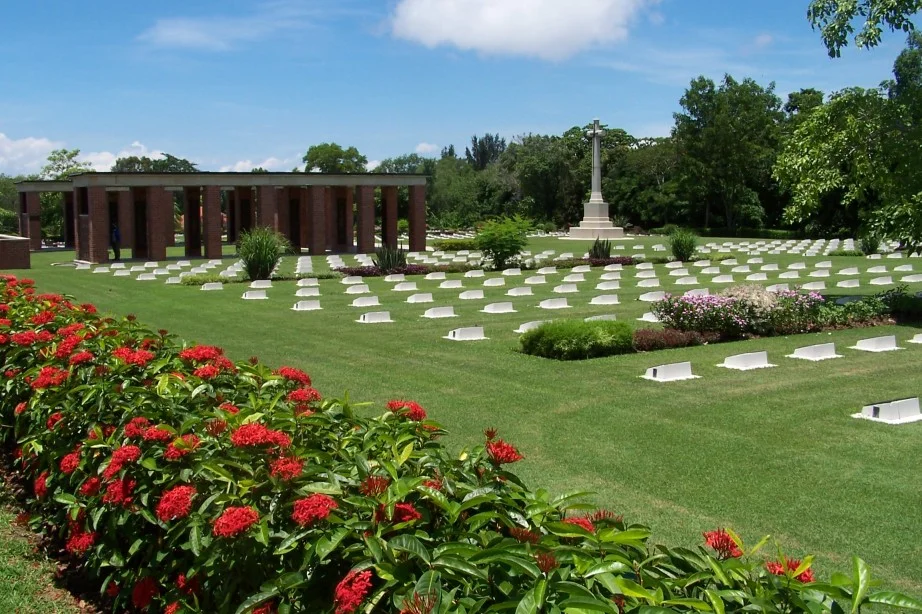

Labuan War Cemetery
Of the roughly 2,500 Allied prisoners of war held at the Sandakan camp in North Borneo, only six Australians survived the war. The rest -- British and Australian soldiers, many already weakened by years of forced labor -- died on three brutal marches through 260 kilometers of jungle, or were killed by their captors as Allied forces closed in. Most of those who perished were eventually brought here, to neat rows of white headstones on a gentle slope overlooking the South China Sea. Labuan War Cemetery holds 3,922 graves, making it the largest Commonwealth war cemetery in Southeast Asia outside of Singapore. More than half the headstones bear no name.
The Marches That Emptied a Camp
The Sandakan Death Marches remain one of the worst atrocities against Allied prisoners of war in the Pacific theater. Beginning in January 1945, Japanese forces ordered three marches from the Sandakan POW camp to Ranau, roughly 260 kilometers through dense Borneo jungle. The prisoners -- Australian and British soldiers captured in Singapore and the Dutch East Indies -- were already starving, many suffering from malaria, dysentery, and beriberi. Of the approximately 2,000 men who left Sandakan, only 260 reached Ranau alive. Nearly all of those survivors died in the weeks that followed. After the war, 2,700 graves from the Sandakan area were transferred to Labuan War Cemetery in 1949. The majority could not be identified.
Two Victoria Crosses, Side by Side
Among the headstones lie two recipients of the Victoria Cross, the Commonwealth's highest military honor. Corporal Jack Mackey was a 22-year-old from Sydney's Leichhardt suburb -- stocky, red-haired, known for his exuberant humor. On 12 May 1945, during the Battle of Tarakan, he charged a Japanese machine-gun bunker, killing its crew with grenades, then seized a sub-machine gun and attacked a second position uphill. He was killed within feet of the enemy, but not before he had silenced three gun posts and cleared the way for his platoon. His Victoria Cross was presented posthumously to his sister Patricia. Lieutenant Tom Derrick, nicknamed "Diver" from his days as a fruit farmer in South Australia's Berri, had already earned the Victoria Cross at Sattelberg in New Guinea, where he scaled a cliff face under fire and destroyed ten machine-gun positions. At Tarakan in May 1945, five bullets from a Japanese machine gun tore through him during the assault on a fortified hill code-named Freda. He died during surgery on 24 May, at the age of thirty-one.
The Other Camps
Sandakan's dead are not the only prisoners resting at Labuan. Approximately 500 graves were transferred from Kuching, where the infamous Batu Lintang internment camp had held British and Australian prisoners of war alongside civilian internees. The cemetery also contains the graves of Indian soldiers who fought during the Japanese invasion of Borneo in 1941-42, and troops who fell during the Allied Borneo campaign of 1945 that liberated the region. The Commonwealth War Graves Commission, which maintains the cemetery, opened it on 28 December 1945 -- barely four months after Japan's surrender. Australian troops attended the ceremony in pressed uniforms, inspecting the graves of men they had known, then filing out through the gates in disciplined silence.
What Remains
The cemetery today is immaculately maintained, its lawn trimmed to a uniformity that contrasts sharply with the chaotic jungle where so many of its occupants died. The headstones stand in precise rows, each one cut from Portland stone shipped from England. A memorial wall records the names of soldiers whose graves could not be found or identified -- a list that runs longer than anyone preparing for a visit expects. Every four years, a Remembrance Day service gathers veterans' descendants, diplomats, and local residents. The island itself has a separate surrender memorial marking the spot where the Japanese formally capitulated to Australian forces in 1945. Between the cemetery and the memorial, Labuan carries a weight of history that belies its small size -- a 91-square-kilometer island that became the place where one of the war's darkest chapters was finally, quietly, laid to rest.
From the Air
Located at 5.287°N, 115.262°E on the island of Labuan, off the northwest coast of Sabah, East Malaysia. Labuan Airport (ICAO: WBKL) is approximately 3 km south. The cemetery is visible from low altitude as a distinctive green rectangle with white rows near the island's northeast coast. The South China Sea surrounds the island, with Brunei's coast visible to the southwest. Best viewed at 2,000-3,000 feet for the contrast between the manicured grounds and surrounding tropical vegetation.
Nearby Stories
- Pelumpong Island: Brunei's Accidental Eden 6.7 km away
- Battle of Beaufort (1945) 9.1 km away
- Where the River Meets the Sea 36 km away
- De Fontaine Memorial 42 km away
- Brunei's Billion-Dollar Bet on Urea 78 km away
- Kinarut Mansion 98 km away
- Maliau Basin 140 km away
- Luconia Shoals 230 km away