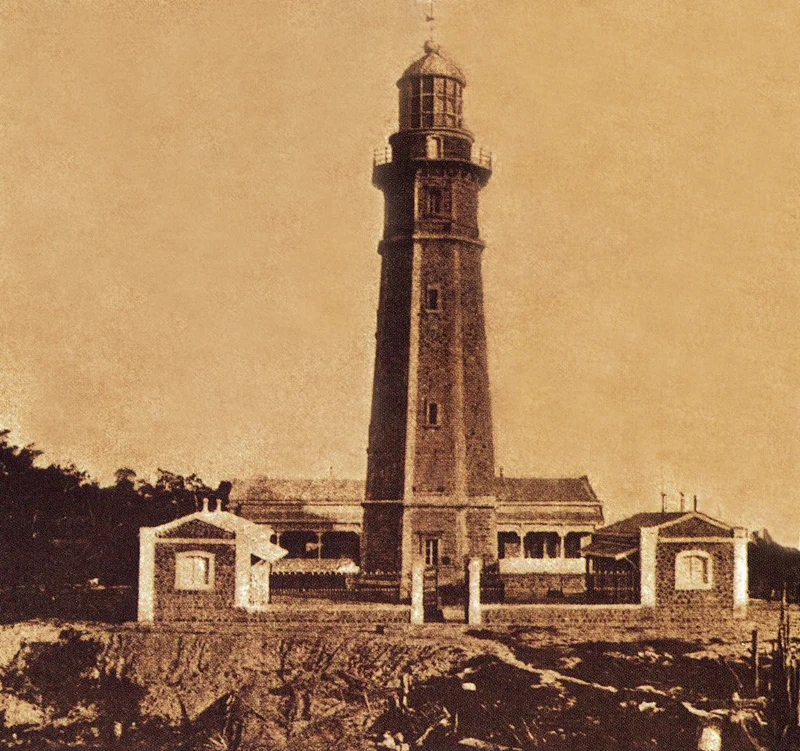

Cape Melville Lighthouse
Construction began in 1818. The light was not lit until 30 August 1892. Seventy-four years to build a lighthouse: the number sounds like a clerical error, but the delays that plagued the Cape Melville Lighthouse were real, spanning changes of government, funding crises, and the sheer logistical difficulty of building a first-order light on a remote hilltop at the southwestern corner of the Philippine archipelago. The tower stands on Balabac Island, the southernmost point of Palawan province, overlooking the Balabac Strait -- the treacherous body of water that separates the Philippines from Malaysia. When the Spanish colonial government finally lit the beacon, it joined an ambitious chain of lighthouses designed to guide ships through the most dangerous waters in Southeast Asia.
The Granite Sentinel
The lighthouse rises 90 feet from a hilltop located one and a half miles northwest of the tip of Cape Melville, placing the light at a total elevation of 297 feet above sea level. The Spanish government built it from granite, a choice of material that speaks to their intention: this was meant to last. The station was part of an extensive lighting plan for the entire Philippine archipelago, a colonial infrastructure project designed to make Spanish waters navigable and Spanish commerce safer. The Balabac Strait, which the lighthouse was built to illuminate, is a corridor of strong currents and shallow reefs between Borneo and the Philippine islands. Ships passing between the South China Sea and the Sulu Sea had to navigate this gauntlet, and the consequences of miscalculation were severe.
Decades of Delay
Why did the lighthouse take 74 years to complete? The historical record does not provide a single answer, but the context tells the story. Balabac Island sits at the extreme margin of the Philippine archipelago, far from Manila and the centers of colonial administration. Construction materials and labor had to be transported by sea to one of the most remote inhabited islands in the region. The Spanish colonial government faced budget constraints, competing priorities, and periodic upheavals throughout the 19th century. The project was started, stalled, restarted, and stalled again across the reigns of multiple colonial governors. When the light was finally lit on 30 August 1892, Spain had barely six years left as the colonial power in the Philippines. The Americans would arrive in 1898, inheriting a lighthouse that had outlasted most of the people who conceived it.
Still Standing
The original Spanish lighthouse is no longer operational. A white aluminum prefabricated tower with a modern solar-powered light has been erected nearby by the Philippine Coast Guard, which maintains all lighthouses in the country. But the granite tower remains. Because the station is still manned, the original lights and lenses survive intact, minus a central glass pane stolen by vandals. The original clockwork mechanism -- the gears that once rotated the lens to create the distinctive flash pattern mariners relied upon -- is still in place, though inoperative. The National Historical Commission of the Philippines has declared the lighthouse, known locally as Minarit, a National Historical Landmark. It stands at Barangay Melville on Balabac Island as a monument to Spanish ambition in the Pacific: a granite tower built at the edge of empire, designed to endure exactly the way it has.
Guarding the Strait
The Balabac Strait remains one of the most challenging maritime passages in Southeast Asia. Currents sweep between the Sulu Sea and the South China Sea. Reefs and shoals extend from both the Philippine and Malaysian sides. For modern vessels with GPS and electronic charts, the strait is navigable but demands attention. For the wooden sailing ships and early steamers of the 19th century, it was a death trap without adequate lighting. The Cape Melville Lighthouse was not the only Spanish light in the Philippines -- the colonial government built dozens -- but its location made it critical. Any ship rounding the southwestern corner of the archipelago, whether heading north toward Manila or south toward Borneo, passed within sight of Cape Melville. The light that took three-quarters of a century to build served as a guide for more than a century after.
From the Air
Located at 7.82N, 117.00E on Balabac Island, the southernmost island of Palawan province, Philippines. The lighthouse sits on a hilltop 297 feet above sea level, northwest of Cape Melville point. From altitude, Balabac Island is visible as the last Philippine landmass before the Malaysian coast of Sabah. The Balabac Strait separating the two countries is clearly visible. Nearest airports are Puerto Princesa (RPVP) in Palawan, approximately 400 km to the northeast, and Kota Kinabalu (WBKK) in Sabah. Remote area with limited facilities.
Nearby Stories
- Pandanan Shipwreck 19 km away
- Balambangan Island 33 km away
- HMS Pelorus (1808) 96 km away
- Tango Maru 133 km away
- Tabon Caves 146 km away
- Turtle Islands National Park 172 km away
- Gaya Island 175 km away
- Sepilok Orangutan Rehabilitation Centre 225 km away