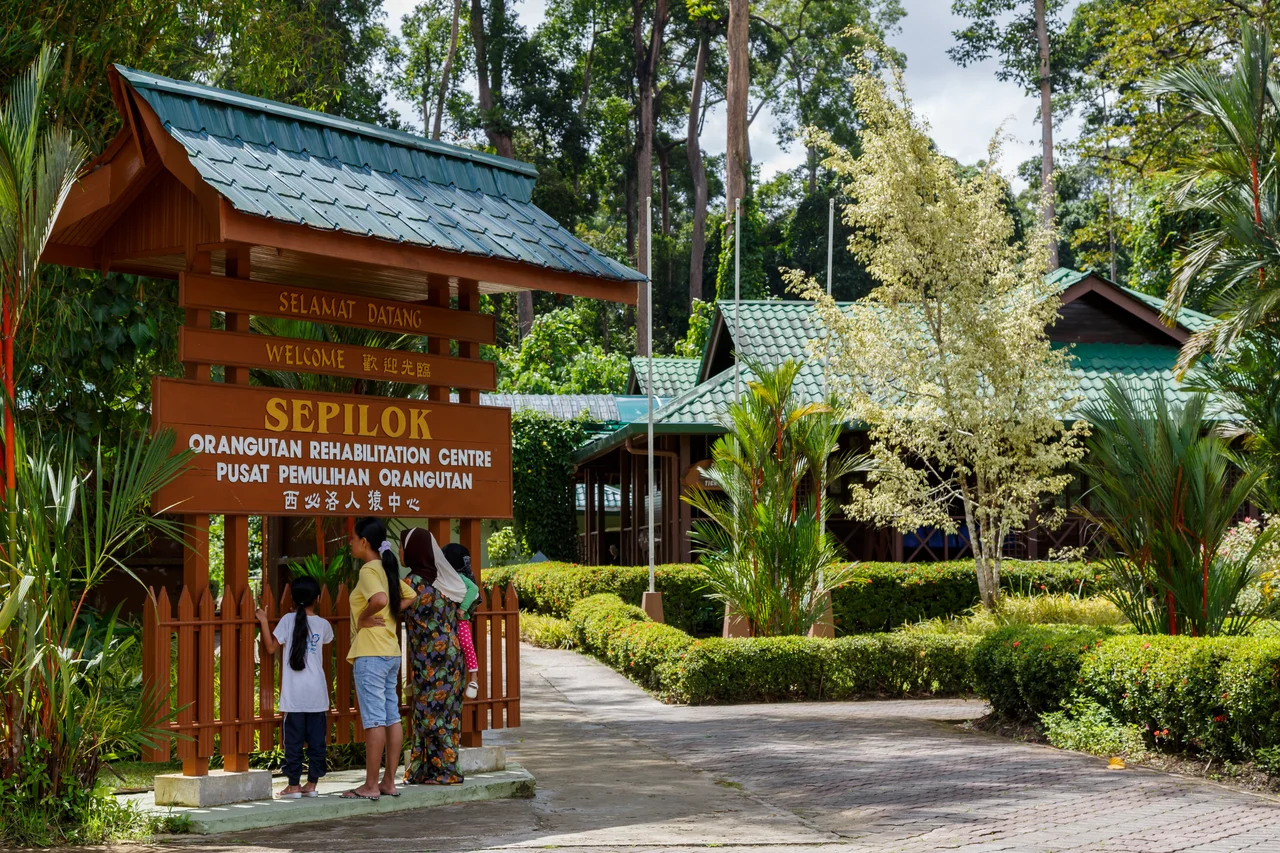

Sepilok Orangutan Rehabilitation Centre
The young orangutan grips the rope with both hands, swings once to test the arc, then lets go at exactly the right moment to land on a wooden platform ten feet away. It is, in every meaningful sense, a wild animal learning to be wild again. At the Sepilok Orangutan Rehabilitation Centre, 25 kilometers west of Sandakan in Sabah, Malaysia, this is the entire point. Opened in 1964 as the world's first official orangutan rehabilitation project, Sepilok takes in orphaned baby orangutans -- rescued from logging sites, palm oil plantations, illegal hunters, or people who kept them as pets -- and teaches them the skills they need to survive in the forest. When they are ready, they are released into the surrounding Kabili-Sepilok Forest Reserve, 4,294 hectares of lowland rainforest, much of it virgin.
Learning to Be an Orangutan
Orangutans are not born knowing how to forage, build sleeping nests, or navigate the canopy. In the wild, they learn these skills from their mothers over a period of six to eight years -- one of the longest periods of parental dependency of any mammal. When a baby orangutan is orphaned, usually because its mother has been killed during logging or captured for the pet trade, that education stops. Sepilok's rehabilitation program essentially substitutes for the missing parent, introducing the young apes to forest foods, climbing structures, and eventually the rainforest itself. In October 2014, the centre opened a nursery viewing area where visitors can watch the youngest orangutans take their first steps onto outdoor climbing frames, observed through large windows from indoor seating areas.
The Forest Reserve
The Kabili-Sepilok Forest Reserve is not a zoo enclosure scaled up. It is a functioning tropical rainforest -- 4,294 hectares of dipterocarp forest, home to hundreds of species of birds, insects, reptiles, and mammals alongside the orangutans. BirdLife International has designated it an Important Bird Area, recognizing the density and diversity of avian species within its boundaries. Between 60 and 80 orangutans currently live free in the reserve, a population sustained by decades of rehabilitation releases. The forest canopy rises forty meters or more in places, providing the three-dimensional habitat that orangutans require. These are arboreal apes that spend most of their lives above ground, and without intact canopy they cannot survive.
Threats That Follow Them Home
Sepilok exists because Borneo's orangutans are under severe pressure. The island has lost vast stretches of rainforest to logging and palm oil cultivation, fragmenting orangutan habitat into isolated patches too small to sustain viable populations. Illegal hunting and the pet trade compound the problem. Every orangutan that arrives at Sepilok represents a failure of protection somewhere upstream -- a forest cleared, a mother killed, a baby taken. The centre's work is rehabilitative, not preventive; it treats symptoms of a crisis it cannot solve alone. That tension -- between the hopeful sight of a young orangutan learning to climb and the industrial-scale deforestation visible from satellite imagery of the same island -- defines Sepilok's position in Borneo's conservation landscape.
Six Decades in the Canopy
Since 1964, Sepilok has operated continuously, making it one of the longest-running primate rehabilitation projects in the world. Its work has been documented in television series including Animal Planet's "Meet the Orangutans" and "Paul O'Grady's Animal Orphans," and actress Michelle Yeoh featured the sanctuary in her documentary "Among the Great Apes." The media attention has made Sepilok one of Sabah's most visited attractions, drawing wildlife tourists from around the world to a patch of forest that most of them would never otherwise encounter. Whether that attention translates into meaningful habitat protection remains an open question. But inside the reserve, the orangutans do not know they are famous. They swing, they forage, they build nests at dusk. For now, the forest holds.
From the Air
Located at 5.865N, 117.949E, approximately 25 km west of Sandakan in Sabah, Malaysia. The centre is within the Kabili-Sepilok Forest Reserve, a clearly visible patch of intact rainforest amid surrounding developed land. Nearest airport is Sandakan Airport (WBKS), approximately 20 km to the east. From the air at 3,000-5,000 feet, the dense canopy of the reserve contrasts sharply with surrounding palm oil plantations and logged areas.
Nearby Stories
- Gomantong Caves 18 km away
- Tabin Wildlife Reserve 44 km away
- Jambongan Island 59 km away
- North Borneo 63 km away
- Nunuk Ragang 66 km away
- USS S-36 105 km away
- Banggi Island 150 km away
- Tubbataha Reef 347 km away