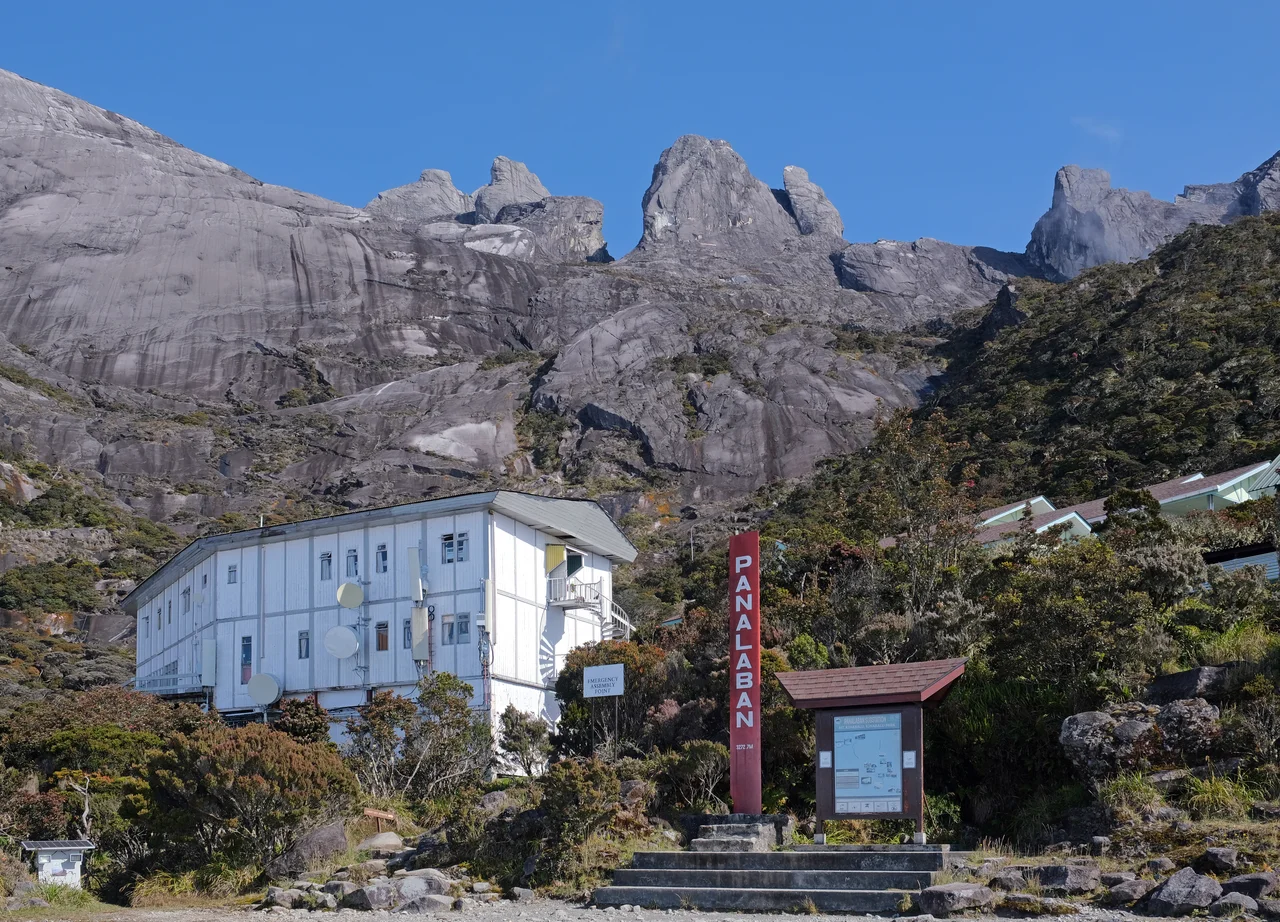

Kinabalu Park
The mountain is still growing. Five millimeters a year, year after year, Borneo's highest peak pushes upward through the crust that formed it between 10 and 35 million years ago. Kinabalu Park wraps 754 square kilometers around this restless granite massif, and within that perimeter lies one of the most biologically dense landscapes on Earth. When UNESCO designated it Malaysia's first World Heritage Site in December 2000, the citation pointed to "outstanding universal values" -- a diplomatic way of saying that nowhere else on the planet packs so many species of plants, birds, mammals, and insects into a single protected area. More than 4,500 species of flora and fauna have been catalogued here, and the count keeps climbing.
Hugh Low's Mountain
In 1851, British colonial administrator and naturalist Hugh Low led an expedition from the coastal town of Tuaran into the interior of northern Borneo. He became the first recorded person to reach the summit of Mount Kinabalu, and the mountain's highest point -- Low's Peak, at 4,095.2 meters -- still carries his name. More than a century later, botanist E. J. H. Corner led two Royal Society expeditions to the region in 1961 and 1964, and his detailed surveys of the mountain's extraordinary plant life helped make the scientific case for protection. The region was designated a national park in 1964, one of the first in the newly formed nation of Malaysia. The park headquarters sits at 1,563 meters elevation on the southern boundary, 88 kilometers by road from Kota Kinabalu. Every climber who ascends the summit trail -- 47,613 of them in 2010 alone -- passes through here.
Four Climate Zones on One Mountain
Kinabalu Park spans an almost absurd range of ecosystems. At the base, lowland dipterocarp forest grows thick and tall, the canopy closing overhead in a green vault. Climb higher and the trees shift to montane oak and rhododendron, the air cooling and the clouds pressing in. Higher still, coniferous forest gives way to alpine meadows and the stunted, wind-scoured bushes of the summit zone. UNESCO has identified the park as a Centre of Plant Diversity for Southeast Asia, noting that it contains representatives of at least half of all Borneo's plant species, with genetic lineages traceable to China, Australia, the Himalayas, and the pan-tropical flora. The mountain is famous for its carnivorous plants -- the pitcher plant Nepenthes rajah chief among them -- and its orchids, which number in the hundreds of species. Among the animal species found nowhere else on Earth are the Kinabalu giant red leech and the Kinabalu giant earthworm.
Into the Gully
One of the park's most dramatic features is Low's Gully, a ravine 1.6 kilometers deep and 10 kilometers long that drops away from the summit plateau on the mountain's north side. The gully was carved by glaciers during the Pleistocene, when sheets of ice covered the upper slopes and scoured the granite surface as they moved. The summit trail begins at Timpohon, with an alternative route along the Mesilau Trail. Every climber must be accompanied by an accredited guide -- a regulation born from both conservation concerns and the real risk of altitude sickness at nearly 4,100 meters. The private company Sutera Sanctuary Lodges manages accommodation, including the mountain hostel at Laban Rata where climbers spend the night before their pre-dawn push to the summit. In 2010, the park received more than 611,000 visitors total, making it one of the most popular destinations in all of Malaysia.
The Living Mountain
Mount Kinabalu is one of the youngest non-volcanic mountains in the world. Its granodiorite core cooled and hardened roughly 10 million years ago -- a geological instant -- and isostatic forces continue to push it upward at a measurable rate. The mountain's youth explains its jagged profile: there has not been enough time for erosion to smooth its peaks into the rounded shapes of older ranges. A 1997 satellite survey established the summit height at 4,095.2 meters, slightly less than the previously published figure but still the highest point on the island of Borneo and in all of Maritime Southeast Asia. The park's biodiversity is directly linked to this altitude. During glacial periods, the mountain's upper reaches served as refuges for cold-adapted species, isolating populations long enough for new species to evolve. When the ice retreated, those species remained -- stranded on a tropical sky island, surrounded by lowland forest with which they share almost nothing in common.
From the Air
Located at approximately 6.15°N, 116.65°E on the Crocker Range in western Sabah. Mount Kinabalu's granite summit is the dominant visual feature of northern Borneo, visible from well over 100 nautical miles in clear conditions. The park covers 754 sq km of mountainous terrain. Kota Kinabalu International Airport (WBKK) is 88 km to the west-southwest. Altitude awareness is critical -- the summit reaches 4,095 meters (13,435 feet). Low's Gully on the north side is a dramatic feature visible from moderate altitude.
Nearby Stories
- Kinarut Mansion 0.8 km away
- Crocker Mountains 7.4 km away
- Tunku Abdul Rahman National Park 11 km away
- Jambongan Island 55 km away
- Tip of Borneo 82 km away
- Operation Agas 97 km away
- Agop Batu Tulug Caves 106 km away
- Tango Maru 177 km away