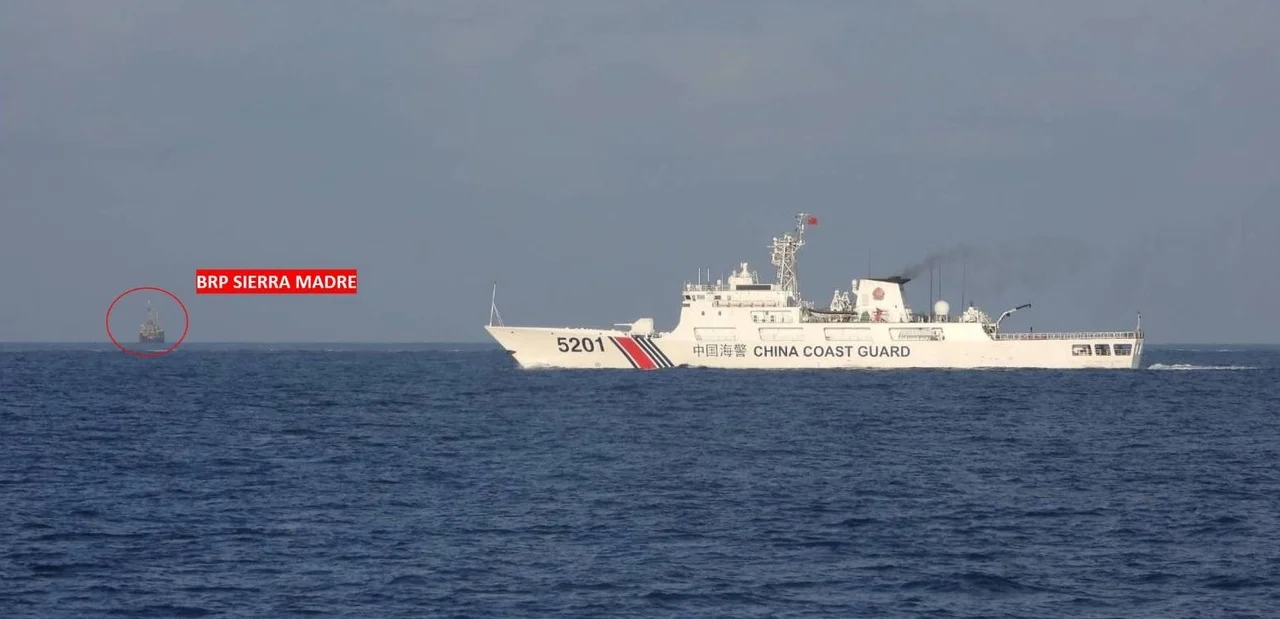

BRP Sierra Madre
She was built in Evansville, Indiana, in the autumn of 1944, one of hundreds of tank landing ships the Missouri Valley Bridge and Iron Company turned out for the United States Navy. Launched on October 27, commissioned on November 22, USS LST-821 was a workhorse of the Asiatic-Pacific theater before she was two months old. Eighty years later, she sits rusting on a coral reef in the South China Sea, unable to move, unable to sail, and yet somehow still on active duty. The ship has had three names, served three navies, and fought in three wars. Her current assignment, holding a patch of submerged reef against the world's largest coast guard, may be the most consequential of all.
Three Names, Three Navies
USS LST-821 spent the final months of World War II ferrying supplies to Western Pacific ports: Eniwetok, Okinawa, Iejima, Ulithi, Guam. She earned one battle star for her service. After Japan's surrender, she supported the occupation before sailing home and entering the reserve fleet in July 1946. Later renamed USS Harnett County after a county in North Carolina, she was recommissioned and served through the Vietnam War before being transferred to South Vietnam's Republic of Vietnam Navy as RVNS My Tho. When South Vietnam fell, the ship passed to the Philippine Navy, which gave her the name she carries to this day: BRP Sierra Madre.
Grounded by Design
In May 1999, the Philippine government ordered the Sierra Madre to be deliberately run aground on Second Thomas Shoal, known locally as Ayungin, a submerged reef 105 nautical miles west of Palawan. China had occupied nearby Mischief Reef in 1994, and Manila wanted to establish its own presence before more features were lost. Two ships were grounded that day. The BRP Lanao del Norte was later towed away at China's insistence, but the Sierra Madre stayed. President Joseph Estrada reportedly promised China the second ship would also be removed. It never was. What began as an improvised response to Chinese expansion became, by 2014, a declared "permanent installation" of the Philippine Navy. The ship that was supposed to leave became a statement that the Philippines would not.
Life on a Sinking Ship
Conditions aboard the Sierra Madre are harsh by any military standard. When BBC correspondent Rupert Wingfield-Hayes visited in September 2014, he found a garrison of eleven Filipino marines on a vessel in severe disrepair. "The ship's sides are peppered with massive holes," he reported. "Waves slosh through them right into the ship's hold." Supplies arrived by airdrop because Chinese coast guard vessels blockaded the surrounding waters. In July 2015, a Philippine Navy spokesman acknowledged the ship needed maintenance to ensure "minimum habitability." In October 2023, the government began repairs: reinforcing sleeping quarters, adding a modern kitchen, and installing internet access. Each improvement carries diplomatic weight. China has argued that the Philippines agreed not to bring construction materials to reinforce the vessel. Manila has rejected that characterization.
Lasers, Water Cannons, and Fishing Boats
Resupplying the Sierra Madre has become a recurring source of confrontation. In March 2014, Chinese coast guard vessels blocked civilian supply boats for the first time, prompting Manila to airdrop provisions and later to slip a fishing boat through shallow coral where Chinese ships could not follow. The tactics escalated. In November 2021, Chinese ships blocked resupply boats again. In February 2023, the Chinese Coast Guard aimed what the Philippines called a military-grade laser at a Philippine vessel, temporarily blinding crew members. In August 2023, water cannons were fired at a Philippine Coast Guard ship. That October, Chinese vessels rammed a Philippine Coast Guard ship and a supply boat during a resupply mission. Each incident has intensified international scrutiny. President Bongbong Marcos expanded the Enhanced Defense Cooperation Agreement with the United States in February 2023, deepening the American military commitment to the Philippines.
The Ship That Will Not Sail
In 2013, The New York Times visited the Sierra Madre and concluded that she would never sail again. That assessment was accurate and entirely beside the point. The ship's value is not in its seaworthiness but in its presence. Under international law, Second Thomas Shoal is a low-tide elevation within the Philippines' exclusive economic zone. The Sierra Madre provides a physical, manned platform to assert Philippine claims, a platform that cannot be dismissed as abandoned. Removing the ship would signal a retreat that no Philippine president has been willing to accept. So the vessel endures: rusting, leaking, patched just enough to remain inhabited, her hull a monument to the stubborn logic of territorial disputes where the act of staying is itself the strongest argument.
From the Air
The BRP Sierra Madre is grounded at Second Thomas Shoal (Ayungin), approximately 9.79°N, 115.86°E. From cruising altitude, the reef appears as a pale submerged oval, with the ship's rusted hull visible as a dark shape on the southeastern rim. No airstrip exists at the shoal. The nearest Philippine airfield is Rancudo on Thitu Island (11.05°N, 114.28°E), roughly 90 nm northwest. Puerto Princesa (RPVP) on Palawan is approximately 200 nm east. Chinese coast guard vessels frequently operate in the immediate area.
Nearby Stories
- Sabina Shoal 26 km away
- Whitsun Reef Incident 77 km away
- Taiping Island 111 km away
- Japanese Cruiser Maya 112 km away
- HMS Pelorus (1808) 155 km away
- 2019 Reed Bank Incident 180 km away
- Tango Maru 202 km away
- Emilio S. Liwanag 205 km away