
Taiping Island
Four wells produce drinking water on Taiping Island. That fact, seemingly mundane, is extraordinary in the Spratly Islands, where fresh water is rarer than sovereignty claims. At 46 hectares, Taiping, also known as Itu Aba, is the largest naturally occurring island in the entire archipelago: 1.4 kilometers long, 400 meters wide, elliptical in shape, and topped by a runway that stretches its full length like a spine. Green sea turtles migrate from the Philippines to nest on its beaches. Coconut palms and papaya grow in its sandy soil. In a region where most "islands" are concrete platforms poured over submerged coral, Taiping is something genuinely rare: a place where people can live without engineering the land into existence.
Fishermen Before Flags
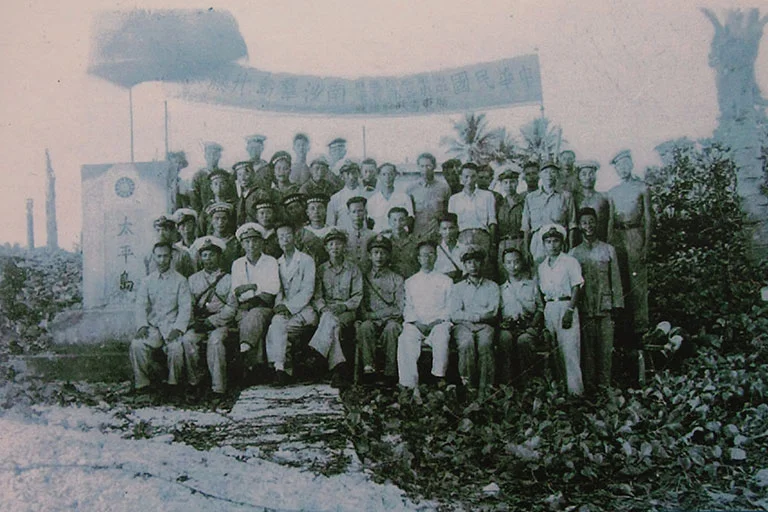
Long before governments drew lines on maps, fishermen from Hainan maintained a semi-permanent settlement on Taiping Island, shipping turtle shells back to the mainland in exchange for supplies. China first asserted sovereignty in the modern sense during the Sino-French War of 1884-1885, when it formally objected to France's efforts to incorporate Itu Aba and other features into French Indochina. France conceded the Paracels and Spratlys to the Qing government. Japan occupied the island during World War II, and after Japan's surrender in 1945, the Republic of China sent naval vessels to reclaim it. The island's modern Chinese name, Taiping, comes from one of those warships: the ROCS Taiping.
The Rock Ruling
In 2016, the Permanent Court of Arbitration delivered a verdict that stung Taiwan even though it was not a party to the case. The Philippines had brought arbitration proceedings against China, and the tribunal classified Taiping Island, the most habitable feature in the Spratlys, as a "rock" under Article 121(3) of the United Nations Convention on the Law of the Sea. Rocks are entitled to only a 12-nautical-mile territorial sea, not a full 200-nautical-mile exclusive economic zone. Taiwan protested vigorously, pointing to the island's freshwater wells, its vegetation, its ability to sustain life. The ruling effectively denied Taiping, and by extension any Spratly feature, the capacity to generate the vast maritime zones that would transform whoever controlled them into a major South China Sea power.
Living on the Edge of Nowhere
Despite its isolation, roughly 500 kilometers from the nearest major landmass, Taiping Island supports genuine infrastructure. Four wells pump about 65 metric tons of drinkable water daily, with freshwater proportions averaging 92.3 percent. Since December 2014, a 40-kilowatt photovoltaic power station with battery storage has supplemented the island's energy needs. The Republic of China Coast Guard patrols the surrounding waters with Type M8 speedboats designated Nanhai 4, 5, and 6, meaning "South Sea" in Mandarin. A rebuilt pier, the Southern Star Ferry Pier, allows resupply vessels to dock. The garrison maintains a hospital, weather station, and communication facilities. It is a tiny, self-contained outpost at the very edge of Taiwan's territorial reach.
Flora, Fauna, and the Sea Turtle Highway
Taiping Island's ecology stands apart in the Spratlys. The island hosts coconut and banana trees, coast oaks, terminalia trees, papaya plants, and a variety of ground cover including gray grass and long-saddle rattan. White-tailed tropicbirds and sparrow hawks nest among the vegetation. The surrounding waters hold tropical fish, jellyfish, and the coral formations that underpin the wider Spratly marine ecosystem. Most remarkable are the green sea turtles that migrate from Philippine waters to lay their eggs on Taiping's beaches, an annual cycle that predates every human sovereignty claim by millions of years. Their continued arrival is a reminder that the island's ecological significance is unrelated to, and potentially threatened by, the geopolitical competition swirling around it.
From the Air
Taiping Island sits at approximately 10.375°N, 114.367°E on the northern edge of the Tizard Bank in the Spratly Islands. The runway spans the full 1.4 km length of the island, oriented roughly east-west, and is easily the most visible feature from altitude. The island appears as an elongated green ellipse against turquoise reef shallows. The nearest civilian airports are Puerto Princesa (RPVP) in Palawan (~300 nm east) and Kaohsiung (RCKH) in Taiwan (~850 nm north). Expect Taiwanese military presence and potential restricted airspace.
Nearby Stories
- Whitsun Reef Incident 33 km away
- Thitu Island 40 km away
- Mischief Reef 70 km away
- Fiery Cross Reef 121 km away
- BRP Sierra Madre 123 km away
- Kashmir Princess 173 km away
- South China Sea 198 km away
- 2019 Reed Bank Incident 225 km away