
Ripon Cathedral
Descend the narrow steps beneath the choir of Ripon Cathedral and you enter a small barrel-vaulted chamber so plain it feels improvised. The walls are rough. The ceiling is low. The space is barely larger than a generous wardrobe. This is the crypt that Saint Wilfrid built in AD 672. It is the oldest intact built space in any English cathedral - older than the Tower of London, older than every visible stone in Westminster Abbey, older than the Magna Carta by 543 years. Wilfrid brought stonemasons, plasterers, and glaziers from France and Italy to construct his great basilica above this crypt, and a contemporary account by his hagiographer Stephen of Ripon describes the wonder of it. The basilica is gone. Almost everything Wilfrid built has been destroyed, rebuilt, dissolved, restored, or burned at least once. The little crypt still stands. It always stands.
The Crypt Beneath Three Cathedrals
Wilfrid founded a monastery at Ripon in the 660s, then refounded it as a Benedictine house in 672. His basilica above the crypt was the work of imported European craftsmen at the very edge of post-Roman knowledge. In AD 948, the English king Eadred devastated Ripon as a warning to the Archbishop of York. Only the crypt survived. A second minster soon rose - and perished too, in 1069, at the hands of William the Conqueror's harrying of the North. The crypt survived. A third church followed, instigated by Thomas of Bayeux, first Norman Archbishop of York. Traces of it were incorporated into the later chapter house of the 12th-century minster built by Archbishop Roger de Pont l'Évêque. The crypt survived. The fourth and present church - constructed between the 13th and 16th centuries - now towers above Wilfrid's tiny vault. The crypt survived again. To stand inside it is to stand in 7th-century England, with thirteen subsequent centuries pressing down through stone.
The Best West Front of Its Type
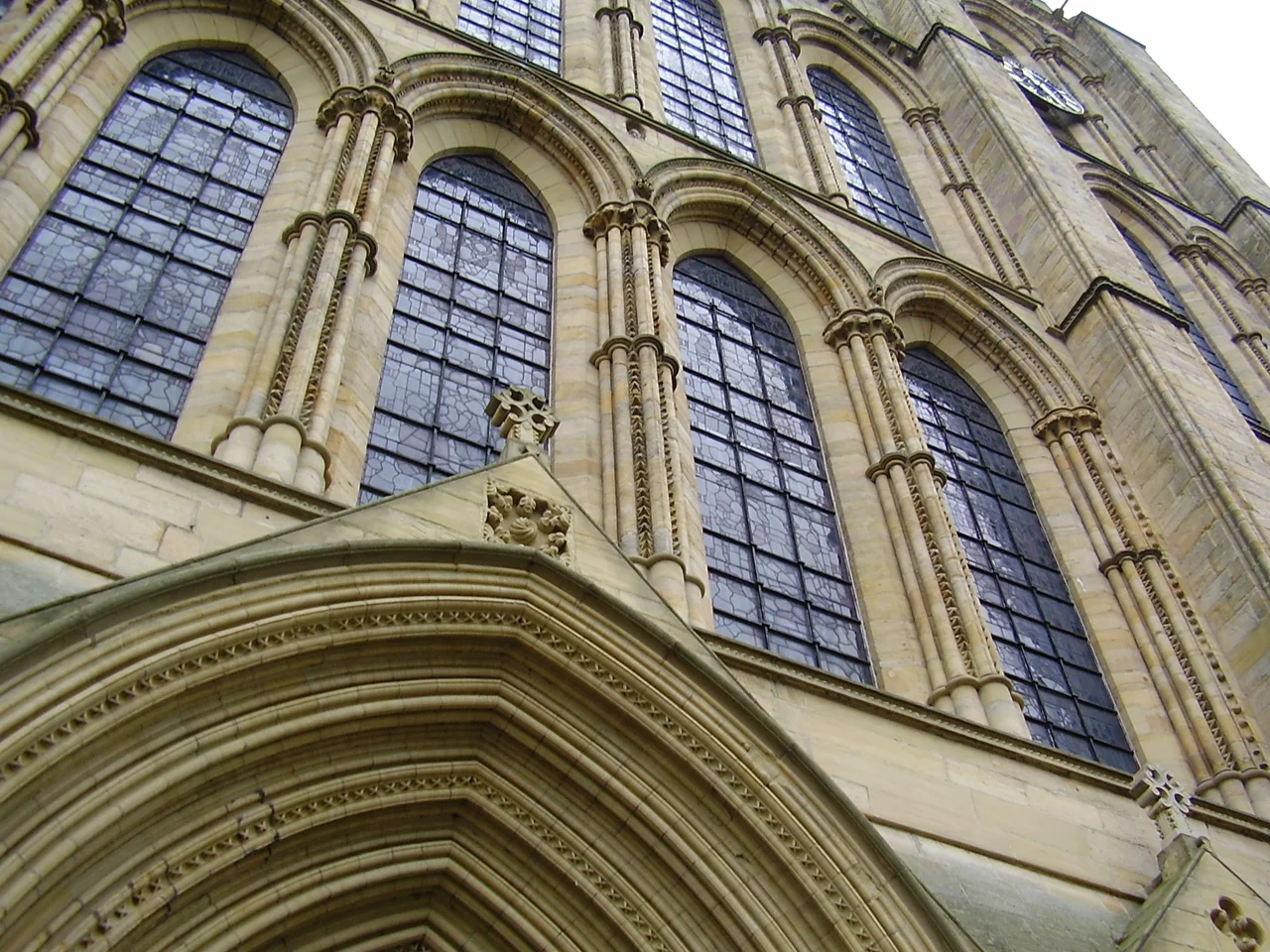
The present cathedral's Early English Gothic west front was added in 1220. Twin towers, originally crowned with wooden spires sheathed in lead, frame three tall pointed arches with deep recessed mouldings. Architectural historians consider it one of the finest examples of Early English design in Britain. The east window followed during a reconstruction of the choir between 1286-1288 and 1330. Nikolaus Pevsner - the great cataloguer of English buildings - called it a "splendid" example of the Decorated Gothic windows of Northern England. Then disaster: in 1450 an earthquake collapsed the crossing tower. Rebuilding stalled when the Wars of the Roses began. After Henry VII's accession in 1485 brought peace, work resumed; the nave walls were raised higher between 1501 and 1522. The cathedral's 34 misericords - hinged choir-stall seats with carved undersides - were created between 1489 and 1494 by the Ripon school of carvers, who also produced the misericords at Beverley Minster and Manchester Cathedral. Then came Edward VI.
Dissolution, Civil War, and Recovery
In 1547, before the medieval rebuilding was finished, Edward VI dissolved Ripon's college of canons. All revenues were appropriated by the Crown. The crossing tower never received its planned Perpendicular arches. For decades the church sat half-finished, its income gone, its purpose uncertain. Not until 1604 did James I issue the Charter of Restoration that gave the minster a working future. The Civil War of the 1640s brought fresh damage - much of the stained glass was smashed by Parliamentary iconoclasts, and statues were destroyed. The minster muddled on through the 18th century as a parish church of unusual grandeur. Then in 1836 came the transformation: the minster finally became a cathedral - the seat of a bishop - as the focal point of the newly created Anglican Diocese of Ripon, the first new English diocese established since the Reformation. The church had waited nearly 1,200 years to become what its name suggested.
Alice in the Choir Stalls
Ripon Cathedral's most surprising claim is literary. Lewis Carroll's father Charles Dodgson was a canon at Ripon from 1852 to 1868, and the young Lewis spent considerable time in the cathedral. The misericords - those Ripon-school carvings from the 1490s - are said to have inspired several of the strange creatures and scenes in Alice's Adventures in Wonderland. Look closely beneath the choir stalls and you find rabbits, griffins, blemyahs (mythical headless creatures with faces on their chests), and other fantastical figures that would not be out of place at the Mad Hatter's tea party. The cathedral also holds 12 bells in the south-west tower - cast in 1932, augmented in 2008 - and a Harrison and Harrison organ rebuilt from a Lewis instrument of 1878. In 2014, the Diocese of Ripon was incorporated into the new Diocese of Leeds, making this church one of three co-equal cathedrals of the Bishop of Leeds. Wilfrid's crypt is still there beneath everything. It always will be.
From the Air
Ripon Cathedral stands at 54.135°N, 1.520°W in the centre of Ripon, North Yorkshire, England. The nearest airport is Leeds Bradford (ICAO: EGNM), 19 miles south. From altitude, the cathedral's distinctive twin western towers and central crossing tower form an immediately recognisable three-towered silhouette - the most prominent landmark in the small cathedral city. Fountains Abbey lies 3 miles south-west, easily identifiable by its dramatic Cistercian ruins. Markenfield Hall's moated medieval manor sits 3 miles south. Harrogate is 11 miles south. Recommended viewing altitude 3,000-5,000 ft for clear identification. Ripon itself is the smallest English city, with the cathedral dominating its compact medieval centre.
Nearby Stories
- Elland Road 1.4 km away
- Gordale Scar 2.6 km away
- Sheriff Hutton Castle 5.1 km away
- Selby Rail Crash 6.6 km away
- Battle of Catraeth 7.5 km away
- Rosedale Abbey 12 km away
- Murder of Sophie Lancaster 12 km away
- Hawes Junction Rail Crash 14 km away