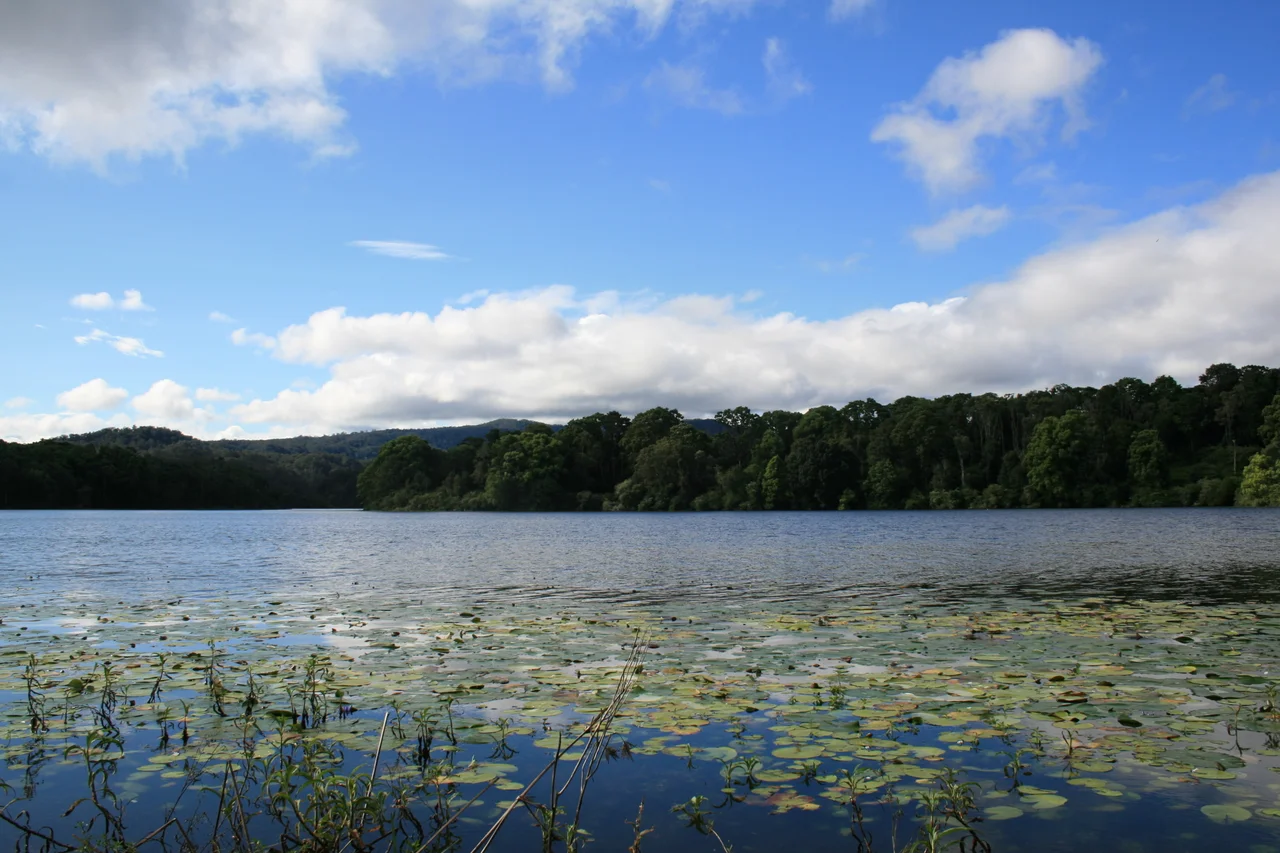

Rocky Creek Dam
Most dams are remembered for what they hold back. Rocky Creek Dam is worth knowing for what it has helped bring back. Tucked into the hills about 25 kilometres north of Lismore, this modest wall of rock and clay has supplied drinking water to the Northern Rivers since 1953. But the catchment around its reservoir, Rocky Lake, has become something rarer: a place where a vanished rainforest is being coaxed, tree by tree, back to life. The water and the forest here are bound together, each protecting the other.
A Wall Across the Creek
The dam itself is unassuming by the standards of Australia's great engineering works. Begun in 1949 and completed in April 1953, it is a rock-fill, clay-core embankment built by contractor Dayal Singh for the Rous County Council. The wall stands 28 metres high and stretches 220 metres across Rocky Creek, made of roughly 80,000 tonnes of rock, soil, clay and concrete. Behind it, Rocky Lake spreads across 200 hectares and holds back 14,000 megalitres at full capacity. When storms come, an uncontrolled spillway can release a torrent of more than 700 cubic metres a second. It is the principal source of water for a region that keeps on growing.
Water for the Northern Rivers
From Rocky Lake, water travels a short distance to the Nightcap Water Treatment Plant and then flows, largely by gravity, to taps across the region: Lismore, Ballina, Byron Bay, Alstonville and Evans Head all drink from this catchment. The supply is usually dependable, thanks to the high rainfall and protected hills upstream. But nature sets the limits. In 2003, the reservoir fell below 20 percent and the region endured severe water restrictions, a wake-up call that pushed Rous County Council to develop a backup source on the Wilsons River near Lismore. By 2008 that second source and an upgraded treatment plant were complete, giving the Northern Rivers a sturdier safety net.
Ghost of the Big Scrub
To understand why the forest here matters, you have to know what was lost. This region once lay beneath the Big Scrub, the largest tract of subtropical lowland rainforest in Australia, sprawling across roughly 75,000 hectares between Byron Bay, Ballina, Lismore and the Nightcap Range, an area larger than Singapore. Towering red cedar and booyong rose from soil enriched by the same ancient volcano that built the nearby ranges. Cedar-getters arrived in the 1840s, drawn by that red cedar; clearing for farmland followed, and between about 1870 and 1910 the great forest was almost entirely cut down and burned. Less than one percent of the original Big Scrub survives. What stood for millions of years was undone in a single human lifetime, leaving only scattered remnants marooned in a sea of pasture.
Bringing the Forest Back
Rocky Creek Dam is where that loss is being reversed. Since 1983, the protected catchment around the reservoir, managed by Rous County Council and bordering Nightcap National Park, has hosted a sustained rainforest restoration effort, expanding the surviving remnants, linking them together and re-establishing forest on cleared ground. It is slow, unglamorous work, planting and weeding and waiting. Over decades, the regenerated areas have matured to the point of largely looking after themselves, needing only light maintenance, a sign that the Big Scrub can, with patience, return. The catchment is kept off-limits to swimming, boating and vehicles, which keeps the water clean and the recovering forest undisturbed. Down by the dam wall, though, there is a gentler welcome: lawns, barbecues, boardwalks and a pontoon bridge, and an edge of the lake so peaceful that couples regularly choose it for their weddings. The water that fills the glasses of half a region, and the forest slowly returning around it, share a single protected home.
From the Air
Rocky Creek Dam lies at roughly 28.63°S, 153.35°E in the hills about 25 km north of Lismore in the Northern Rivers of New South Wales, on the south-western edge of the Nightcap Range. From the air, Rocky Lake reads as a slender, forest-fringed reservoir set among densely wooded ridges, with the green bulk of Nightcap National Park rising immediately to the north and the eroded spire of Wollumbin (Mount Warning) beyond it. Recommended viewing altitude is 3,000–5,000 ft to take in the lake and its regenerating rainforest catchment together. Nearest airports: Lismore (YLIS) about 25 km south-south-west, Ballina Byron Gateway (YBNA) about 35 km south-east. Expect high humidity, frequent cloud over the adjacent range and heavy rainfall, the very conditions that make this catchment so reliable.
Nearby Stories
- Richmond River Massacres 7.2 km away
- Fingal Head Light 16 km away
- Spicers Gap Road 56 km away
- Allan Cunningham Monument 78 km away
- Washpool National Park 83 km away
- HMS Porpoise (1799) 693 km away
- Wreck Reefs 722 km away
- SS Elingamite: Gold, Fog, and a Captain Wrongly Blamed 1809 km away