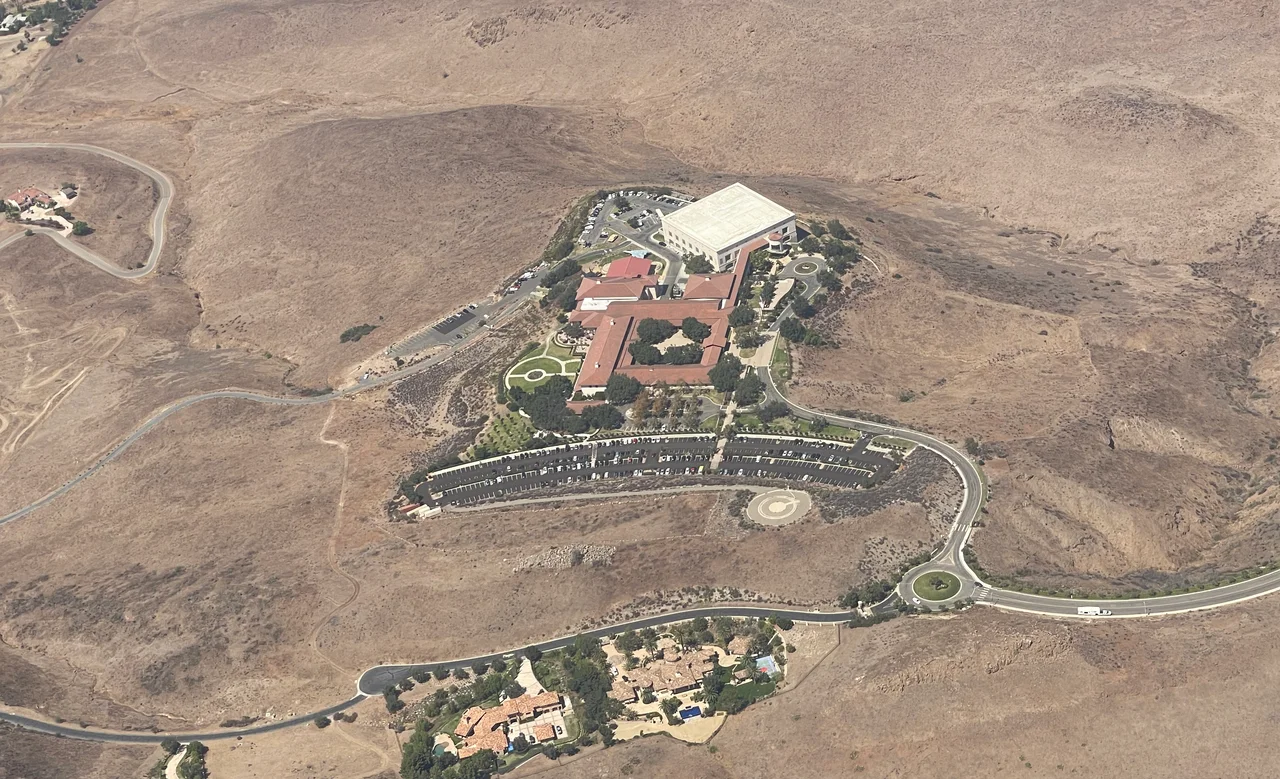

Ronald Reagan Presidential Library
On November 4, 1991, five presidents stood together on a hillside in Simi Valley. It was the first time in American history that five living presidents had gathered in one place, and they had come to dedicate a library. Ronald Reagan, Jimmy Carter, Gerald Ford, George H.W. Bush, and Richard Nixon — a span of administrations covering a quarter century of American history — stood in the California sun as the Ronald Reagan Presidential Library opened its doors. The building commanded a view that stretched, on clear days, to the Pacific Ocean.
Built in the Hills
The library occupies a hilltop in the hills above Simi Valley in Ventura County, at an elevation that places it above most of the marine layer that routinely obscures the Los Angeles basin. Architect Hugh Stubbins designed the building in the Spanish Mission style — red tile roof, white stucco walls, arched colonnades — a visual language that connects to California's architectural heritage while providing a neutral setting for a collection focused on the Reagan presidency.
The $60 million facility was funded entirely through private donations, consistent with the tradition of presidential libraries being private institutions that operate under the oversight of the National Archives. The site's remoteness — thirty miles northwest of downtown Los Angeles, requiring a specific trip rather than a casual visit — did not deter the crowds. From the day it opened, the library drew visitors in numbers that established it as one of the most popular presidential libraries in the country.
Air Force One on the Ground
The library's most spectacular artifact arrived in 2005: SAM 27000, the Boeing VC-137C that served as Air Force One for seven presidencies, from Richard Nixon through Bill Clinton. The aircraft is 152 feet long and required the construction of a dedicated 90,000-square-foot pavilion to house it. Visitors walk beneath the wings and through the interior of the plane, past the compartments where presidents slept and worked and received news of crisis and triumph.
The plane is not a replica or a mockup. It is the actual aircraft that carried Reagan to Reykjavik for his summit with Mikhail Gorbachev, that brought him home from foreign trips, that served as a mobile command center during the most volatile years of the Cold War. The experience of standing inside it — inside the actual machine, in a gallery 30 miles from Los Angeles — carries a weight that photographs of the aircraft cannot convey.
The Wall Comes to California
In addition to Air Force One, the library holds a section of the Berlin Wall — one of the physical remnants of the structure whose fall in November 1989 punctuated the end of the Cold War. The presence of this fragment at a Reagan library is not incidental; Reagan's 1987 speech at the Brandenburg Gate, in which he challenged Mikhail Gorbachev to 'tear down this wall,' has become one of the most cited moments of his presidency.
Whether the speech was causally connected to the wall's eventual fall remains a matter of historical debate. What is not debated is that the wall fell, and that its falling was one of the defining events of the late twentieth century. A piece of that wall now stands in a garden at the library, alongside a statue of Reagan. Visitors can touch it — the concrete, the graffiti, the physical substance of a barrier that divided a city and a continent for twenty-eight years.
A Resting Place on a California Hillside
Ronald Reagan died on June 5, 2004, at his home in Bel Air. His state funeral brought his body to Washington for ceremonies at the Capitol Rotunda and the National Cathedral, after which he was returned to California and buried on the grounds of the library he had dedicated thirteen years earlier. Nancy Reagan was buried beside him in 2016.
The grave site occupies a promontory at the edge of the library grounds, looking out toward the hills and valleys of Ventura County. An inscription carved in the stone reads: 'I know in my heart that man is good, that what is right will always eventually triumph, and there is purpose and worth to each and every life.' Visitors stand there on most days — quiet, often, in a way that is distinct from the energy inside the exhibits. The library is a museum and an archive, but it is also a grave, and that changes how people move through it.
From the Air
The Ronald Reagan Presidential Library is located at 34.259517 N, 118.819744 W, in the hills above Simi Valley in Ventura County. It sits at approximately 1,600 feet elevation, above the marine layer that often obscures the LA basin. The Simi Valley (KSZP) general aviation airport is approximately 5 miles to the southeast. On clear days, the hilltop is visible from aircraft transiting the Santa Monica Mountains corridor between Los Angeles and the Central Valley.
Nearby Stories
- Mount Lowe Railway 2.4 km away
- Murder of Larry King 2.8 km away
- Bruce's Beach 22 km away
- Disneyland Railroad 23 km away
- Antelope Valley California Poppy Reserve 39 km away
- Edwards Air Force Base 55 km away
- San Nicolas Island 81 km away
- The San Andreas Fault at Carrizo Plain 83 km away