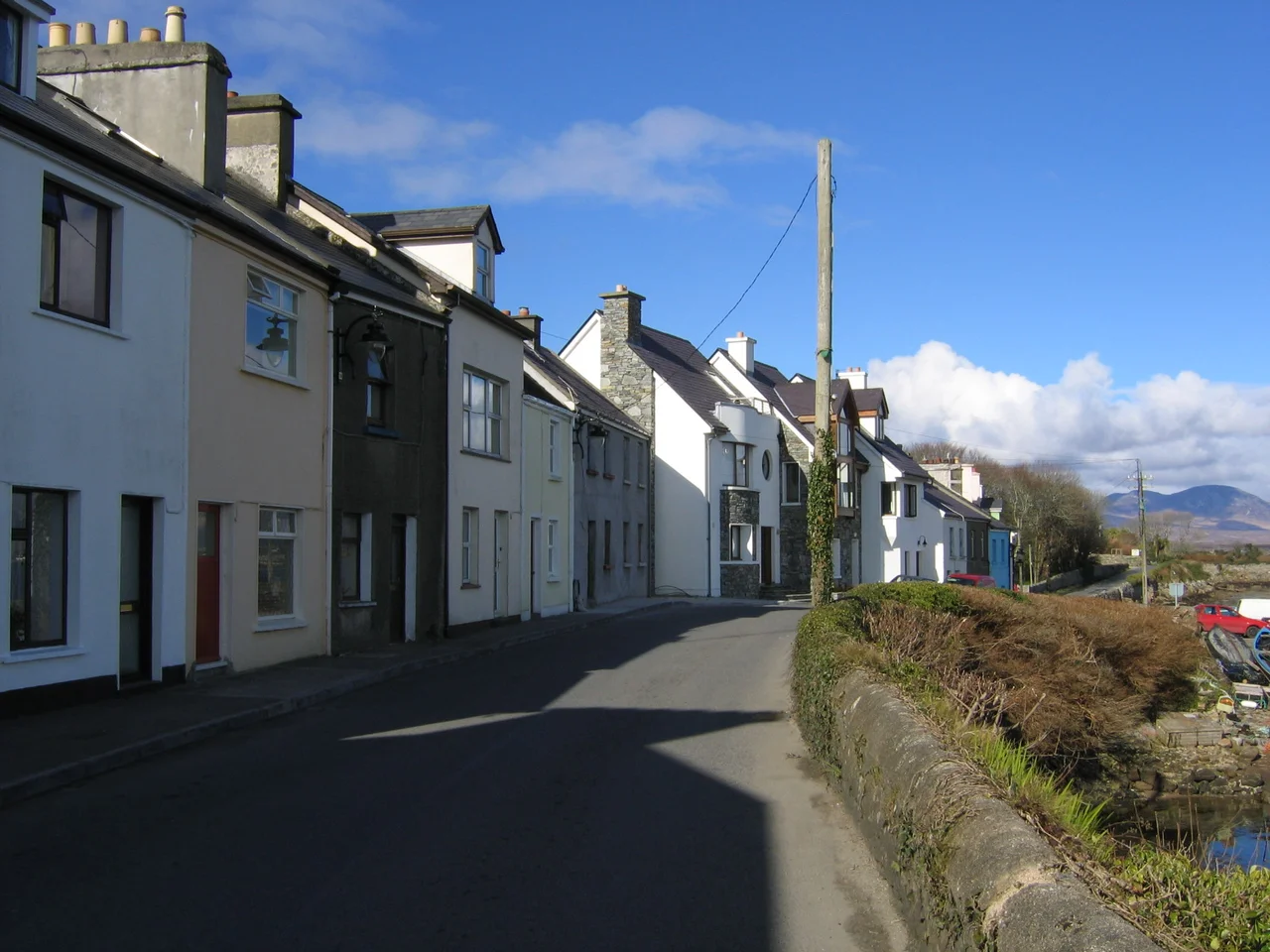

Roundstone, County Galway
The English-language name Roundstone is, almost certainly, a translation error. The Irish original is Cloch na Ron - 'rock of the seals'. Ron means seal, not round, but the Ordnance Survey cartographers who anglicised Irish place names in the nineteenth century either heard wrong, guessed wrong, or simply preferred the homophone. The mistake stuck. There is, in fact, a strikingly round stone at the entrance to Roundstone Bay, which has only deepened the confusion. The bay was being called Round-stone Haven as early as 1684, in the writings of Roderick O'Flaherty, so it is possible the two names emerged independently. Either way, the village has lived with its translated name for two centuries now, and the seals are still in the bay.
A Village Built to Order
Most Connemara villages grew without anybody deciding they should. Roundstone is different. In the 1820s, the Scottish engineer Alexander Nimmo was working his way across the west of Ireland, building roads, harbours, and houses on commission from the Irish Board of Works. As part of that programme he laid out the village of Roundstone - its streets, its quay, its planned shape - and brought in Scottish fishermen to settle it. The cultural transplant left traces that still show. Following Catholic Emancipation in 1829, a Franciscan monastery was built here in 1835, and by the late 1840s Roundstone had a thriving fishing industry and a population of four hundred. Earlier history runs further back. The land to the north was ruled by the chiefs of Clan O'Flaherty, who built a Dominican Priory about two miles north of the modern village in the fifteenth century.
Painters of the Western Light
Roundstone became, somehow, a magnet for Irish art. Paul Henry - whose paintings of Connemara mountains and skies defined how a generation of Irish people pictured their own country - worked here. So did Jack B. Yeats, the painter brother of W.B. Yeats and arguably the greatest Irish painter of the twentieth century. Gerard Dillon, who brought a folk-art sensibility to scenes of the western shore, came too. So did Nano Reid. What drew them was the light - the specific quality of Connemara light, sharpened by the proximity of so much water and softened by so much cloud. The mountains north of the village rose in shapes that suited landscape painting. The bay reflected the sky and broke it into shifting silver. Filmmakers followed: John Huston shot The Mackintosh Man here in 1973, Mike Newell shot Into the West in 1992, and the location appears in The Matchmaker, Marley and Me, and the 2021 drama series North Sea Connection.
The Regatta and the Hookers
Every July the village hosts the Roundstone Regatta. The boats that race in it are not modern racing yachts but Galway hookers - the traditional working sailboats of Connemara, black-hulled, rust-red-sailed, with hulls shaped to handle Atlantic swell while carrying turf or fish or whatever the village needed moved. Hookers were nearly lost in the mid-twentieth century when motorised craft made them obsolete. They came back as heritage vessels, lovingly restored and sailed by enthusiasts who understood that something would be lost if the last working hooker rotted away on a stony shore. At the regatta, they fill Roundstone Bay with rust-coloured sails again, and from the shore you can imagine the village as it looked when those sails meant work, not weekend pleasure.
Looking Outward
Roundstone is twinned with Noyelles-sous-Lens, a suburb of Lens in northern France - an unlikely pairing on the face of it, since one is a coal-and-industrial town and the other is a fishing village, but the partnership reflects the long historical reach of the West of Ireland: emigrants, exiles, soldiers, missionaries, all of them scattering from these small ports into the wider world. The R341 connects Roundstone to the N59, and through that to Galway, seventy-six kilometres east. Clifden is eighteen kilometres northwest. Most visitors arrive by road. A few still arrive by water.
From the Air
Located at 53.40 N, 9.92 W, on the west Connemara coast of County Galway, on the western shore of Roundstone Bay opposite Inishnee island. The Twelve Bens mountain range rises to the northeast - a dramatic visual reference. Nearest airports: Connemara Regional (EICA) at Inverin, about 35 km east; Galway (EICM) further east. The bay's curved shape and the village's planned street grid are visible from low altitude. Expect Atlantic weather with the characteristic shifting light that drew the painters here.
Nearby Stories
- County Galway 3.2 km away
- Uggool Beach 9.7 km away
- Doolin 11 km away
- Aughagower 17 km away
- RMS Carinthia (1925) 17 km away
- Inishmaan 29 km away
- Action of 7 May 1794 92 km away
- Inishtooskert 106 km away