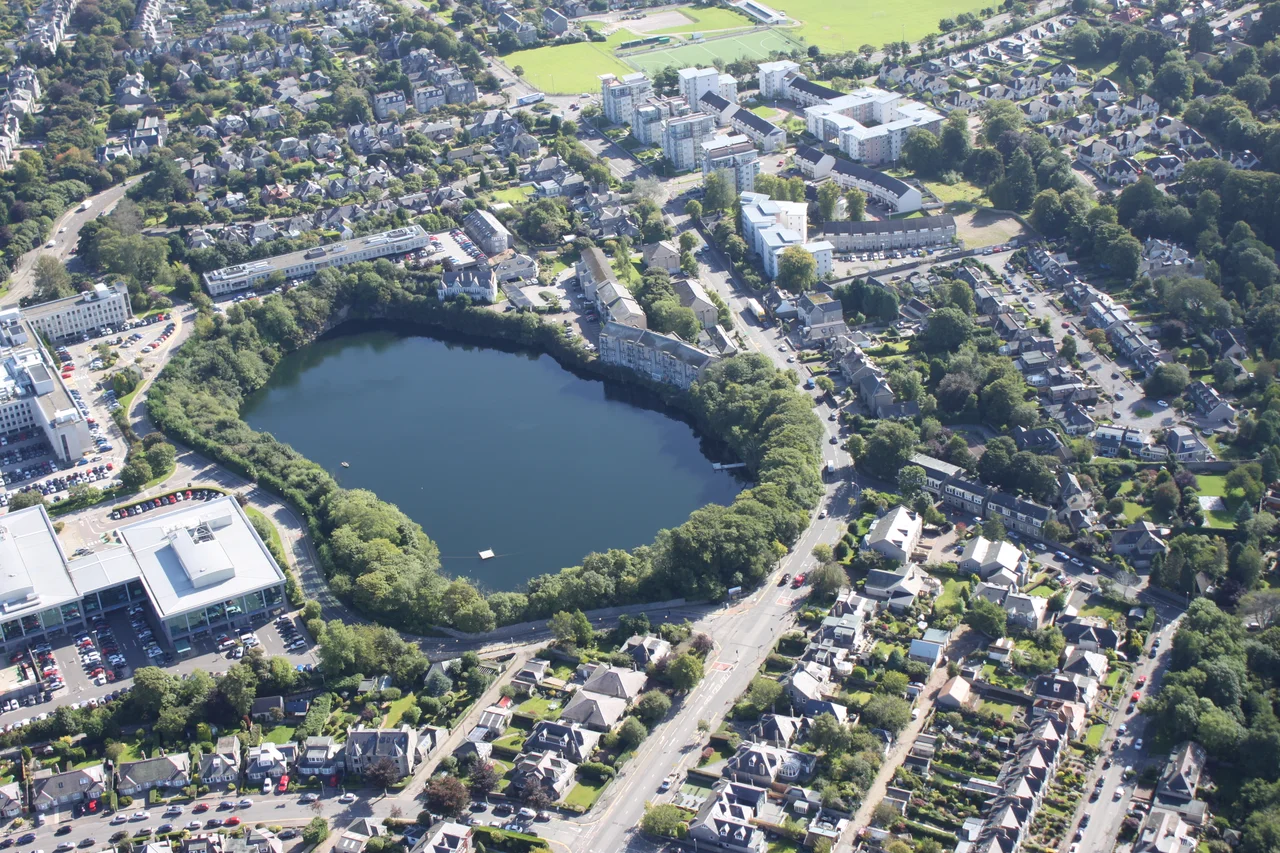

Rubislaw Quarry
In 1778, Aberdeen City Council sold Rubislaw Quarry for thirteen pounds. It was not thought to be a source of good building material. Over the next two hundred years, six million tonnes of granite came out of that thirteen-pound hole. It rebuilt Aberdeen in the silver-grey stone that gave the city its name. It paved Waterloo Bridge in London. It became the terrace of the Palace of Westminster. It anchored the Forth Bridge. When the last cutters finally laid down their tools in 1971, they left behind a void 142 metres deep and 120 metres across - one of the biggest man-made holes in Europe, and an extraordinary monument to the worst land deal in Scottish municipal history.
The Granite City Came From Here
Aberdeen had a problem in the late eighteenth and early nineteenth centuries: it kept burning down. Its wooden buildings were too vulnerable, and after a series of fires the city's architects and councillors turned to stone. They turned to Rubislaw. The hill on the western edge of town was sitting on a vast deposit of high-quality blue-grey granite - quality the council had dismissed when they sold the site, and that the buyer's successors would spend two centuries proving them wrong about. The men who shaped Aberdeen's gleaming nineteenth-century centre - John Smith, Archibald Simpson - designed in this stone and trusted the quarry to provide it. Marischal College, the second-largest granite building in the world and still the headquarters of Aberdeen City Council, came out of this pit. So did most of Union Street.
Six Million Tonnes
The numbers are easier to write than to absorb. Six million tonnes of granite, extracted by hand and steam over roughly two hundred years, ledge by ledge, blast by blast. At Rubislaw's peak the work supported hundreds of masons, cutters, drillers and labourers. In 1879 an initiative by the Association for Improving the Condition of the Poor saw up to 350 unemployed men presenting themselves at the quarry to break stones for wages during a winter of hardship. By December 1889, when the Rubislaw Granite Company Limited was formed, an internal assessment estimated nearly four million tonnes of "superior rock" still ready for extraction, at a likely pace of 50,000 to 60,000 tonnes a year. Profit was reckoned at one shilling and sevenpence per tonne. The economics worked because the demand never stopped. London wanted granite. Westminster wanted granite. The Forth Rail Bridge alone consumed thousands of tonnes.
The Cost in Lives
Quarry work was brutal and dangerous. Heavy stone, primitive cranes, sheer faces hundreds of feet deep, and no safety nets at all. In 1926 a man named George Hutcheon Jones slipped on a grassy slope at the rim and fell 320 feet to the foot of the quarry. He was killed instantly. In 1936 another man fell over 400 feet. Those are the two falls that made the newspapers. The lung disease - silicosis from breathing pulverised granite dust - quietly killed many more, decade after decade, in the small terraced houses of the west end. The masons whose work made Aberdeen visible from the air worked among hazards no modern safety officer would tolerate. Their bodies are part of the city's stone.
Closure and Flood
By 1971 the economics had finally turned. Cheap imported stone, reinforced concrete, and the simple difficulty of extracting granite from a hole now nearly 470 feet deep all closed the operation down. The pit was abandoned. Without pumps running, the groundwater seeped in. Slowly, over decades, Rubislaw Quarry filled with water until it became a near-cylindrical lake the colour of cold mineral. As late as the 1800s the quarry had stood in open farmland on the western fringe of Aberdeen. By 1971 the city had grown around it on three sides; today it sits awkwardly on a main road, ringed by residential streets to the south, east and west and a business park to the north. In 2010 the disused quarry was bought by Sandy Whyte, a former oil consultant, and Hugh Black, a former construction company managing director, for a reported sixty thousand pounds. In December 2022 plans were announced to reopen it for watersports.
What the Hole Means
Stand on Union Street and look at the granite around you. The buildings catch the light differently when wet - it is the quartz and feldspar in the stone reflecting weak North Sea sunshine through wet air. That gleam is the reason Aberdeen is called the Granite City, and the stone for it came from one specific hole in the ground a few minutes west of where you are standing. Matthew Forster Heddle, the great Victorian mineralogist, recorded that the quarry was also a fine source of tourmaline and beryl, with traces of emerald. The stone took up residence everywhere. Walk over Waterloo Bridge in London. Touch the terrace at the Palace of Westminster. Cross the Forth Bridge. Some part of Rubislaw is under your hand. The hole that produced all that is silent now, blue with water, and waiting for the kayaks.
From the Air
Rubislaw Quarry is at 57.140N, 2.149W in the west end of Aberdeen, approximately 1 nm west-south-west of the city centre. From the air it appears as a distinctive flooded circular pit - roughly 120 m across and 142 m deep, the water surface dark blue or green depending on light - ringed by residential streets on three sides and a business park to the north. The Gordon Highlanders Museum is approximately 1 nm to the south-west. The granite city centre and Marischal College, built from the quarry's stone, lie to the east. Nearest airport: EGPD (Aberdeen Dyce), 4 nm to the north.
Nearby Stories
- Dunnottar Castle 5.4 km away
- Kildrummy Castle 5.9 km away
- Delgatie Castle 10 km away
- Keith, Moray 11 km away
- Battle of Mons Graupius 12 km away
- German submarine U-58 (1938) 84 km away
- Longstone Lighthouse 146 km away
- HMS Daring (H16) 158 km away