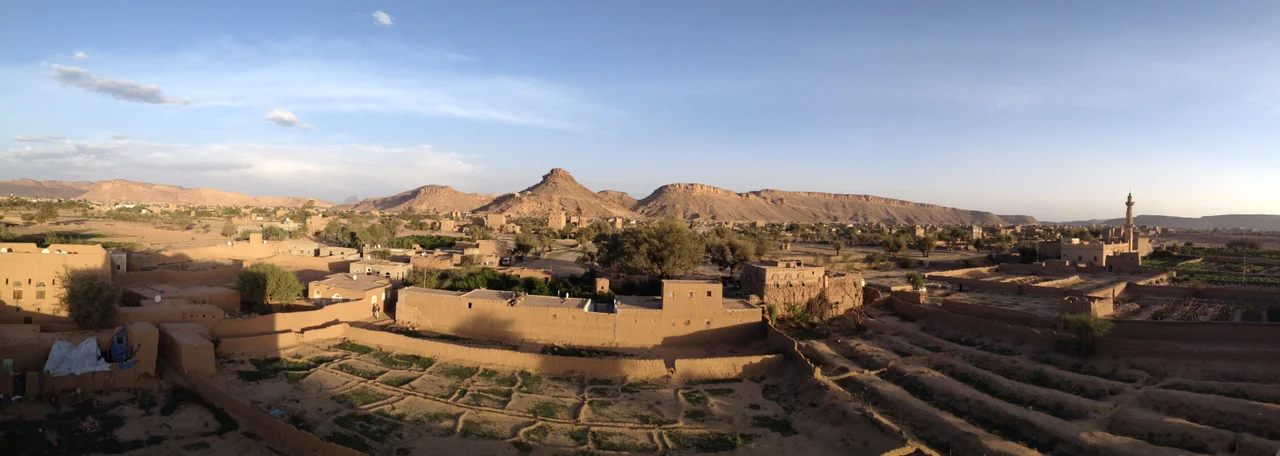

Saada
In 897, a theologian from Medina named Yahya bin Hassan came to northwest Yemen to mediate tribal conflicts and ended up founding a city. The tribes of Saada and Howran had invited him. When he settled their disputes, they gave him their allegiance and the title Imam Hadi, the guiding leader. The dynasty he founded lasted from 893 to 1962, over a thousand years, the longest in Yemeni history. The city he built, Saada, is still here. Its walls are still three kilometers around and four meters thick, with 52 watchtowers and 16 gates. The Imam Hadi Mosque inside them is considered the oldest Shiite mosque on the Arabian Peninsula.
A City at 1,800 Meters
Saada sits in the Serat mountains of northwest Yemen at an altitude of roughly 1,800 meters, a Horst of ancient crystalline rock lifted between desert basins on either side. The climate is dry and cool by Arabian standards. The city has been part of the map since the Ma'in Kingdom, the earliest known polity in Yemeni history, around the 14th century BCE. Sheba, Himyar, Aksum, Sassanian Persia, and the early Arab Caliphates all held the territory at one point or another. None of them made the Sarawat their capital for long, because the highlands have always resisted being ruled from outside them. This is the geography the Zaydi Imamate would eventually exploit for its own survival.
Imam Hadi and the Rassid Dynasty
Al-Qasim al-Rassi, a Medinan scholar from the Ras Hills (hence Rassi, 'one who lives in the Ras Hills'), was a descendant of Hasan ibn Ali and the man who formulated the theology of Zaidism. His grandson Yahya bin Hassan brought the teaching to northern Yemen. When the tribes bestowed the title Imam Hadi on him in 897, he established a theocracy in Saada that merged religion and state. The Rassid dynasty would reign, with many interruptions, for more than a thousand years. Its authority was repeatedly challenged by outside powers, the Fatimids, the Ayyubids, the Mamluks, the Ottomans, and by rival Yemeni dynasties, the Rasulids, the Tahirids. The Zaydi Imamate did not always hold Saada. It always came back to Saada. The mountainous northwest was the final redoubt, the place where the dynasty could retreat and wait.
The Rock Art Outside the Walls
Beyond the Yemen Gate, a cluster of large rocks carries Neolithic carvings of ibex, now-extinct wild animals, and human figures. These are Yemen's oldest rock art. Nearby sits an ancient cistern. Inside the walls, a mountain of iron-ore slag remains from ancient workshops, the mineral wealth that once made Saada a trading hub. Caravans along the spice route passed through the surrounding villages for a millennium, carrying goods from northern Yemen to what is now Saudi Arabia. The Zaydi Muslim Cemetery outside the old city is the largest and oldest in Yemen, its tombstones elaborately carved. Four fortresses, Turmus, Alsama, Sinara, and Abra, the last rebuilt by the Ottomans, guarded the approaches. Small valley villages beyond the walls had farmland, vineyards, and fruit trees, a hint of what Saada was when rain was less scarce.
A Jewish Community, Long Resident
For centuries, Saada was also one of the principal settlements of Yemeni Jews. At the beginning of the 19th century, about 1,000 Jews lived here, most of them merchants and silversmiths whose craft was integral to the city's economy. Yemeni Jewish silverwork was famous across the region. When Israel organized Operation Magic Carpet in 1949-50, most of Yemen's Jews left for Israel, and the Saada community shrank to a handful. The craftsmanship stayed behind in the buildings and in memory, embedded in a city that had been home to Muslims and Jews for close to 1,500 years.
The Houthi Birthplace
The Houthi movement, formally Ansar Allah, was founded here in 1992 as Youth of Belief by Hussein al-Houthi, a religious and military leader from a local Zaydi family. He argued that the Saleh government was letting Wahhabi influence from Saudi Arabia erode Zaydi life in the north. In 2004 he began preparing for armed rebellion. On September 10 of that year, he was killed by Yemeni government forces in Saada province. His followers renamed the movement in his honor. His brother Abdul-Malik al-Houthi took over leadership. Through the 2004-2010 insurgency, the movement grew. In March 2011, in the wake of the Day of Dignity massacre in Sanaa, Houthi fighters took Saada city, drove out pro-government forces, and appointed Fares Manaa governor. Saada became the first city in Yemen to break away from the central government during the crisis. The movement has held it since.
Under the Airstrikes
Since the Saudi-led coalition intervened in Yemen in March 2015, Saada and the surrounding governorate have been among the most heavily bombed areas of the country. The coalition at various points designated the entire governorate a military zone. The ancient Imam Hadi Mosque was damaged. In October 2015, a coalition airstrike destroyed a Medecins Sans Frontieres hospital in Saada, deepening a humanitarian crisis in a region already short of everything. In January 2022, an airstrike on a prison in Saada killed at least 87 people. Civilians in this city, Yemenis whose families have lived in these buildings for generations, have borne most of the cost. The houses inside the medieval walls, where residents still live, have been shaken by concussions. Schools have closed and reopened. Water has been rationed and rerationed. The oldest surviving city of distinct Arab-Islamic architectural style in Yemen has become one of the most bombed places in the Arab world, and the people inside it have kept making a living, raising children, and burying their dead in the old cemetery beyond the Yemen Gate.
From the Air
Saada is at 16.94 degrees north, 43.76 degrees east, in northwest Yemen at roughly 1,800 meters altitude. The local airport is Saada (OYSH), with a 3,000-meter runway but no scheduled passenger service. Cross-border roads link the city to Najran and the Asir region in Saudi Arabia. Visual landmarks from altitude include the Sarawat mountain range running north-south, the walled medieval city core, and the approach to the Saudi border to the north. Hot desert climate. The airspace has been active throughout the civil war and coalition bombing campaign since 2015. Current NOTAMs are essential.
Nearby Stories
- Abu 'Arish 43 km away
- Najran Province 49 km away
- Battle of Port Midi 56 km away
- Jazan Province 84 km away
- Battle of Amran 117 km away
- Marib Dam 177 km away
- Mundafan 185 km away
- Sheba 201 km away