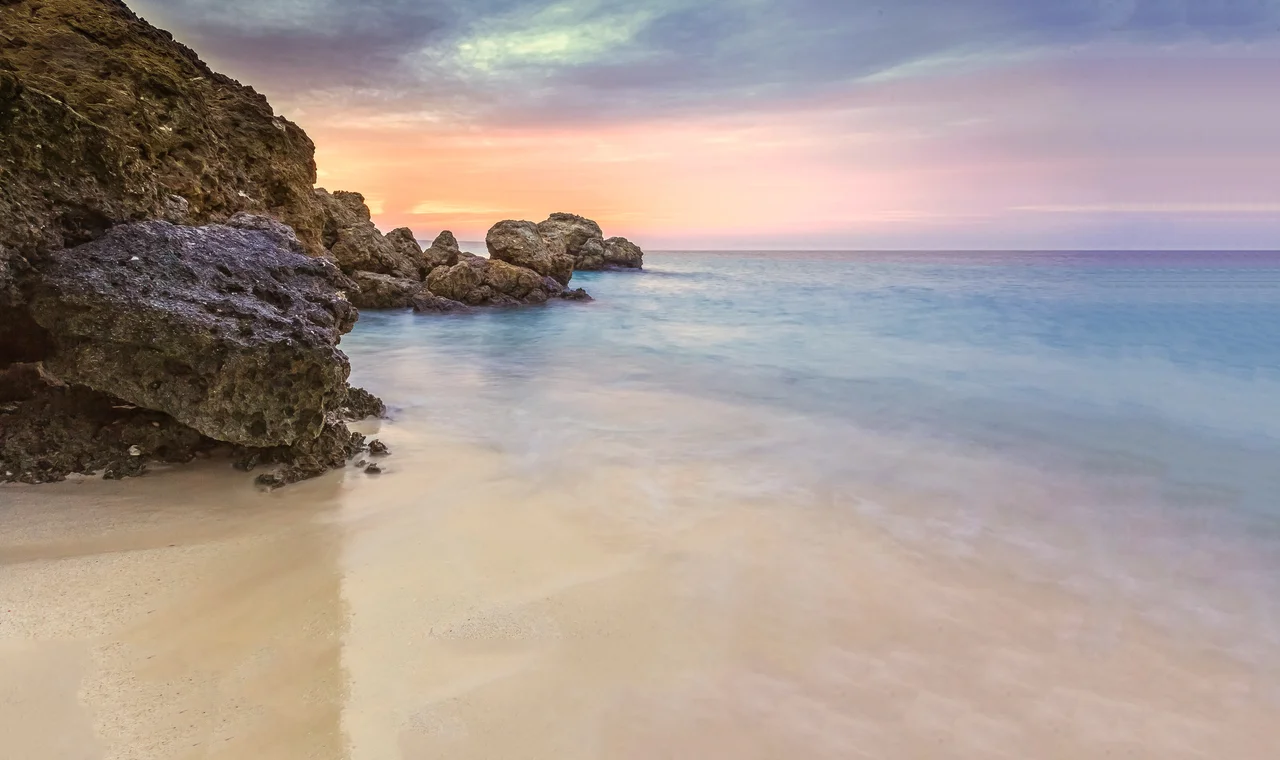

Jazan Province
Jazan does not look like the rest of Saudi Arabia. The coast is tropical, the lagoons steam with humidity that tops 80 percent on summer afternoons, and the interior rises into the Sarawat Mountains where coffee grows at nearly 3,000 meters. Two hundred islands lie offshore in the Red Sea, some of them hosting European migratory birds that spend their winters here rather than in Africa. And in the plains between mountain and sea, farmers grow mangoes, guavas, papayas, and more than thirty other fruits in a country most people picture as unbroken desert. Jazan is the smallest Saudi province after Al-Baha, but it has the kingdom's highest population density, and it does nearly everything the rest of Saudi Arabia does not.
Three Climates, One Province
The geography is tripartite. Inland rise the Sarawat Mountains, where rainfall occurs year-round and temperatures stay moderate even in summer. Between the mountains and the coast stretches Al-Hazoun forest, a district of forest broken by pastureland. Then the coastal plain, part of the belt called Tihamah, arguably the hottest region in the kingdom. July afternoons reach 40°C in the shade. January highs are 31°C. Rainfall across the lowland averages less than 75 millimeters a year, about three inches, and the humidity from coastal lagoons makes the heat feel worse than the numbers suggest. Farmers coax bananas, grapes, and citrus from the plains. In the highlands, coffee thrives in a climate that would be unimaginable most places in Saudi Arabia.
The Oldest Coast
Archaeologists digging in Jazan have found stone tools belonging to the Acheulean civilization of the Lower Paleolithic, suggesting the Red Sea coast here was among the earliest homes of humans migrating out of Africa. The first people survived on fish and shellfish from the shallow waters; you can still watch fishermen haul in similar catches today. When the ancient incense-route kingdoms of southern Arabia rose (the Minaeans, the Sabaeans of Sheba, the Qatabanians, the Hadhramis, and the Himyarites), Jazan sat at a strategic crossroads, but the evidence suggests its inhabitants kept their own counsel. They traded with the great kingdoms without being ruled by any of them, a stubborn independence that has marked the region for most of its recorded history.
The Last Region to Join the Kingdom
In the early twentieth century, Jazan was governed by the Idrisid emirs from the city of Sabya. In October 1926, King Abdulaziz Al Saud and the Idrisid ruler al-Hassan al-Idrisi signed the Treaty of Makkah, bringing the region under Saudi protection. But four years later the Idrisids attempted to break away; Abdulaziz sent his troops, and by 1930 Jazan had fully joined the new kingdom. That made it the last region of the Arabian Peninsula absorbed into Saudi Arabia. Yemen did not accept the loss quietly. In 1934 a brief Saudi-Yemeni war was fought, ended by Imam Yahya's suspension of Yemen's claim in the Treaty of Taif. Not until the Saudi-Yemeni border agreement of 2000 was the question settled formally. For most of a century, Jazan has been disputed ground that nobody could quite let go of.
Coffee, Mangoes, and the Sea
The numbers in Jazan agriculture are surprising. The coastline of roughly 330 kilometers yields 6,394 tons of fish and shellfish each year, more than 20 percent of Saudi Arabia's entire fish production, including 1,753 tons of Spanish mackerel and 428 tons of tuna. The livestock count exceeds 3.9 million animals: 1.72 million sheep, 2.1 million goats, nearly 100,000 cattle, 57,400 camels. In May 2022, the Saudi Public Investment Fund launched the Saudi Coffee Company with plans to invest more than 319 million dollars over a decade, aiming to boost annual coffee production from 300 tons to 2,500 tons. Much of that coffee will come from Jazan's terraced mountain villages, where farmers have been growing arabica for generations in conditions nobody else in the kingdom can match.
Farasan and the Future
Off the coast lies the Farasan archipelago, Saudi Arabia's first designated conservation area, where coral reefs, mangroves, and over 200 islands host European migratory birds each winter. The provincial capital is Jizan, a port city of around 200,000 that currently hosts King Abdullah International Airport (a new airport will eventually replace it). In April 2023, Crown Prince Mohammed bin Salman announced Jazan as one of four new Saudi special economic zones, aiming to attract 2.93 billion dollars in foreign investment by 2040. The Arabian-Nubian Shield geology underlying the province promises mining and metal-conversion industries. Between the mangoes and the metals, the coffee and the coral, Jazan is quietly becoming the most unusual corner of a country famous for its deserts.
From the Air
Jazan Province covers roughly 13,457 km² along Saudi Arabia's southwestern Red Sea coast, bordered by Yemen to the south. Centered near 17.5°N, 42.5°E. Principal airport is King Abdullah bin Abdulaziz Airport (OEGN) near Jizan city. Sarawat Mountains inland reach about 3,000 m (9,800 ft); plan for significant terrain clearance east of the coast. Recommended cruising altitude 15,000 ft or higher eastbound. Farasan Islands archipelago lies 40-50 km off the coast.
Nearby Stories
- Emirate of Asir 28 km away
- 2025 Saada prison airstrike 96 km away
- Saada 111 km away
- Dhorm Mountain 111 km away
- Asir 139 km away
- Italian Submarine Guglielmotti (1938) 155 km away
- Battle of Kunfuda Bay 174 km away
- Shadah Al-asfal 254 km away