.jpg)
Battle of Kunfuda Bay
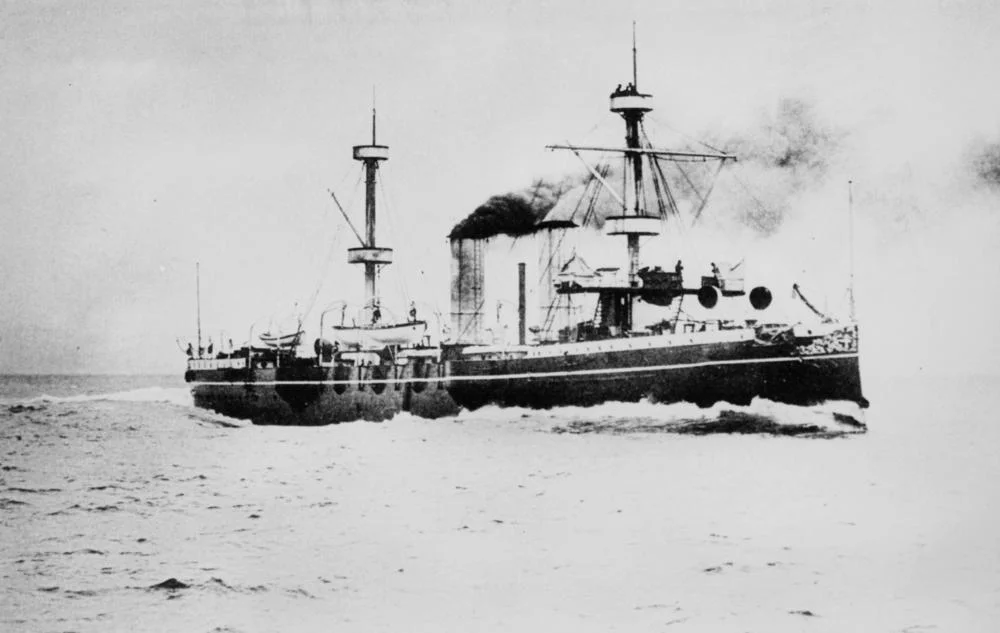
The Ottoman gunboats had come too far on too little coal. Six of them had been stationed in the Persian Gulf when the Italo-Turkish War broke out in September 1911, and they had been recalled - but the steamer carrying their resupply of coal had been captured in December by the Italians. They could not reach the Mediterranean. They could barely reach anywhere. They sheltered in the harbor at Kunfuda, on the Arabian Red Sea coast, along with a tugboat and a yacht, and waited. On 7 January 1912, the Italian protected cruiser Piemonte and two destroyers found them there.
A War Over Libya, Fought in the Red Sea
The Italo-Turkish War began as a scramble over Libya - Italy wanting it, the Ottoman Empire technically ruling it. But the fighting quickly spread wherever the two empires had naval assets. Italy worried about its colony of Eritrea, on the African shore of the southern Red Sea, and concentrated a naval squadron there to prevent any Ottoman attempt to ferry an army across. By the end of 1911, the Italians had amassed three protected cruisers, a torpedo cruiser, four destroyers, two gunboats, and other vessels, all under Captain Giovanni Cerrina Feroni. They began attacking Ottoman ports to destroy any shipping that could threaten Eritrea. The Ottoman naval response was thin. The main fleet sat safely in the Sea of Marmara, defending the Dardanelles. In the Red Sea there was one significant warship - the torpedo cruiser Peyk-i Sevket - which briefly engaged an Italian torpedo cruiser off Al Hudaydah before retreating into port. The Persian Gulf gunboats were supposed to change the equation. Instead, they ran out of fuel.
The Harbor at Kunfuda
Kunfuda - today spelled Al Qunfudhah - sits on the Red Sea coast of what is now Saudi Arabia, in Mecca Province. In January 1912 it was part of Ottoman Hejaz. On the morning of 7 January, Piemonte arrived with two destroyers after the Italians received intelligence on the gunboats' location. At the same time, the cruisers Puglia and Calabria had been carrying out diversionary bombardments against Jebl Tahr and Al Luhayyah, drawing Ottoman attention south. The Italian squadron opened fire at 4,500 meters - a range safe from the small-caliber weapons aboard the Ottoman vessels. The bombardment lasted three hours. Three of the gunboats were sunk outright. The other three, damaged enough to be sinking, ran themselves aground on the beach to prevent going under. The tugboat and the yacht were also hit. The yacht sank; the Italians would later salvage it, commission it into their own service, and rename it Cunfida after the place of its capture.
The Next Morning
On 8 January, the Italian vessels returned. Landing parties went ashore to destroy the three beached gunboats and strip their light guns. The Italian warships bombarded the port of Kunfuda itself, then seized four dhows - small Arab sailing vessels - before withdrawing. The Ottoman naval presence in the region had ceased to exist. Every combatant vessel in the southern Red Sea flying the Ottoman flag was now sunk, captured, or disabled. It had taken, essentially, an afternoon and a morning.
A Blockade, a Peace, an Empire Fading
With no Ottoman ships to contest them, the Italians proclaimed a full blockade of the Arabian Red Sea coast. They began seizing vessels carrying contraband. To their credit - or to the political necessity of not enraging the Islamic world - they continued to allow Muslim pilgrims to cross the Red Sea on their way to Mecca for the Hajj. For the rest of the war, Italian cruisers operated along the Arabian and Yemeni coasts essentially at will, bombarding Ottoman positions without meaningful response. The war ended in October 1912 with the Treaty of Ouchy. Italy got Libya. The Ottomans lost another piece of an empire that would be gone entirely within a decade. Kunfuda had been a small action in a small war, but it was also a glimpse of what the 20th century's naval power looked like in practice: cruisers outranging gunboats, coal logistics deciding battles that never really became battles, and a coastal town of the Hejaz watching foreign warships shell its harbor.
The Harbor Today
Al Qunfudhah today is a Saudi port city of roughly 250,000 people on the Red Sea coast, well south of Jeddah, known for fishing, shipping, and a small refinery complex. Nothing visible on the waterfront marks where the Ottoman gunboats went down in 1912. Their wreckage, presumably, is still out there somewhere - scattered across a shallow harbor that mostly forgot them quickly. The yacht Cunfida served in the Italian navy for years afterward, its captured name a quiet reminder of an afternoon that ended one empire's presence in this part of the world and announced another's.
From the Air
The Battle of Kunfuda Bay took place in the harbor at Kunfuda (modern Al Qunfudhah) on the Red Sea coast of Saudi Arabia, near 19.136 N, 41.065 E. The nearest airport is Al Qunfudhah Airport (a domestic field) with Abha International (OEAB) to the east and King Abdulaziz International (OEJN) in Jeddah well to the north. Coastal weather is warm and humid year-round; Red Sea haze is common in summer. The Red Sea is well-trafficked commercial airspace - expect cruise-altitude traffic along the coast. Look for the coastal town against the Tihamah plain with the Sarawat mountains rising behind it to the east.
Nearby Stories
- Bareq 51 km away
- Shadah Al-asfal 63 km away
- Dhorm Mountain 70 km away
- Al-Baha Province 74 km away
- Siege of Ta'if 215 km away
- Jazan Province 219 km away
- Ta'if 244 km away
- First and second battles of El Teb 290 km away