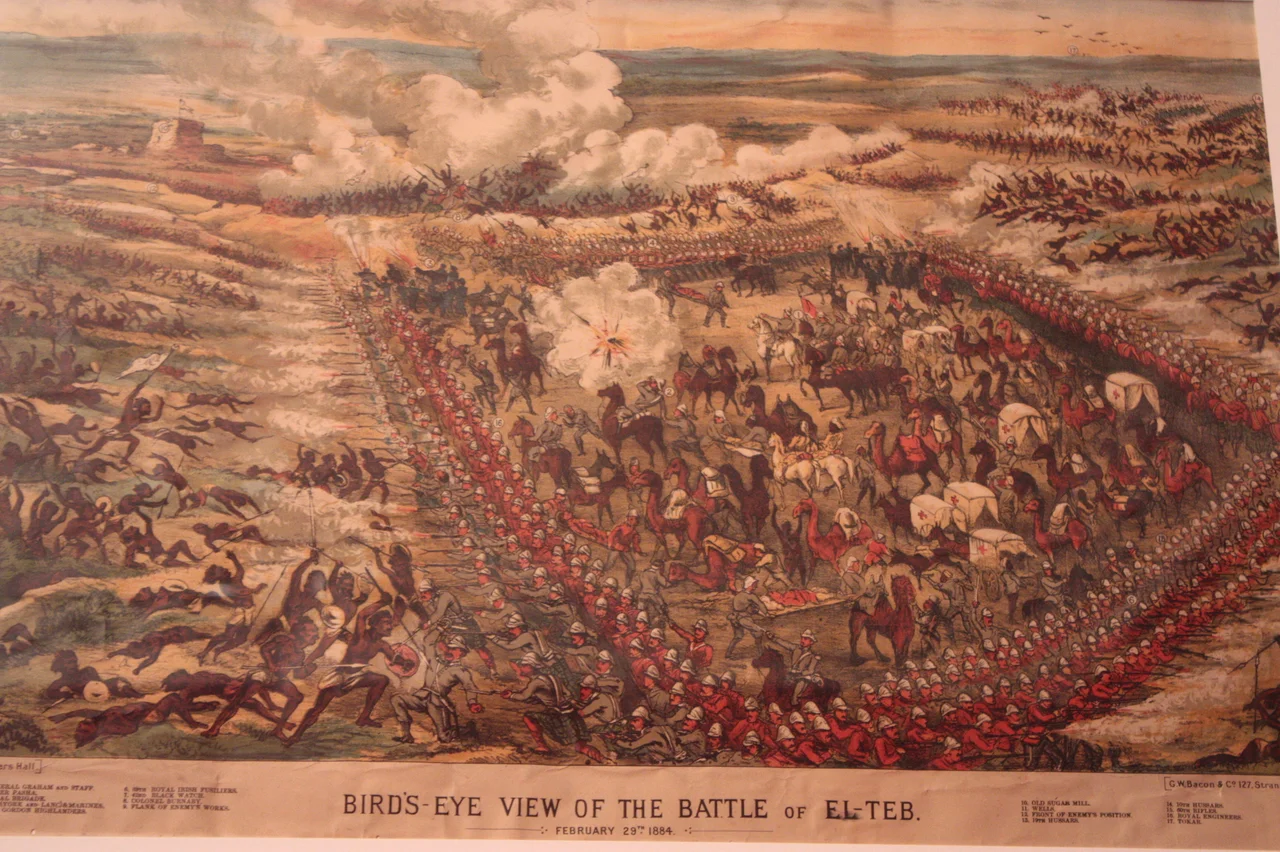

First and second battles of El Teb
The march began at dawn on 4 February 1884, along the coast road to Tokar. Valentine Baker - Baker Pasha to the Egyptian army he commanded - had 3,500 men and orders to relieve a garrison trapped somewhere beyond the dunes. Most of his infantry were Egyptian gendarmes who had enlisted for civil duty in the Nile Delta and woke up one morning to find themselves shipped to Sudan. They did not want to be there. Halfway to Tokar, at a dry wadi called El Teb, roughly 1,000 Sudanese fighters rose out of the scrub. The gendarmes fired a single volley, then broke. By the end of the morning, of 3,500 men, barely 700 returned.
How Sudan Became Everyone's Problem
Britain had not meant to be in Sudan. It had meant to be in Egypt, quietly protecting the Suez Canal after putting down Urabi Pasha's revolt in 1882. But the Khedive of Egypt, whose rule now depended on British bayonets, nominally governed Sudan too - and Sudan was in revolt. Muhammad Ahmad, a Nile Valley religious teacher who declared himself the Mahdi, had called a jihad against what he called the "Turks": the Egyptian garrisons that ran Khartoum and the Red Sea ports. By 1883, Mahdist armies were rolling up Egyptian forts faster than anyone in Cairo or London could follow. Prime Minister Gladstone, no imperialist, wanted Egypt simply to leave. But the coastal garrisons at Tokar and Sinkat were surrounded, and in those garrisons were families - soldiers, dependents, and the women and children of the merchant quarters. Someone had to go in.
The Rout at El Teb
Baker chose Osman Digna's ground by accident. He had ferried his men from Suakin to Trinkitat and set off inland in a loose mass - the Egyptians were not trained to march in square. When Digna's fighters charged, every European officer who tried to rally the line was killed. Baker himself rode back to the beach camp with the survivors. The Mahdists - Beja fighters from the hills, Arab tribesmen from the coast, men Kipling would later call "Fuzzy-Wuzzy" with more admiration than he had any right to - took more than a thousand rifles and most of the ammunition. The Sinkat garrison, hearing the news, tried to walk out. They were cut down on the road. The Tokar garrison surrendered without a fight, along with the families inside the walls.
Graham Comes Back Heavy
In Britain, the defeat at El Teb turned the political tide. Lord Wolseley's imperialist faction demanded regulars. Gladstone reluctantly agreed, and on 21 February a 4,500-strong column under Sir Gerald Graham - Royal Irish Fusiliers, York and Lancasters, Marines, and three battalions of the Egypt garrison - sailed for Suakin. They landed at Trinkitat and marched the same road Baker had. At a village near El Teb, Digna's fighters had dug trenches and fortified a hilltop. This time the British came in square, with naval guns and cavalry. Captain Arthur Wilson of the Naval Brigade, stepping in for a mortally wounded lieutenant, fought hand-to-hand with Mahdist swordsmen to protect a gun detachment and earned the Victoria Cross. Quartermaster Sergeant William Marshall of the 19th Hussars won another for carrying his wounded colonel out under fire.
The Dead, Counted and Uncounted
By day's end on 29 February, roughly 2,000 Mahdist fighters were estimated dead, though only 825 bodies were counted on the field. British casualties were light. The dead at El Teb on the first day - Baker's Egyptian gendarmes, nearly three thousand of them, abandoned in their panic - were still out there; a party of the 42nd Regiment was sent from Graham's column specifically to bury the Europeans, while the rest were left to the sand. The 700 survivors of the Tokar garrison were escorted to Trinkitat. Sinkat's dead were never recovered. Osman Digna, wounded but free, withdrew into the hills. He would keep fighting the British for another fourteen years.
The Road That Led to Omdurman
El Teb was not a famous battle. Isandlwana happened five years before, Rorke's Drift too; Omdurman and Kitchener's reconquest were still fourteen years away. But the two days at El Teb compressed the entire story of the Sudan war into a single landscape: a hinterland people fighting for their faith and their sovereignty; an empire hauled in by its own logic of canal-and-coaling-station; Egyptian conscripts dying for a war that was not theirs; British soldiers winning hard fights for reasons that, in retrospect, are difficult to explain. Winston Churchill, twenty-three years old, would ride with Kitchener at Omdurman in 1898 - a campaign whose first chapter was written on the scrub beach near Tokar in February 1884.
From the Air
Battlefield coordinates approximately 18.61°N, 37.69°E, on the Sudanese Red Sea coast roughly 45 nautical miles south of Suakin and 30 nautical miles east of Tokar. Nearest current airfield: Port Sudan New International (HSPN). Terrain: coastal scrub rising to low hills of the Red Sea Hills. Best viewing FL150-FL250 in morning light; afternoon haze typical.
Nearby Stories
- Suakin 59 km away
- Port Sudan 90 km away
- Iran–Israel proxy conflict in Sudan 119 km away
- Nakfa 180 km away
- Anseba region 255 km away
- Battle of Kunfuda Bay 291 km away
- Northern Red Sea region 292 km away
- Kassala 328 km away