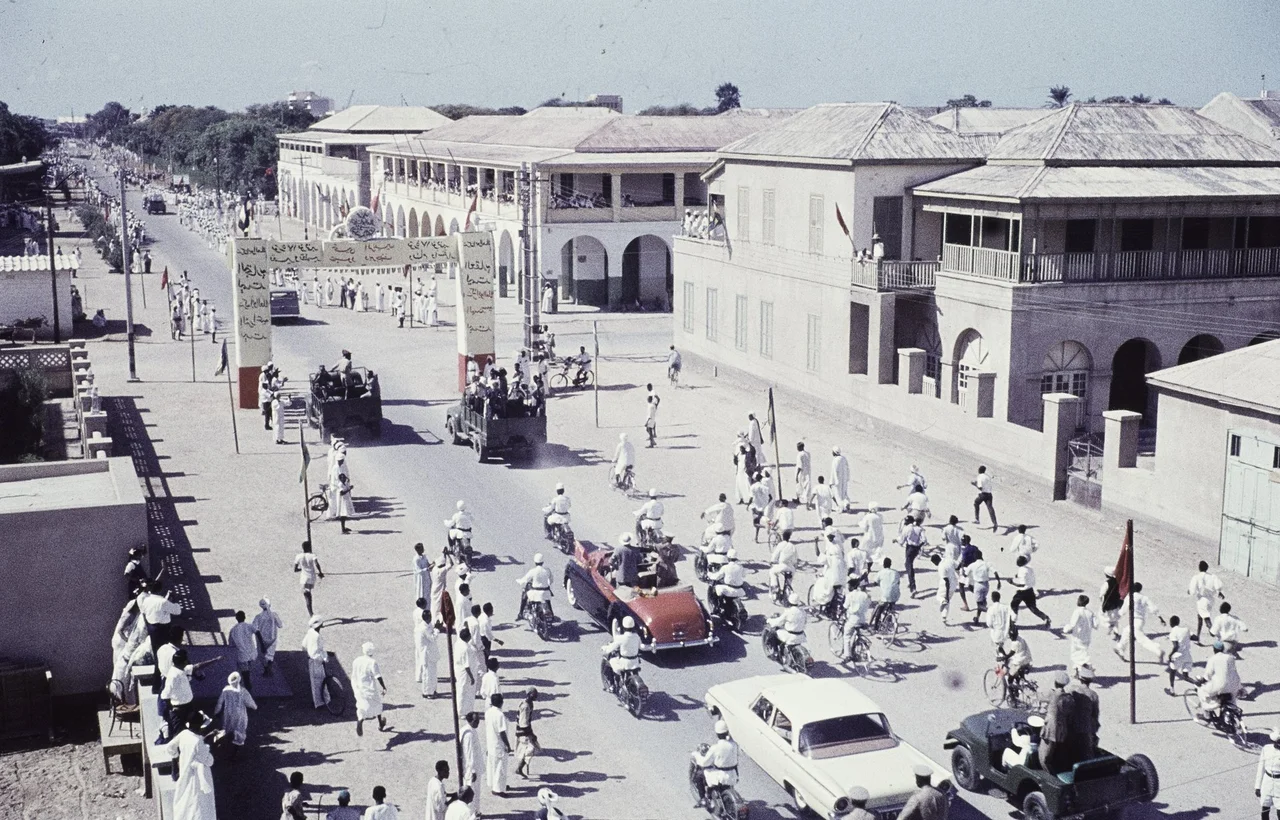

Port Sudan
The British built Port Sudan between 1905 and 1909 to replace Suakin, the old Arab port a few kilometers south whose coral harbor had silted up until ships could no longer reach it. They drew straight streets and a deep anchorage, laid rails across 780 kilometers of desert to the Nile, and handed the Red Sea a new capital for trade. In April 2023, when the fighting in Khartoum made the old capital uninhabitable, Port Sudan became the capital for something else entirely: a country trying not to break apart.
A Port That Replaced a Port
Suakin had been the principal African pilgrimage port to Mecca for centuries, its coral buildings famous throughout the Red Sea world. By 1900 its harbor was too shallow for modern steamships, and the Anglo-Egyptian administration decided to start over. Port Sudan was a purpose-built colonial city, laid out for cargo rather than character. Within a generation it was handling nearly all of Sudan's international trade, a share it has never given up. Today the port still moves 90 percent of what the country imports and exports, a chokehold that has shaped every political calculation in Sudanese history. An oil pipeline reached the port from Khartoum in 1977, and a modern road and a 1,067-millimeter-gauge rail line follow the same general route across the Nubian Desert.
Heat, Wind, and No Rain
Port Sudan sits on the western shore of the Red Sea at the foot of the Red Sea Hills, in a climate as hostile as anywhere on the African coast. Summer temperatures routinely exceed 45 degrees Celsius. Winter still pushes past 30. Average annual rainfall is 76 millimeters, and between January 1983 and June 1984 no rain fell at all. Fresh water has to be pulled from the Wadi Arbaat in the hills or distilled from the sea in salt-evaporating pans. In 2016, reporters described a city rationing water while the fuel depots along the waterfront ran full. The Beja people, the indigenous inhabitants of this coast, have lived in these conditions for millennia. Their Bar'uut, "the harbor," is what Beja speakers still call Port Sudan.
A City Under Tribal Pressure
After the October 2021 coup in Khartoum, the Beja tribal council closed the port for a week in protest. Trade stopped. Fuel stopped. The new military government negotiated, and the blockade lifted, but it demonstrated what every Sudanese ruler has had to learn: Port Sudan's economics are national, but its politics are local, and the Beja can turn off the country's circulatory system when they choose. Parallel pressures were building from outside. In 2020, Russia announced plans for a naval base for 300 personnel and four warships. The deal stalled, then returned, then stalled again. Iran held similar talks. A proposed new seaport at Abu Amama, 200 kilometers north, attracted six billion dollars in preliminary Emirati investment in 2022. For a city of under 400,000 on a coastline most of the world cannot locate, Port Sudan has had a great deal of attention.
The Wartime Capital
In April 2023, fighting broke out in Khartoum between the Sudanese Armed Forces under General Abdul Fattah al-Burhan and the Rapid Support Forces under Mohamed Hamdan Dagalo, known as Hemedti. Khartoum collapsed street by street. The government that could flee, fled, and much of it fled to Port Sudan. Ministries reopened in requisitioned buildings near the waterfront. Embassies relocated. Al-Burhan ran the war from the city, and Hemedti, from the territory he controlled, threatened to declare a rival government, a warning that Sudan might be on the Libyan trajectory of two rival capitals, two rival states. Analysts used the phrase "de facto capital" for Port Sudan, and the phrase turned into reality by administrative default.
A Refuge That Struggles to Hold
Displaced families began arriving as soon as the shells started falling on Khartoum. They came by bus, by truck, on foot, carrying what they could. Reuters and Bloomberg and Al Jazeera all filed the same story from different angles: Port Sudan, a port designed for goods, not for people, trying to hold hundreds of thousands of them. Shelters opened in schools. Aid agencies set up at the port itself. The heat that had always defined the city now pressed down on families with no insulation, no reliable water, and sometimes no food. In 2023, VOA reported displaced Sudanese in Port Sudan suffering heat exhaustion, food shortages, and the complete loss of whatever they had left behind. The city was doing what it could. It was not enough, and nobody pretended it was.
Drones on the Coast
On May 4, 2025, the Rapid Support Forces launched a drone attack on Port Sudan, the first time the war's front lines had reached the wartime capital. The strikes targeted the Osman Digna Air Base and a goods warehouse, and the damage was reported as limited. A day later, another wave of drones hit fuel depots. A fire rose over the waterfront. Arab nations condemned the strikes. The message was clear. The war was no longer somewhere else. For a city that had absorbed the country's displaced population, fed the front with fuel, and run what remained of the government, the attack landed as a warning. Even the refuge is within range. Port Sudan, the British-built port that never set out to be a capital, is the only one the country has right now.
From the Air
Port Sudan is at 19.62 degrees north, 37.22 degrees east. The main airport is Port Sudan New International (HSPN). From altitude, the distinctive landmarks are the deep natural harbor, the oil pipeline terminus, the sharp transition between the coastal plain and the Red Sea Hills inland, and the corridor of the Khartoum road and railway reaching west. Hot desert climate, persistent haze, and low humidity in summer. Airspace in and around Port Sudan has been active during the 2023-present civil war, with drone activity reported since May 2025.
Nearby Stories
- Operation Moses 19 km away
- Suakin 36 km away
- First and second battles of El Teb 81 km away
- Red Sea State 102 km away
- Red Sea Rift 133 km away
- Nasseef House 266 km away
- The Travels of Ibn Battuta 275 km away
- Halaib Triangle 337 km away