.jpg)
Nasseef House
For decades, Jeddans did not need to know the street number. If you were looking for Bayt Nasseef, you asked for the house with the tree. In a walled coral-stone town where fresh water was scarce enough that no one else bothered, a single neem cast shade over a little square on the north side of Omar Nasseef's front door, and that shade became an address. The tree still stands, probably the oldest in Jeddah.
The House with the Tree
Construction began in 1872 along Suq al-Alawi, old Jeddah's main thoroughfare, and finished nine years later. Omar Nasseef Effendi, a wealthy merchant and governor of Jeddah, wanted the house for his family, but he also wanted something the neighborhood did not have. In Al-Balad, almost every drop of water had to be hauled in from wells or stored in cisterns beneath the floors. Growing a neem tree in that climate was not gardening, it was statement. For generations afterward, when residents gave directions they pointed toward the tree. The botanical name is Azadirachta indica. The social name, in Arabic conversation, was simpler. That tree. That house.
A Salon for a New Kingdom
In December 1925, Abdulaziz Ibn Saud entered Jeddah after the siege that ended Hashemite rule over the Hejaz. He did not build himself a palace first. He moved into Bayt Nasseef. During his early stays in the city, the merchant's house became his royal residence, the place where he received consuls, tribal leaders, and foreign merchants. The British writer John R. Bradley described the 1920s scene as a kind of social salon, where the men who would shape the new Saudi state negotiated in rooms lined with Arabic calligraphy and Ottoman-period tilework. The king eventually built elsewhere. The Nasseef family stayed until 1975, when Muhammad Nasseef did something unusual with the building. He turned it into a public library.
Sixteen Thousand Books
Muhammad Nasseef's private collection grew to 16,000 volumes, and he let anyone who visited him read them. For two decades the old merchant's house was a living library, quiet rooms where scholars and curious neighbors pulled down histories, theology, poetry. After his death the entire collection went to King Abdulaziz University. The rooms it had filled are now open to visitors, and the Regional Museum of Archaeology and Ethnography in Jeddah keeps a model of the house, because the thing itself is hard to photograph in full.
A Plan in Threes
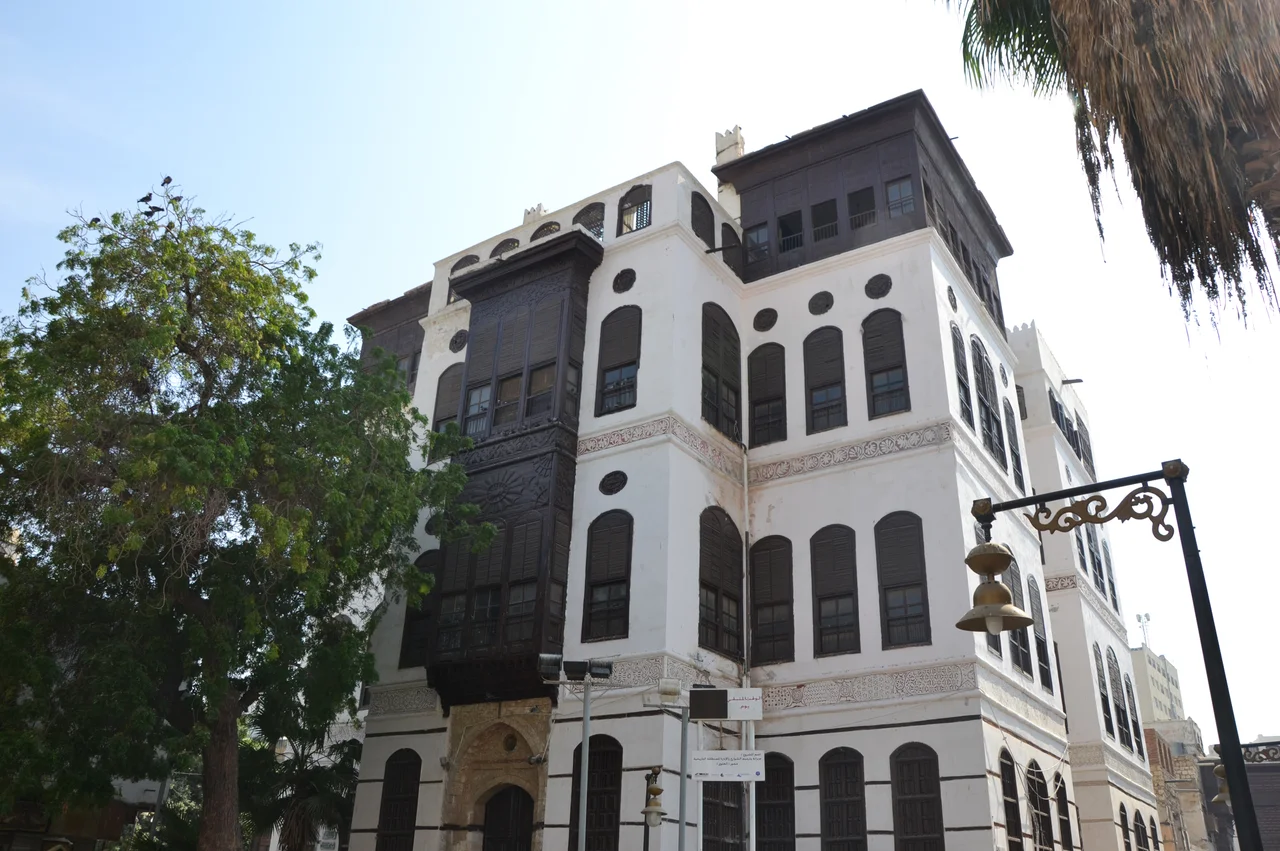
The house has 106 rooms and, depending how you count the offset levels, seven stories. The main entrance faces north, with a second entrance on the west that women used. Inside, a motive of groupings in threes keeps reappearing, three windows, a door flanked by two niches, a symmetry that draws the eye around rectangular rooms arranged around a central hall. Above the main door, two large rawashin, the carved wooden bay windows traditional to Jeddah, stack on each other through the floors. The main staircase is unusually wide, with very flat steps. Local tradition says camels carried provisions up to the fifth-floor kitchen. A donkey, more plausibly, would have had an easier time with the turns.
Coral and Cooling Breezes
Old Jeddah is built from coral blocks cut from the Red Sea reefs, and Bayt Nasseef is one of its finest examples. The style is often called Ottoman Turkish, but that mostly describes when it was built, not what it resembles. The real influences run along the Red Sea, through Egypt and the Levant, in a vernacular that evolved to handle extreme heat and humidity. The upper floors open onto terraces. A pavilion-like structure rises above the middle of the building, where the family slept on the hottest nights, catching whatever cooling breeze could be coaxed out of the sea air. Two cisterns collect water on the ground floor. Latrines serve every level. A domed shower sits on the third floor. Pipes feed the wastewater to underground septic tanks, a system that was sophisticated for its time and still works.
Al-Balad Endures
In 2014, UNESCO inscribed historic Jeddah, the Al-Balad district, on the World Heritage List, recognizing coral-stone architecture as a distinct Red Sea tradition. Bayt Nasseef is one of the anchors of that designation. Today it operates as a museum and cultural center, hosting special exhibits and lectures by historians. The books are gone to a university library across town, but the house still functions as it always did, a gathering place that tells visitors what Jeddah was, and still is: a port city where merchants mattered, where a single tree could define a neighborhood, and where the coral cut from the sea made walls thick enough to cool a century of summers.
From the Air
Bayt Nasseef is located at 21.4839 degrees north, 39.1878 degrees east, in the Al-Balad district of central Jeddah. Nearest airport is King Abdulaziz International (OEJN), about 18 km north of the old city. From cruise altitude the Red Sea coastline and the Corniche are prominent visual landmarks. The old town itself is a dense patch of multi-story coral-stone buildings just inland from the port. Hot desert climate, persistent haze common in summer, best visibility November through February.
Nearby Stories
- Battle of Fakhkh 12 km away
- Siege of Ta'if 72 km away
- Red Sea 73 km away
- Red Sea Rift 76 km away
- Ghadir Khumm 115 km away
- Ta'if 126 km away
- Hejaz 223 km away
- Operation Moses 229 km away