
Red Sea
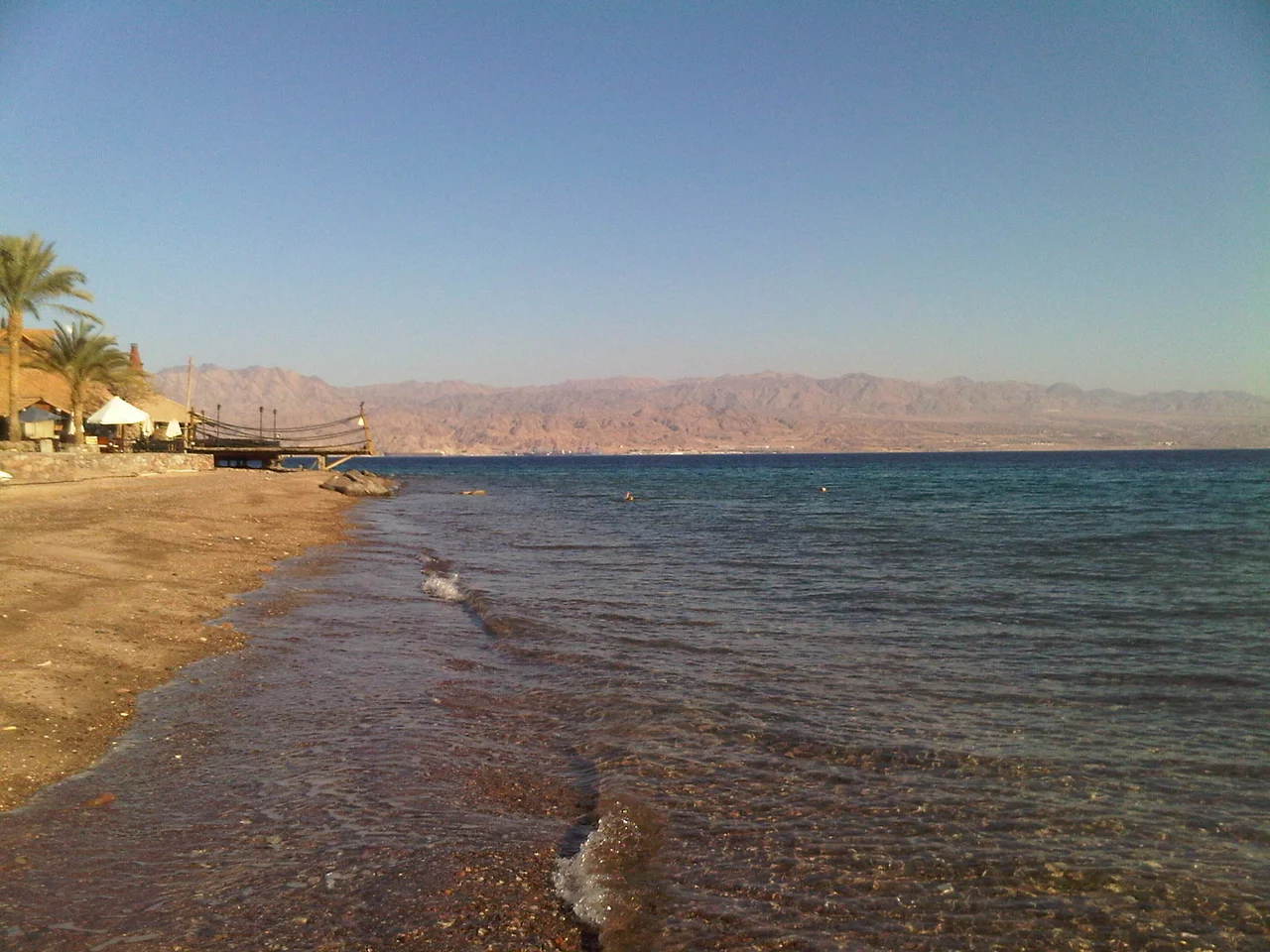
Name a color. The Greeks named this one the Erythra Thalassa, the red sea, and the name stuck through Latin, through Arabic, through every language that touched its shores. Nobody is quite sure why they chose red. One theory blames the seasonal blooms of the cyanobacterium Trichodesmium erythraeum, which sometimes tints the surface rust-orange. Another points to an old Asiatic convention by which colors signaled cardinal directions, with red for south, as the Black Sea's name may signal north. Whatever its origin, the sea itself is most emphatically blue, the brilliant blue of a tropical basin walled in by desert on both sides.
Geometry of a Young Sea
The Red Sea is a narrow, elongated basin lying between Africa and Asia, connected to the Indian Ocean in the south through the Bab-el-Mandeb Strait and the Gulf of Aden. In the north, it splits into the Gulf of Aqaba and the Gulf of Suez, the latter leading to the Suez Canal and on to the Mediterranean. It is underlain by the Red Sea Rift, part of the Great Rift Valley, a slowly spreading mid-ocean ridge that is still pulling Africa and Arabia apart by about a centimeter a year. In 2005, three weeks of tectonic activity in the Afar region widened the sea measurably. Given enough geological time, this will become an ocean. About 40 percent of its area is shallow, less than 100 meters deep, while the central Suakin Trough plunges past 2,200 meters.
One of the Saltiest Waters on Earth
No significant rivers drain into the Red Sea. Its southern connection to the Indian Ocean is narrow. Evaporation runs far ahead of rainfall, which averages only a few millimeters per year along most of its coasts. The result is salinity ranging from about 36 parts per thousand in the south to 41 in the north near the Gulf of Suez, with an average around 40. That is well above the 35 parts per thousand of typical ocean water. Surface temperatures in summer hover near 26 to 30 degrees Celsius. The water is warm, saline, and stratified, with only limited seasonal variation. These are not the conditions most coral reefs prefer. And yet.
Reefs That Should Not Be This Good
More than 1,200 fish species live in the Red Sea. About ten percent are found nowhere else. Over 200 species of soft and hard coral build the fringing reefs along both coasts, reefs 5,000 to 7,000 years old, shaped mostly from stony Acropora and Porites. Unusual offshore formations, including several true atolls, defy classic coral-reef classification and are attributed to the area's tectonic activity. The reefs have stayed remarkably healthy. Low human population along much of the coast, minimal runoff from rivers that do not exist, and the coral's own adaptation to heat have combined to produce a marine ecosystem that researchers now study as a possible model for coral survival in a warming ocean. An expedition offshore from Sudan and Eritrea found only nine percent of coral infected by the white plague agent Thalassomonas loyana. A virus, BA3, harbored by Favia favus coral, appears to kill that pathogen. Scientists are investigating whether the Red Sea's corals carry genetic tricks that could be used to rescue bleached reefs elsewhere.
The Sea That Ancient Empires Fought Over
The earliest recorded explorations of the Red Sea were Egyptian expeditions to the Land of Punt, the first around 2500 BCE, another around 1500 BCE under Queen Hatshepsut, who had her story carved into the walls of her mortuary temple at Deir el-Bahari. In the 6th century BCE, Darius the Great of the Achaemenid Empire surveyed the sea for hazards and built an ancient predecessor of the Suez Canal linking the Nile to the Gulf of Suez. Alexander the Great sent Greek naval expeditions down the sea to the Indian Ocean. The Periplus of the Erythraean Sea, written around the 1st century CE by an anonymous Greek merchant-sailor, catalogued the ports and sea routes in detail. Under Augustus, Rome used the sea to trade with India. Contact reached as far as China until the rise of Aksum disrupted the route around the 3rd century. Across all these centuries, another trade ran alongside: the Red Sea slave trade, which carried enslaved Africans to the Arabian Peninsula from antiquity into the 20th century, a history that has drawn increasing scholarly attention and international condemnation in recent decades.
A Modern Crisis
The Suez Canal opened in November 1869, and the Red Sea became one of the busiest shipping routes in the world. Twelve to fifteen percent of global trade passes through it today. That volume has always made the sea strategically vital and environmentally vulnerable. Oil spills threaten the coral. Maritime traffic threatens the wildlife. Since the Gaza war began in October 2023, Iranian-backed Houthi forces based in Yemen have attacked Western shipping in the southern Red Sea and the Bab el-Mandeb strait, including warships. One commercial vessel was hijacked and taken to Yemen. Global shipping companies rerouted around the Cape of Good Hope, a 10-day detour, and insurance rates spiked. The sea has been a strategic chokepoint for three millennia. It still is.
Volcanoes in the Middle
Several small volcanic islands rise from the center of the sea. Most are dormant. In 2007, Jabal al-Tair in the Bab el-Mandeb strait erupted after 124 years of quiet. In December 2011, Sholan Island emerged in the Zubair Archipelago during a new eruption. In September 2013, Jadid Island appeared the same way. The sea is actively making new land while simultaneously spreading apart. Tourists who dive the reefs at Dahab, or sail south from Hurghada, or visit the marine park at Ras Mohammed in the Sinai, are swimming over a geological and ecological phenomenon with few parallels anywhere. The color may not be red. The story, in every other sense, is as vivid as water gets.
From the Air
The Red Sea runs roughly from 12 degrees north at the Bab-el-Mandeb to 30 degrees north at the Gulf of Suez. The central reference point is 22.85 degrees north, 37.75 degrees east. Major airports along the sea include Hurghada (HEGN), Sharm el-Sheikh (HESH), Jeddah (OEJN), Port Sudan (HSPN), and Djibouti-Ambouli (HDAM). From cruise altitude the sea is a long narrow blue trench bordered by desert on both sides, with the Sinai Peninsula's triangular mass visible at the northern end. Airspace in the southern Red Sea and Bab-el-Mandeb has been subject to security restrictions since October 2023 due to the Houthi maritime attacks.
Nearby Stories
- Jeddah Tower 43 km away
- Ghadir Khumm 69 km away
- Habesh Eyalet 77 km away
- Red Sea Rift 90 km away
- The Travels of Ibn Battuta 116 km away
- Battle of Badr 169 km away
- Operation Moses 204 km away
- Halaib Triangle 220 km away