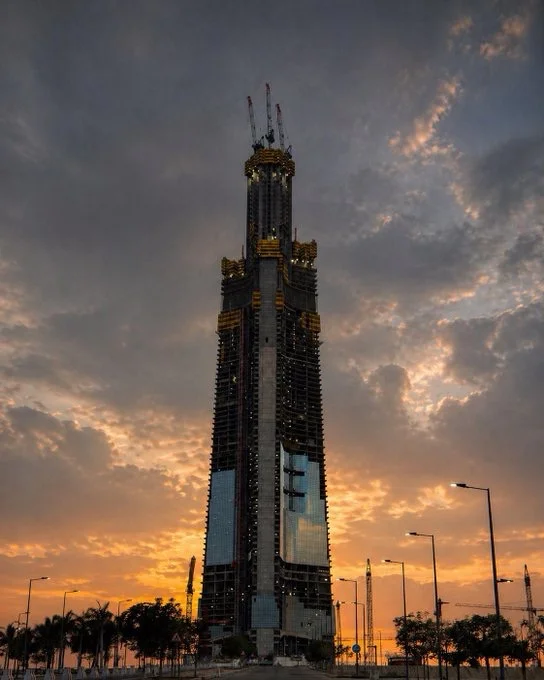

Jeddah Tower
A one-kilometer building has never been built. The Burj Khalifa in Dubai, which currently holds the record for the world's tallest structure at 828 meters counting its antennas, comes close, but not that close. Jeddah Tower was designed by American architect Adrian Smith, who also designed the Burj Khalifa, to leap at least 180 meters beyond it. For almost five years between 2018 and 2023, the tower sat unfinished on the edge of the Red Sea, its core stalled at about the 63rd floor after a political purge and then a pandemic. Then in January 2025, cranes began moving again. By December 2025, the building had reached 81 stories. The final height remains secret. Adrian Smith once hinted in an interview that it would be a little over twice the height of the Burj Khalifa, suggesting something closer to 1,600 meters: one mile high.
A Foundation on Coral
The site lies about 20 kilometers north of Jeddah, on 50 hectares of waterfront that was previously undeveloped. The geology here is a problem. Beneath the surface is soft bedrock and porous coral rock, the kind of foundation that would normally settle unevenly under the weight of anything tall, let alone a tower that will weigh more than 900,000 tons when finished. Langan International engineered a foundation that has to be similar to Burj Khalifa's but larger: a concrete pad around 7,500 square meters, averaging 4.5 meters deep. German contractor Bauer drilled 270 bored piles up to 110 meters deep. The concrete had to be engineered to low permeability, keeping the corrosive salt water of the Red Sea from reaching the steel. The building will settle. The engineers know that. The goal is to make it settle evenly.
The Architect and the Competition
Adrian Smith of Adrian Smith + Gordon Gill Architecture won the design competition in 2010, beating out Kohn Pedersen Fox, Pickard Chilton, Pelli Clarke Pelli, Foster + Partners, and his former firm Skidmore Owings and Merrill. Smith had designed the Burj Khalifa while at SOM; he had also designed the Zifeng Tower in Nanjing, the Jin Mao Tower in Shanghai, Trump International Hotel in Chicago, and the zero-net-energy-ambition Pearl River Tower in Guangzhou. Four of his buildings are among the forty tallest on Earth. The client for Jeddah Tower is the Jeddah Economic Company, led by Saudi Prince Al-Waleed bin Talal's Kingdom Holding Company. The main contractor is the Saudi Binladin Group, the construction empire founded by the father of Osama bin Laden and, according to Smith, one of the few firms in the region with the scale and experience for a project this large.
A Building That Pauses
Construction started on 1 April 2013. Pilings were complete by December, above-ground work began in September 2014. By 2017 the tower had reached 58 floors; by October 2018, the walls stood 248 meters tall with the core reaching 60 stories. Then in late 2017, both the owner of Kingdom Holding Company and the chairman of the Saudi Binladin Group were arrested as part of the 2017 Saudi Arabian purge ordered by Crown Prince Mohammed bin Salman. Structural concrete work stopped in January 2018. The tower sat at roughly one-third of its planned height. In 2020, COVID-19 arrived, and the pause became an absence. For nearly five years, the tower was the tallest unfinished building in the world, a concrete stump on the desert horizon, visible from satellites but still.
The Restart
In September 2023, the Middle East Economic Digest reported that the project was back on. Fourteen contractors from the region, Europe, and China were invited to bid on completing construction. In May 2024, Adrian Smith confirmed the work would resume. Construction officially restarted in January 2025. A new crane was installed on the tower's core to speed the ascent. Progress slowed briefly during Ramadan, then accelerated. By April 2025, the tower had reached 66 floors. By June, 70. By late October, 75. By mid-December 2025, 81. Engineers estimate it will top out in roughly two years, with completion possibly as early as 2028. The building is planned to hold a Four Seasons hotel, luxury condominiums, Class A offices, and the world's highest observation deck.
A Statement in Concrete
The estimated construction cost is around 1.23 billion dollars, less than the Burj Khalifa cost despite the greater height, partly because Saudi labor costs are lower and construction runs in three shifts. The tower's 23-hectare surrounds will include a shopping mall, public spaces, and a waterfront district. Like most supertall buildings, its financial case is indirect: it exists less for its own rental income than to raise the value of the land around it and to announce something about the country that built it. Businessman Al-Waleed bin Talal has described the tower as a political and economic statement, a declaration of Saudi ambition. Adrian Smith called it a symbol of technological capability. If completed near the one-mile height Smith once implied, it will be so tall that clouds will form below its observation deck, and a sunset watched from the top floor will end minutes after the sunset visible to someone standing at street level below.
From the Air
Jeddah Tower is located at 21.734°N, 39.083°E, about 20 km north of central Jeddah on the Red Sea coast. Closest major airport is King Abdulaziz International Airport (OEJN), roughly 20 km south-southeast. When completed, the tower's airspace implications (officially at least 1,000 m tall, possibly up to 1,600 m) will require VFR avoidance at low altitudes and coordination with Jeddah approach. Currently under construction; check NOTAMs for active cranes and lighting.
Nearby Stories
- 2002 Mecca girls' school fire 9.8 km away
- Battle of Fakhkh 30 km away
- Siege of Mecca (683) 64 km away
- Red Sea 69 km away
- Red Sea Rift 86 km away
- Ghadir Khumm 96 km away
- Hejaz 206 km away
- The Travels of Ibn Battuta 235 km away