.jpg)
Hejaz
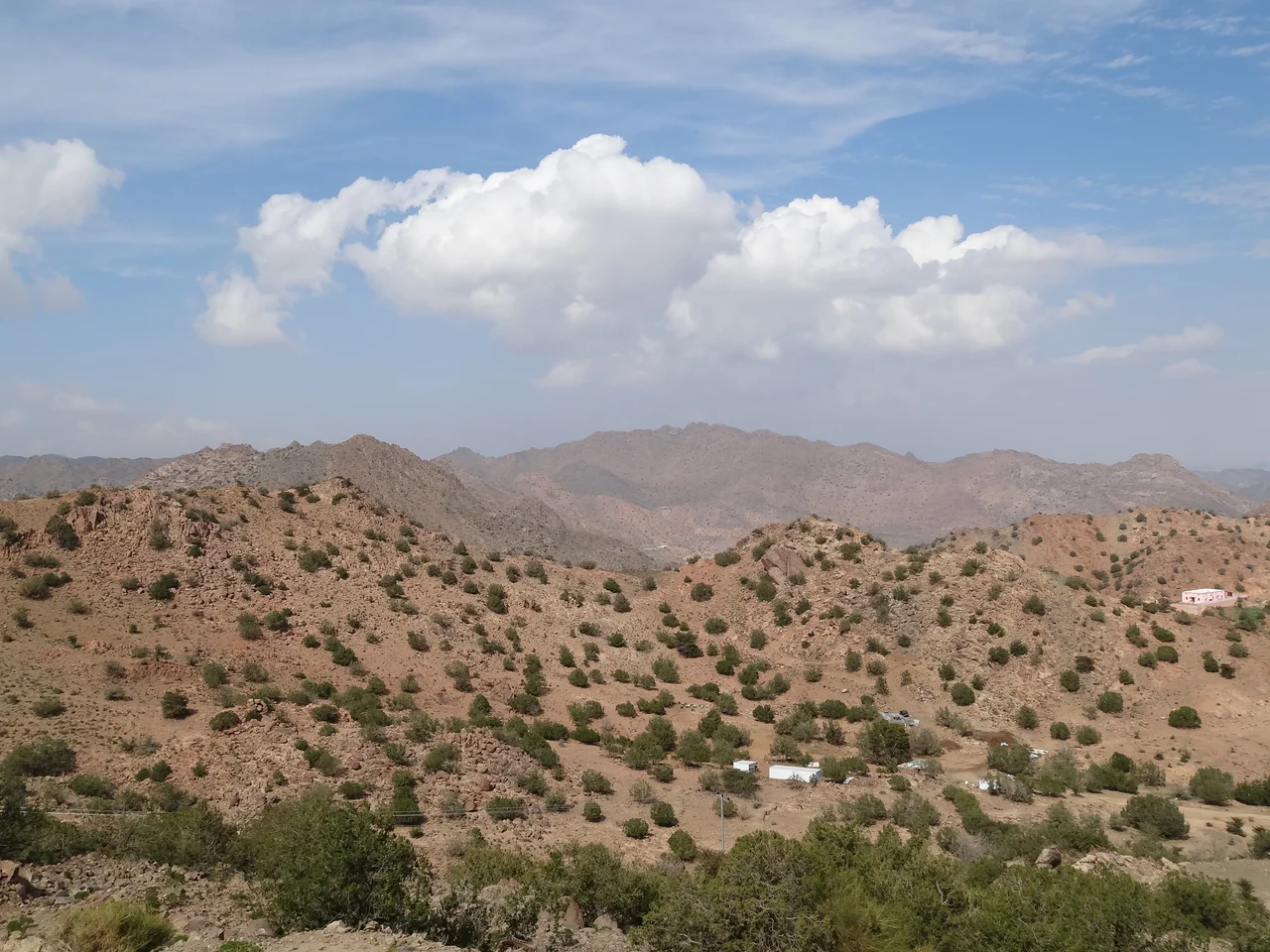
The name itself describes the land. Hejaz comes from an Arabic root meaning "to separate," and the region does exactly that, a long spine of mountains and coast dividing the high inland plateau of the Najd from the Red Sea. But geography is the least of what makes this stretch of western Arabia matter. Within it stand Mecca and Medina, the two holiest cities in Islam, and from its towns and tribes came the faith that would spread across continents. To travel the Hejaz is to move through the birthplace of a religion followed by nearly two billion people, across ground where the sacred and the historical have been braided together for fourteen centuries.
The Holy Heart
Mecca is the spiritual center of Islam, the city Muslims face in prayer five times a day and the destination of the Hajj, the great pilgrimage that every able Muslim aspires to make. According to Islamic tradition the prophet Muhammad was born here, in a city held to have been founded by Abraham, Hagar, and their son Ishmael. Medina, to the north, is the second holiest city, the place to which Muhammad migrated and where he is buried beneath the Green Dome of the Prophet's Mosque. Around these two cities the early Muslim community took shape, and from the Hejaz the faith carried outward through the Rashidun, Umayyad, and Abbasid caliphates. For the people of this region, that connection to the holy places remains the deepest source of identity.
Layers Beneath the Sand
Long before Islam, the Hejaz was already old. The Nabataeans carved their southern city of Hegra here, a place the Qur'an associates with the vanished people of Thamud. The Midianites of the Bible are placed in this land, in the area around modern Tabuk. There are even fainter traces: a river system, dried out for thousands of years, that once flowed northeast toward the Persian Gulf when the climate was wetter, around 2500 to 3000 BC. The region's geology is dramatic in its own right. The Hejaz lies along the Red Sea Rift, and Saudi Arabia counts more than two thousand dormant volcanoes; the dark lava fields here, called harrat, form one of the largest expanses of alkali basalt on Earth.
The Iron Road to Medina
In the early twentieth century the Ottoman Empire drove a railway south through the Hejaz, aiming to link Damascus to Medina and ease the long, dangerous pilgrim journey. The Hejaz Railway was an extraordinary feat for its time, and it carried enormous symbolic weight as a connection between the Ottoman capital and Islam's holiest ground. It also became a target. When war came, the rails that bound the empire together turned into its vulnerability, a single thin line of supply stretched across hundreds of kilometers of desert that could be cut almost anywhere.
Revolt in the Desert
In 1916, Sharif Hussein bin Ali of the Hashemite family, custodian of Mecca, launched the Arab Revolt against Ottoman rule. His son Faisal led fighters in the field, joined by the British officer T. E. Lawrence, later known as Lawrence of Arabia. Their strategy turned on mobility and the railway: Arab raiders struck the Hejaz line again and again, eventually derailing or destroying more than seventy trains and pinning down thousands of Ottoman troops forced to guard and repair the tracks. The revolt helped end Ottoman control of Arabia. Its political aftermath was tangled and often bitter, as wartime promises collided with imperial ambitions, but the Hejaz had become, briefly, an independent kingdom under Hussein.
Becoming Saudi Arabia
The independent Kingdom of Hejaz did not last long. After a series of wars with the rising house of Saud, Sharif Hussein surrendered in December 1925, ending both his kingdom and the centuries-old Sharifate of Mecca. For a few years the Hejaz and the inland Najd were ruled together as a dual kingdom, until on 23 September 1932 they were unified and renamed the Kingdom of Saudi Arabia, a day still marked as Saudi National Day. Today the Hejaz is the kingdom's most populous region, home to the busy port of Jeddah and to Hejazis who, shaped by centuries of pilgrims and empires passing through, often see themselves as the most cosmopolitan people in Arabia.
From the Air
The Hejaz spans the western edge of Saudi Arabia along the Red Sea; the regional reference point used here is roughly 23.5°N, 40.9°E, inland of the coast. Major airports include Jeddah's King Abdulaziz International (ICAO: OEJN / IATA: JED), Medina's Prince Mohammad bin Abdulaziz International (ICAO: OEMA / IATA: MED), and Tabuk's Prince Sultan bin Abdulaziz Airport (ICAO: OETB) in the north. Note that Mecca and Medina, and the airspace around them, are restricted to Muslims on the ground. From the air the Hejaz is defined by the Sarawat mountains running parallel to the Red Sea coast, the dark volcanic harrat lava fields inland, and the sharp line where green coastal plain meets desert. Best viewed in clear conditions; the coastal escarpment and lava fields are striking from cruising altitude.
Nearby Stories
- Quba Mosque 114 km away
- Al-Baqi Cemetery 139 km away
- Ghadir Khumm 145 km away
- Prophet's Mosque 159 km away
- Siege of Ta'if 222 km away
- Najd 223 km away
- Battle of Turubah 226 km away
- Al-Baha Province 386 km away