and_Akil_bin_abi_Talib.jpg)
Al-Baqi Cemetery
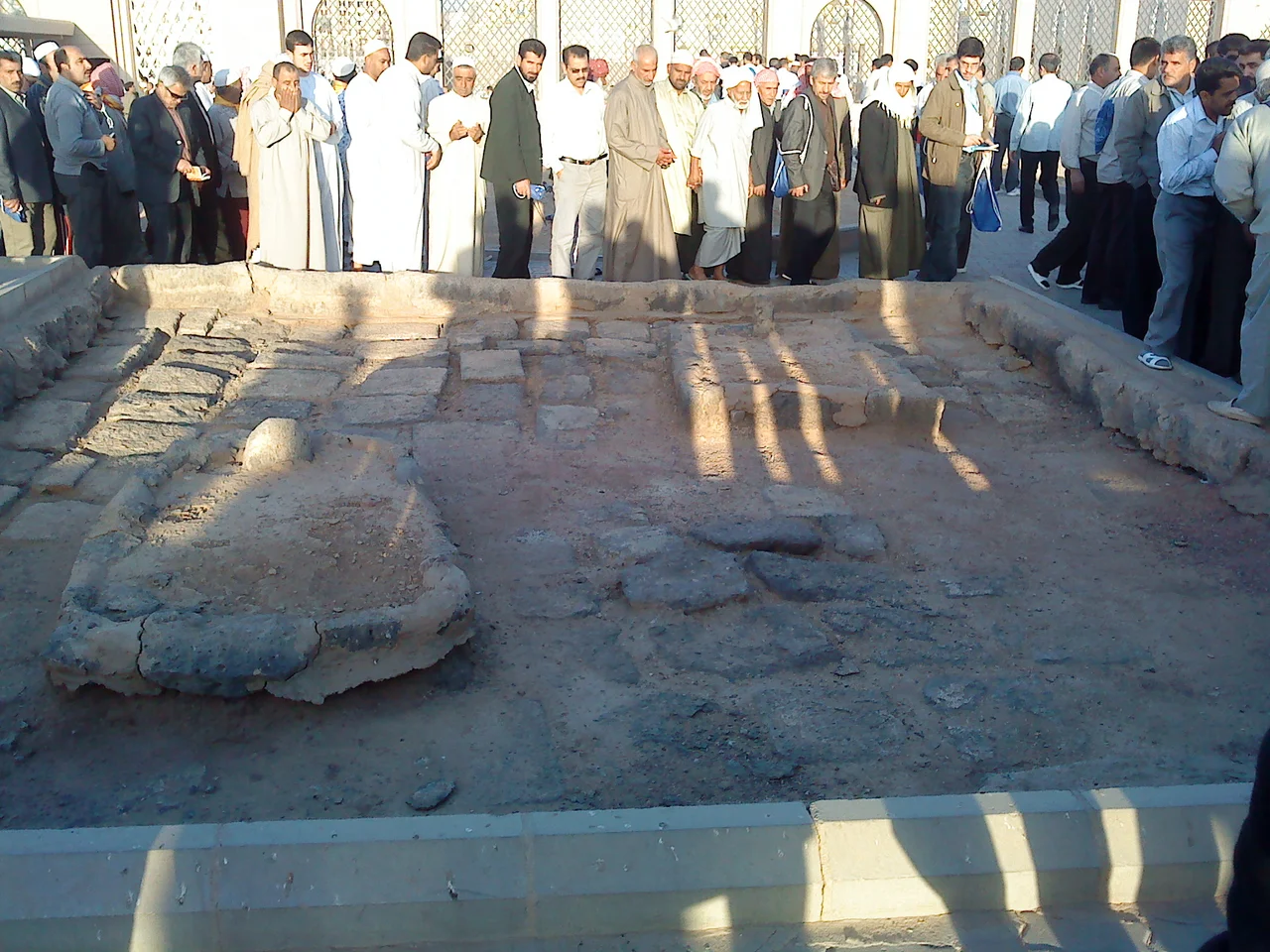
Step out the eastern gate of the Prophet's Mosque, and you arrive at one of the most beloved patches of ground in all of Islam. Jannat al-Baqi, the "Garden of Heaven," is a wide field of pale earth where, by tradition, some ten thousand of the earliest Muslims lie buried. There are almost no headstones here, no domes, no inscriptions to mark who rests where. Yet for fourteen centuries pilgrims have come to stand at its edge in the soft Medinan light, lift their hands, and greet the dead by name: the daughters of the Prophet, his infant son, his wives, and the companions who carried his message into the world.
The First to Be Laid to Rest
The cemetery's history begins with grief. As Muhammad and his followers built the Prophet's Mosque after the migration from Mecca in 622, one of his companions, As'ad ibn Zurarah, fell ill and died. Muhammad chose this nearby ground for his burial, and As'ad became the first of the Ansar, the people of Medina who had welcomed the new community, to be interred at al-Baqi. Soon others followed. While Muhammad was away at the Battle of Badr in 624, his daughter Ruqayyah died of fever and was buried here, the first member of his own household to rest in the cemetery. The field is named Baqi al-Gharqad, after the boxthorn shrubs that once grew across this stretch of Medina, their thorned branches the only canopy over the graves.
A Field of Names
Walk the perimeter and the litany of those buried within reaches back to the founding generation of a world religion. Here lie three of the Prophet's daughters and his small son Ibrahim, who died in infancy. Here too rest most of his wives, the Mothers of the Believers, among them Aisha and Hafsa. The companions gathered nearby read like a roll call of early Islam: Uthman ibn Affan, the third caliph; Abd al-Rahman ibn Awf, a wealthy merchant who gave much of his fortune away; Abu Hurayra, who preserved more sayings of the Prophet than almost any other. For Shia Muslims, al-Baqi is holier still, for four of their revered Imams are believed to lie within the family enclosure: Hasan ibn Ali, Ali Zayn al-Abidin, Muhammad al-Baqir, and Ja'far al-Sadiq.
The Domes That Once Stood
For most of its long history, al-Baqi did not look as it does now. Over the centuries the Umayyads, Mamluks, and Ottomans raised domes and shrines above the most honored graves, and travelers described a skyline of cupolas rising over the family of the Prophet. That skyline is gone. The structures were demolished in 1806, rebuilt, and then leveled again in 1925-26, when the cemetery's domes and even its simplest gravestones were removed in keeping with a strict reading of Islamic law that holds the veneration of tombs to be a danger to the worship of God alone. The decision divided Muslims then and divides them still. For many Sunni and Salafi believers it restored an austere purity; for many Shia, the loss remains a deep and continuing sorrow, marked each year as Yaum-e Gham, the "Day of Sorrow."
Standing at the Edge
Today al-Baqi is an open expanse enclosed by a low wall, its surface a sea of small unmarked mounds. Pilgrims are not permitted to walk among the graves but gather at the western fence to recite greetings and prayers for the dead, a practice rooted in reports that the Prophet himself came here to do the same. There is a particular stillness to the place, the kind that settles over ground where the famous and the forgotten lie side by side under identical earth. Whatever one believes about the domes that once stood, al-Baqi endures as it began: a quiet field beside the mosque, holding the first generation of a faith that now spans the globe.
From the Air
Jannat al-Baqi lies at 24.467 degrees north, 39.616 degrees east, immediately east of the Prophet's Mosque in central Medina. Out of respect, this is best appreciated from a distance or from altitude, since non-Muslims may not enter the sacred central district. From the air the cemetery reads as a large rectangular open field of pale ground walled off within the dense city fabric, set against the green-roofed mass of al-Masjid an-Nabawi just to the west. The nearest airport is Prince Mohammad bin Abdulaziz International Airport (ICAO OEMA), about 15 km northeast; the wider Hejaz region is served by Jeddah's King Abdulaziz International (OEJN) roughly 350 km southwest. Clear desert skies and the distinctive marble plazas around the mosque make the district easy to identify by day.
Nearby Stories
- Battle of Badr 64 km away
- Khaybar 105 km away
- Hejaz 116 km away
- Mahd Al-Dhahab 138 km away
- Ghadir Khumm 167 km away
- Al-Ula 231 km away
- Hegra 277 km away
- Rock Art of Hail Province 367 km away