
Rock Art of Hail Province
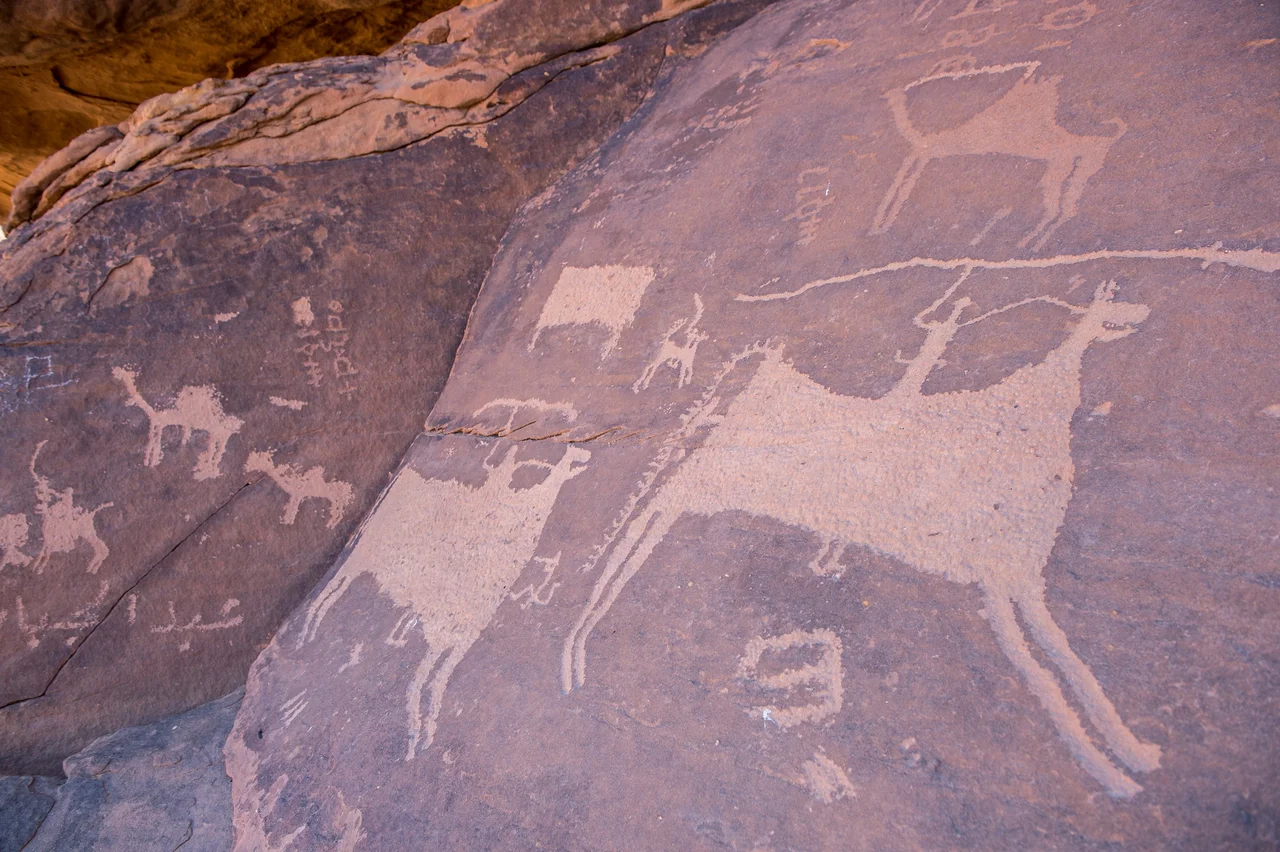
A figure stands carved into the sandstone at the foot of a hill called Umm Sinman, arm raised, surrounded by the animals of a country that no longer exists. There are cattle here, and ibex, and big cats that have not prowled this land for millennia. The people who pecked these images into the rock were watching a real landscape: a freshwater lake spread below the hill, and the desert that now stretches in every direction was once green enough to support all of it. Across two sites in the Hail Province of northern Saudi Arabia, at Jubbah and at Shuwaymis, the rock carries roughly ten thousand years of that human story, an open-air archive scratched into stone.
Two Galleries in the Sandstone
The World Heritage listing covers two clusters of outcrops about 160 kilometers apart. The first, Jabal Umm Sinman, rises beside the town of Jubbah roughly 90 kilometers northwest of the city of Hail, its panels and inscriptions numbering in the many thousands. The second, the rocks of Jabal al-Manjor and Jabal Raat at Shuwaymis, lies some 250 kilometers south of Hail and holds even more, so dense that parts of the surrounding area remain unsurveyed. Together they form the richest concentration of rock art in Saudi Arabia and one of the most significant in the world. In 2015 UNESCO inscribed them as the kingdom's fourth World Heritage Site, recognizing carvings made over millennia with nothing more than simple stone hammers.
When the Desert Was Green
The oldest carvings reach back to a time when this corner of Arabia ran with water. During the early Holocene, lakes and flowing wadis turned the region into a mosaic of grassland and wooded valleys, rich enough to support large grazing herds and the predators that hunted them. The artists drew what they saw and what they pursued: hunting scenes crowded with prey, the weapons and tactics of the chase, and at least four kinds of large carnivore moving through a world thick with game. This is not imagined wilderness but reportage, a record of an environment scientists can read like a chronicle. The art tracks the land itself as the climate shifted and the green slowly drained away.
The Coming of the Camel
As the wet phase ended and the lakes shrank, the carvings changed with the country. Around three thousand years ago, with water growing scarce, the camel became central to survival, and it began to dominate the rock, drawn again and again by the ancestors of the Bedouin who would inhabit this desert. Alongside the animals appear lines of early script, Thamudic and later Arabic, names and messages left by passing travelers and herders. The newest carvings sit beside the oldest on the same weathered faces, layer upon layer, so that a single panel can span thousands of years of changing life. To read the stone is to watch a way of living transform under pressure, generation by generation.
Faces in the Rock
What lingers most at Jubbah and Shuwaymis is how human it all feels. These were not anonymous marks but the work of specific hands: hunters proud of a kill, herders proud of their cattle, families and clans announcing that they had passed this way. The large human figures, some life-size, carry headdresses and ornaments and stand with a presence that survives the erosion of ten thousand years. The Saudi authorities have worked to protect the sites since the UNESCO listing, widening buffer zones and monitoring the fragile surfaces. The people who made this art left no buildings and no graves we can name, but they left their world drawn plainly on the desert's walls, and through it they are still speaking.
From the Air
The two components lie in northern Saudi Arabia near 28.00°N, 40.90°E, with Jubbah northwest of Hail and Shuwaymis well to the south. The sandstone outcrops of Umm Sinman and the Shuwaymis jebels rise as isolated dark masses from pale desert, visible from altitude as abrupt rock islands in flat terrain. The natural gateway is Hail International Airport (OEHL / HAS), at about 1,015 m elevation, roughly 90 km southeast of Jubbah. Desert visibility is typically excellent, with occasional reduction during seasonal dust events; the low sun of early morning and late afternoon throws the rock formations into sharp relief.
Nearby Stories
- Tayma 186 km away
- Al Naslaa 204 km away
- Mustatil 261 km away
- Najd 441 km away
- Wadi Rum 508 km away
- Eridu 518 km away
- Battle of 73 Easting 528 km away
- Ancient Mesopotamia 563 km away