
Tayma
Around 552 BC, the most powerful man in Mesopotamia did something his subjects could not fathom: he left. Nabonidus, last king of the Neo-Babylonian Empire, handed the day-to-day rule of Babylon to his son Belshazzar, gathered an army, and marched south into the Arabian desert. He stopped at Tayma, an oasis on the caravan roads, and there he stayed for roughly ten years. A king who could command the great city of Marduk chose instead to live among the date palms and wells of a remote trading town. Babylonian scribes were baffled and resentful. Modern historians are still arguing about why. But the bare fact remains carved into the record: an emperor walked away from the center of the world to dwell here, in Tayma.
The Oasis That Mattered
Tayma earned its importance the way every desert settlement does, by having water. The oasis sat at the edge of the Nafud sands, exactly where the caravan route from Medina toward the northeast began its crossing of the desert. Travelers and their camels needed to drink before and after that ordeal, and Tayma was where they did it. The town grew rich and proud on this traffic, trading in dates, in rock salt that it shipped across Arabia, and in alum used to tend the camels themselves. Its reputation reached the great empires to the north. Assyrian kings recorded tribute from Tayma; one of them, Sennacherib, named a gate of Nineveh the Desert Gate, noting that the gifts of the Teymeite passed through it.
A Name in Ancient Mouths
Few small towns are mentioned by so many ancient civilizations. Tayma appears in Neo-Babylonian inscriptions as far back as the eighth century BC. It surfaces in the Hebrew Bible as Tema, named for one of the sons of Ishmael, and the prophet Jeremiah pronounced against it. For a time it was governed by an Arab dynasty whose queens, Samsi and Zabibe, are recorded by name, a striking detail from an age when women rulers rarely entered the written record. The oasis was a meeting point not just of trade routes but of languages and peoples, leaving inscriptions in Aramaic, Taymanitic, Thamudic, and Nabataean scattered through its ruins.
Why a King Came
Nabonidus left no simple explanation, so historians have offered several. He was devoted to the moon god Sin, whom he tried to elevate above Babylon's chief deity Marduk, antagonizing the powerful priesthood; Tayma may have been a refuge for that devotion. The oasis also commanded lucrative Arabian trade, a prize worth ruling directly. Some suspect a quieter political exile. Whatever the reason, his long residence left a mark. A basalt stele found in the region carries a 26-line cuneiform inscription, the longest such text discovered in Saudi Arabia, showing the king beneath the symbols of the crescent moon, the sun, and a serpent.
What the Desert Kept
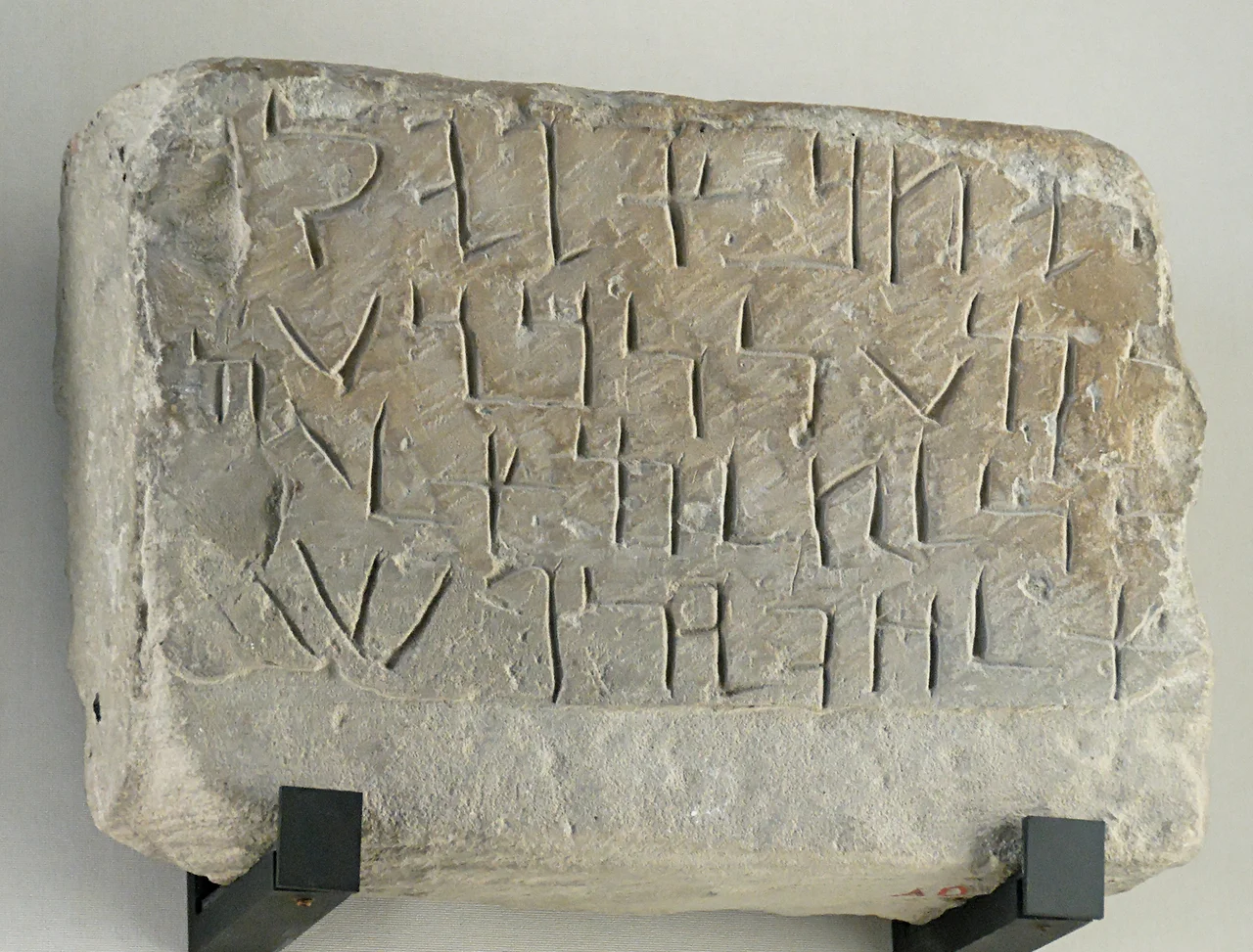
Tayma still wears its age openly. At the heart of the oasis is Bir Haddaj, a great well thought to be some 2,500 years old, around which the town's life has always turned. A massive perimeter wall, raised in the sixth century BC, once guarded three sides of the old city. Palaces named in local memory, qasrs built by warrior-poets and merchant families, dot the site. Much of Tayma's most precious testimony has scattered to distant museums; the famous Tayma stele, a dedication to the god Salm carved in Aramaic, now rests in the Louvre in Paris. Archaeologists from the German Archaeological Institute continue to dig here, still pulling the deep history of this oasis out of the sand.
From the Air
Tayma sits at 27.63°N, 38.55°E in Tabuk Province, northwest Saudi Arabia, on the western fringe of the Nafud desert. The nearest major airport is Tabuk's Prince Sultan bin Abdulaziz Airport (ICAO: OETB / IATA: TUU) to the northwest; Al-Ula International (ICAO: OEAO) lies to the south. From the air the oasis reads as an unmistakable patch of green cultivation and date groves against the surrounding pale sands, with the old town's archaeological mounds and perimeter wall nearby. The freestanding Al Naslaa rock lies roughly 50 km to the south. Best viewed in clear winter conditions; recommended viewing altitude 3,000-6,000 feet AGL to take in the contrast between the watered oasis and the encircling desert.
Nearby Stories
- Al Naslaa 23 km away
- Hegra 68 km away
- Al-Ula 120 km away
- Mustatil 175 km away
- Rock Art of Hail Province 184 km away
- Battle of Khaybar 223 km away
- Neom 272 km away
- Wadi Rum 350 km away