
Neom
The renderings looked like science fiction: two mirrored walls a hundred stories tall, running in a perfectly straight line across the desert for a hundred and ten miles, a city of nine million with no cars and no streets. Saudi Arabia called it The Line, the centerpiece of a megaproject named Neom on the empty coast where the Red Sea meets the Gulf of Aqaba. It was meant to be the boldest urban experiment ever attempted. By 2026, after a written-down fortune and years of delays, the reality on the ground was 2.4 kilometers of foundations, mostly bare sand, and a story far more complicated, and far more human, than any animation had promised.
A City the Size of a Country
Neom is vast even on paper: a planned zone of 26,500 square kilometers, larger than many nations, launched in 2017 by Crown Prince Mohammed bin Salman as the showpiece of Saudi Vision 2030, the kingdom's plan to wean its economy off oil. The ambitions were staggering. A floating industrial complex called Oxagon. A mountain ski resort, Trojena, in a desert. A luxury island, Sindalah, whose grand opening party in 2024 came three years late and at three times its budget. Robots were to handle security and deliveries; the whole region would run on wind and sun. Experts were skeptical from the start, and the skepticism proved warranted. An internal audit, reported in 2025, found executives had leaned on unrealistically rosy assumptions, and the document described evidence of deliberate manipulation of the project's finances.
The People Who Were Already There
The coast Neom claimed was not empty. For centuries it had been home to the Howeitat, a Bedouin tribe whose villages, herds, and ancestral ground lay squarely in the project's path. Around twenty thousand people were slated for forced relocation, and villages were razed. The tribe said plainly that they did not oppose the city itself; what they refused was eviction without fair process and the violence that came with it. In April 2020, a Howeitat man named Abdul Rahim al-Huwaiti posted videos online declaring he would defy the eviction orders from his home in al-Khuraybah. He predicted, accurately, that the authorities would try to discredit him. Days later, Saudi security forces shot and killed him; officials said he had opened fire on them, an account his relatives disputed, noting he owned no weapons. He was one man with a phone, standing on his own land.
The Cost of the Dream
Al-Huwaiti's death was not the end of the matter. In October 2022, a Saudi court sentenced three members of the Howeitat tribe to death for resisting displacement, among them Shadli al-Huwaiti, Abdul Rahim's brother. United Nations experts publicly raised the alarm over the executions linked to the project. The human cost extended to those who built it, too. Migrant laborers from Bangladesh, India, and Nepal described sixteen-hour days in heat reaching fifty degrees Celsius, and human rights investigators documented deaths officially logged as natural causes that had in fact begun with workers collapsing on the job. These are not abstractions or line items in a budget. They were families who lost a father, a brother, a son, on a construction site or in a courtroom, in the shadow of a city that, for now, exists mostly as a promise.
Mirage on the Gulf
What stands at Neom today is a study in the distance between vision and ground truth. The Line, once a hundred and ten miles, was quietly trimmed toward a couple of kilometers, its projected population cut from millions to fewer than three hundred thousand. In September 2025, the kingdom's sovereign wealth fund suspended construction on it. Sindalah held its party but stayed shut to visitors. Architects and advisers who once lent their names to the project distanced themselves. And yet the desert and sea here remain genuinely spectacular, the same dramatic mountains and coral coast that drew planners in the first place. Whether Neom becomes a city or a cautionary tale, it has already left a permanent mark on this stretch of Arabia, and on the people who called it home before the renderings arrived.
From the Air
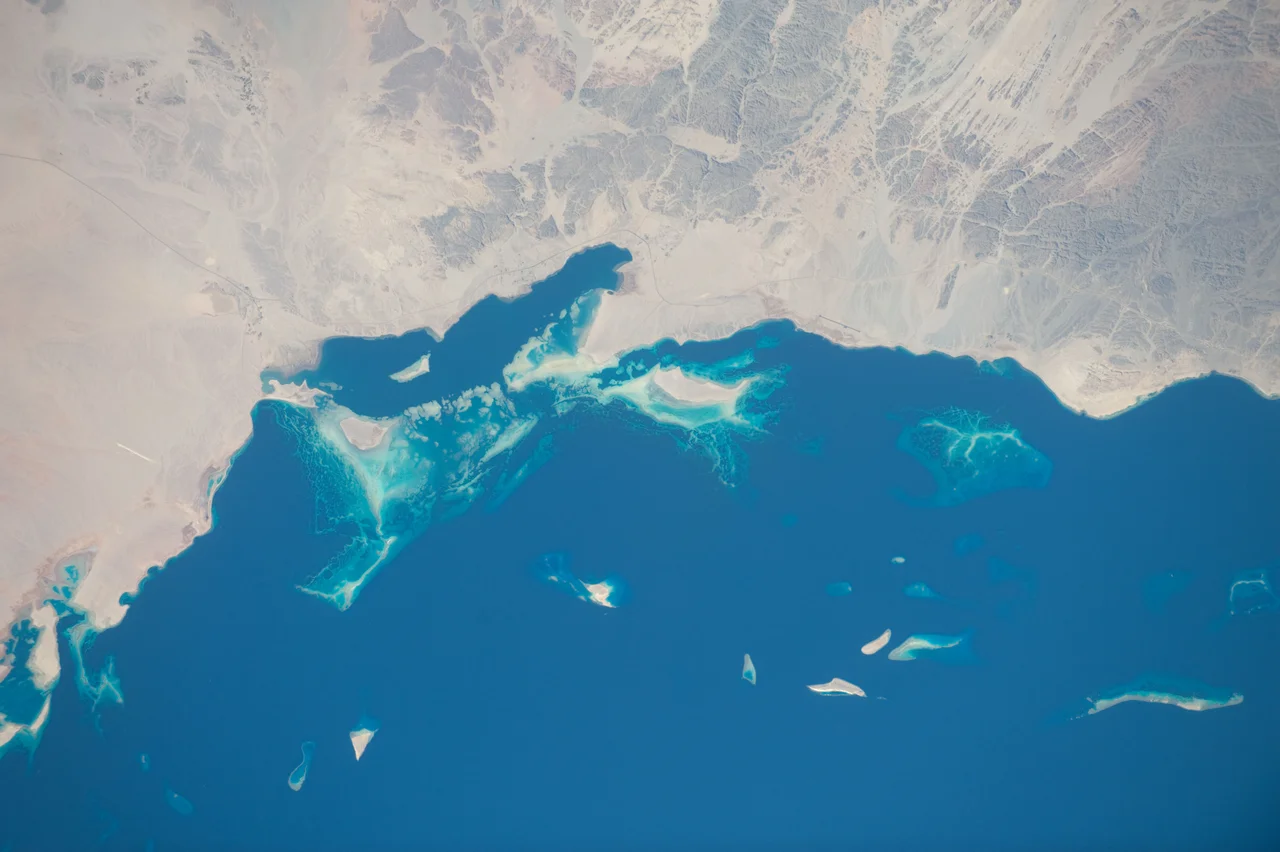
Neom occupies the far northwestern corner of Saudi Arabia around 28.0 degrees N, 35.2 degrees E, on the eastern shore of the Gulf of Aqaba directly across the water from the Sinai Peninsula and just south of Jordan. From the air the site is identifiable by the abrupt meeting of the Sarawat mountains and the deep-blue gulf, with construction scars and graded earthworks visible along the coastal plain. Neom Bay Airport (IATA NUM) near Sharma serves the development; Tabuk Regional Airport (ICAO OETB) lies to the southeast, and Sharm El Sheikh International (ICAO HESH) sits across the gulf to the west. The skies over this desert coast are usually clear, and the linear grading of The Line's footprint is the most distinctive man-made feature on the landscape.
Nearby Stories
- Tiran Island 25 km away
- Ras Muhammad National Park 59 km away
- Saint Catherine's Monastery 86 km away
- Wadi Rum 142 km away
- Hurghada 161 km away
- Hegra 232 km away
- Al-Ula 258 km away
- Amman 405 km away