.jpg)
Al-Ula
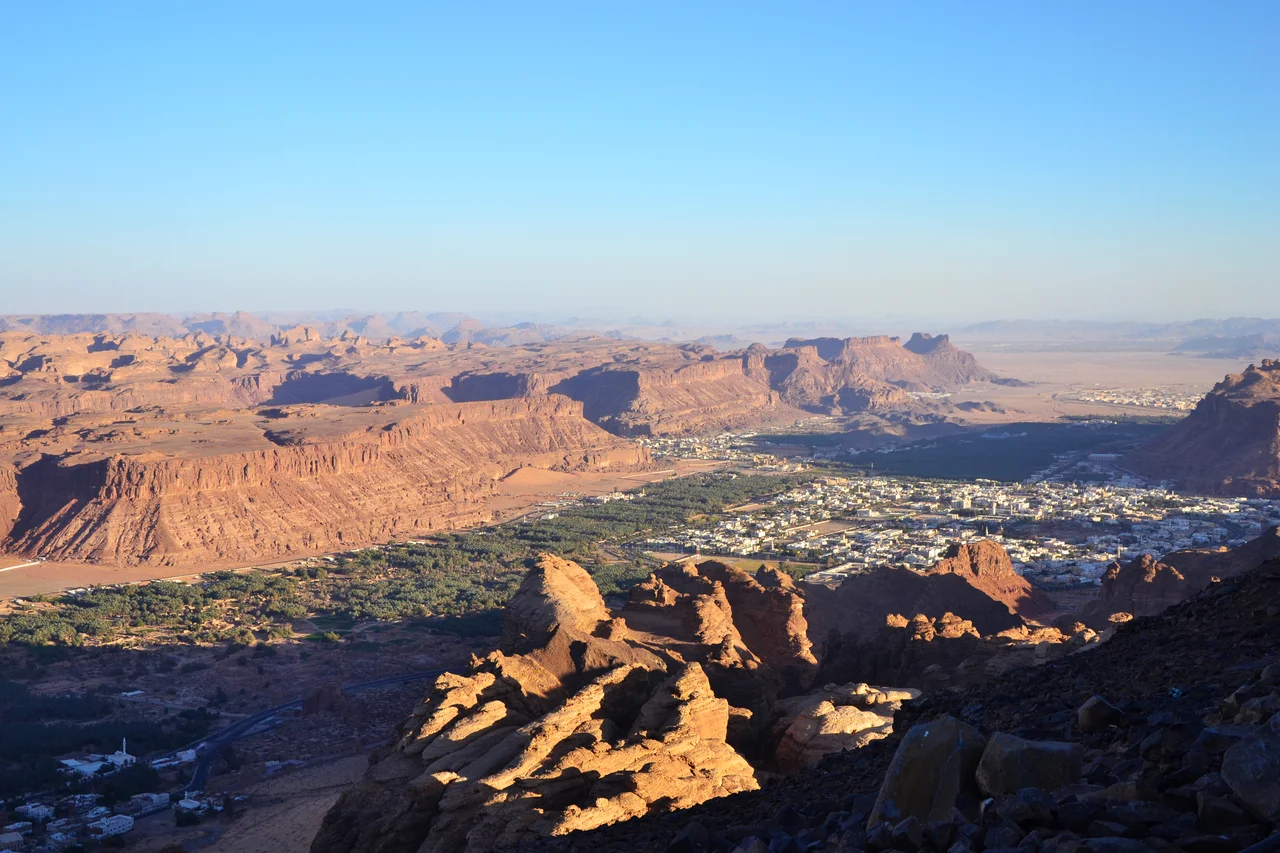
Drive into the valley and the walls close in, sheer sandstone cliffs the color of rust and honey, rising hundreds of feet on either side. Then the floor turns green. A river of date palms runs down the middle of the canyon, fed by springs that have never failed, and you understand in an instant why people have stopped here for seven thousand years. AlUla is one of the oldest continuously settled oases in Arabia, a place where the caravans of the ancient incense road paused to water their camels, and where the kingdoms that grew rich on that trade left their names carved into the rock. Few landscapes anywhere fold so much deep time into so dramatic a setting.
The Labyrinth of Mud and Stone
At the valley's heart stands AlUla Old Town, known locally as al-Dirah, a dense warren of mudbrick and stone houses packed shoulder to shoulder beside the palm grove. Built up from the thirteenth century, its builders quarried the past for materials, reusing stones from the ancient Dedanite and Lihyanite ruins nearby. For centuries families lived in its shaded, interlocking lanes, the rooftops forming a near-continuous surface that doubled as a defensive wall. Then, within living memory, the town emptied. The last family is said to have left in 1983, and the final prayer in the old mosque was held in 1985, as residents moved to a modern town beside the ruins. To walk the old lanes now is to move through a settlement abandoned not in antiquity but yesterday, its doorways and stairwells still recognizably a place where people made their homes.
Kingdoms Written in the Cliffs
AlUla stands on the site of biblical Dedan, and it became the capital of the kingdoms of Dadan and then Lihyan, North Arabian powers that controlled the caravan trade between roughly the eighth and second centuries BCE. They carved sanctuaries into the cliffs and raised colossal stone statues of their kings. After them came the Nabataeans, the same desert traders who built Petra in Jordan, who held the region until Rome annexed it in 106 CE. Their masterwork lies just north of the city: Hegra, also called Mada'in Salih, Saudi Arabia's first UNESCO World Heritage Site, where more than a hundred tombs with elaborate facades stand cut into freestanding sandstone outcrops. Petra's quieter sister, untouched for centuries, Hegra makes the abstraction of ancient Arabia suddenly, breathtakingly concrete.
The Open-Air Library
Tucked into a narrow gorge near AlUla is Jabal Ikmah, a canyon wall so thick with ancient writing that scholars call it an open-air library. Nearly three hundred inscriptions cover the rock, scratched and carved by travelers, pilgrims, and traders over more than two thousand years. They are written in the scripts and languages that crossed this oasis, Dadanitic, Thamudic, Minaic, Aramaic, the very letters that document how the Arabic language took shape. In 2023, UNESCO added Jabal Ikmah to its Memory of the World register. Across the wider valley the cliffs carry still older marks: petroglyphs of ibex, camels, horses, and hunting scenes pecked into the stone by people who passed through millennia ago, turning the canyon walls into one of the richest galleries of rock art in the kingdom.
An Oasis Reawakened
For most of the twentieth century AlUla was a quiet farming town that few outsiders ever saw. That has changed fast. In 2017 Saudi Arabia created the Royal Commission for AlUla to develop the valley as a global destination, signing a ten-year cultural partnership with France and training hundreds of young locals as guides, conservators, and hosts. The mirror-clad Maraya concert hall rose in the desert nearby, its walls covered in 9,740 square meters of reflective glass, earning a Guinness World Record as the largest mirrored building on Earth and hosting performers from Andrea Bocelli to Lionel Richie. Elephant Rock, a wind-sculpted sandstone arch, has become an icon. The challenge the commission has set itself is a delicate one: to open this fragile valley to two million visitors a year while keeping intact the very silence, scale, and antiquity that make it worth the journey.
From the Air
AlUla lies at roughly 26.61 degrees N, 37.92 degrees E in Medina Province, about 350 km northwest of Medina, set in a north-south sandstone valley in the Hejaz. From the air the signature feature is the abrupt green ribbon of the palm-filled oasis threading between bare red cliffs and open desert, with the tombs of Hegra visible as isolated rock outcrops to the north. AlUla International Airport (Prince Abdul Majeed bin Abdulaziz, ICAO OEAO, IATA ULH) sits just southwest of the city and now handles international flights; Medina's Prince Mohammad bin Abdulaziz International (ICAO OEMA) is the nearest large hub to the south. Skies are typically clear and dry, and low-angle morning or evening light dramatically deepens the color and shadow of the canyon walls.
Nearby Stories
- Al Naslaa 45 km away
- Tayma 110 km away
- Mustatil 120 km away
- Battle of Khaybar 142 km away
- Khaybar 167 km away
- Neom 238 km away
- Tiran Island 305 km away
- Wadi El Gemal National Park 316 km away