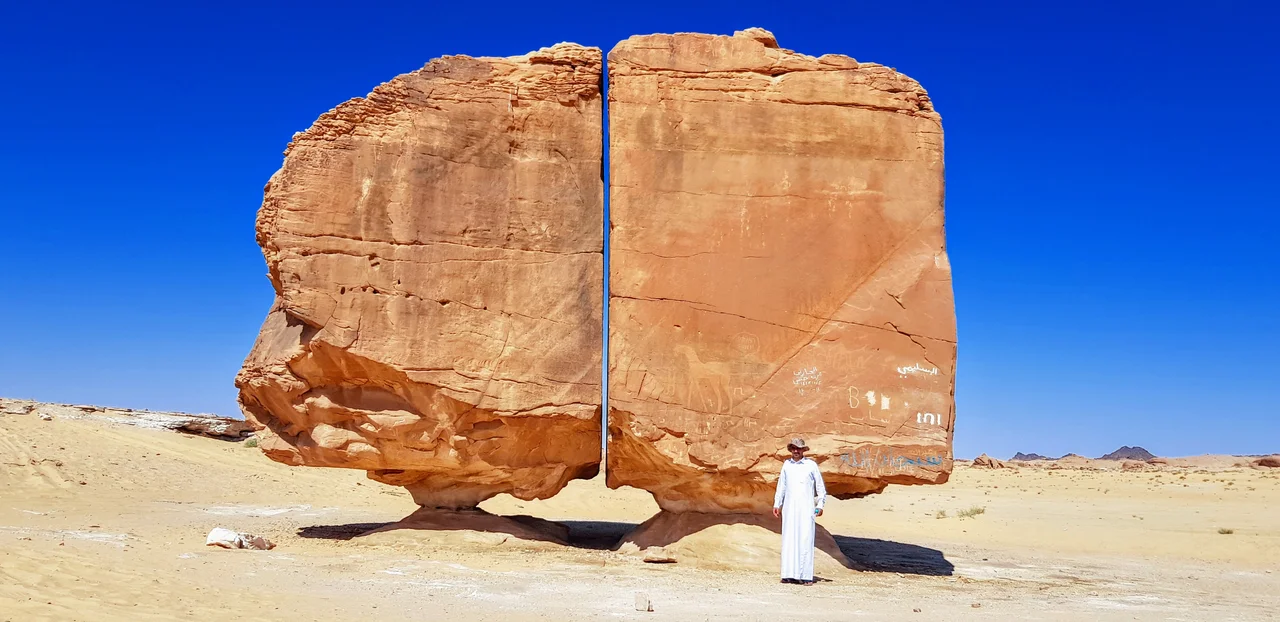

Al Naslaa
The gap is what stops people. A boulder the size of a small house stands balanced on the desert floor south of Tayma, and straight through its center runs a fissure so narrow, so vertical, so improbably clean that the two halves look like they were sliced apart with a single blade. No saw marks. No rubble. Just a perfect dark seam dividing six meters of sandstone into two leaning slabs, each perched on its own slender pedestal. Photographs of Al Naslaa have circled the internet for years, usually wrapped in breathless captions about lasers and ancient astronauts. The rock deserves better than that. Its real story is stranger in a quieter way, a tale of stress, time, and the patient violence of wind.
Just a Joint
Geologists have a plain word for the split: a joint. Rock fractures all the time. As sandstone is buried, uplifted, heated, and cooled over geological ages, internal stresses build until the stone simply cracks along a plane of weakness. Often these fractures run remarkably straight, because they follow the path of least resistance through the rock's structure. One leading idea is that Al Naslaa sits along an old line of tectonic stress, and the boulder parted at that weak point as the ground beneath it shifted. The fracture isn't unique. What is unusual is how cleanly it has been exposed and preserved, standing free in the open rather than buried in a cliff face.
Carved by Wind
Once the rock had cracked, the desert went to work on it. The narrow gap acted like a funnel, channeling wind laden with fine sand straight through the opening. Decade after decade, century after century, those abrasive grains sandblasted both inner faces smooth, widening and polishing the seam. Erosion shaped the rest of the boulder too: wind scoured the exposed surfaces while chemical weathering, helped by moisture trapped in the cooler, shaded underside, slowly undercut the base. That undercutting is why each half balances on a pedestal, like a mushroom of stone. The smoothness that looks so artificial is exactly what relentless natural abrasion produces, given enough time and a steady supply of sand.
Older Hands
The boulder is not only a geological curiosity. Its southeastern face is covered in petroglyphs, images pecked into the stone by people who passed this way thousands of years ago. They left figures of animals and human forms, the kind of rock art scattered throughout northwest Arabia near ancient oases and caravan routes. These carvers were not splitting the rock or shaping it; they were marking it, the way travelers everywhere have always left their presence on prominent landmarks. To them Al Naslaa was probably already old and already strange, a natural monument worth claiming, long before anyone dreamed up lasers to explain it.
The Pull of Mystery
Why do the alien theories persist when the geology is well understood? Partly because the rock genuinely looks engineered, and the human eye reads straight lines as intentional. Partly because mystery travels faster than explanation; "nobody knows how this happened" makes a better caption than "differential erosion along a tectonic joint." There is no shame in being fooled by Al Naslaa at first glance, because it really is astonishing. The deeper pleasure is learning that nature, given a fracture and a few thousand years of wind, can produce something that outdoes our wildest theories about who might have built it.
From the Air
Al Naslaa lies at 27.23°N, 38.57°E, about 50 km south of the Tayma oasis in Tabuk Province, northwest Saudi Arabia, in the western Nafud desert. The nearest sizeable airport is Tabuk's Prince Sultan bin Abdulaziz Airport (ICAO: OETB / IATA: TUU), well to the northwest; Al-Ula International (ICAO: OEAO) lies to the south. The rock itself is small (about 6 m tall, 9 m wide) and not a feature you would pick out from cruising altitude, but the surrounding terrain of pale sand sheets and scattered sandstone outcrops is distinctive. Reach it by ground vehicle; the site sits in open desert. Clear, low-sun conditions in early morning or late afternoon best reveal the famous fissure and the petroglyph-covered face.
Nearby Stories
- Hegra 9.2 km away
- Tayma 23 km away
- Al-Ula 61 km away
- Mustatil 119 km away
- Battle of Khaybar 155 km away
- Khaybar 165 km away
- Rock Art of Hail Province 196 km away
- Neom 280 km away