.jpg)
Battle of Khaybar
In the spring of 628 CE, farmers walked out of the oasis of Khaybar at dawn with their spades and baskets, expecting an ordinary day in the date groves. Instead they saw an army. Word ran back through the palms, and the workers fled to their fortresses. The force that had appeared was small, perhaps fifteen hundred men, led by the Prophet Muhammad from Medina a hundred and fifty kilometers to the southeast. What followed over the next weeks would become one of the most consequential episodes of early Islam, a siege of stone strongholds amid the palms, decided in part by a single duel that Muslims have retold for fourteen centuries.
A Fortress Oasis
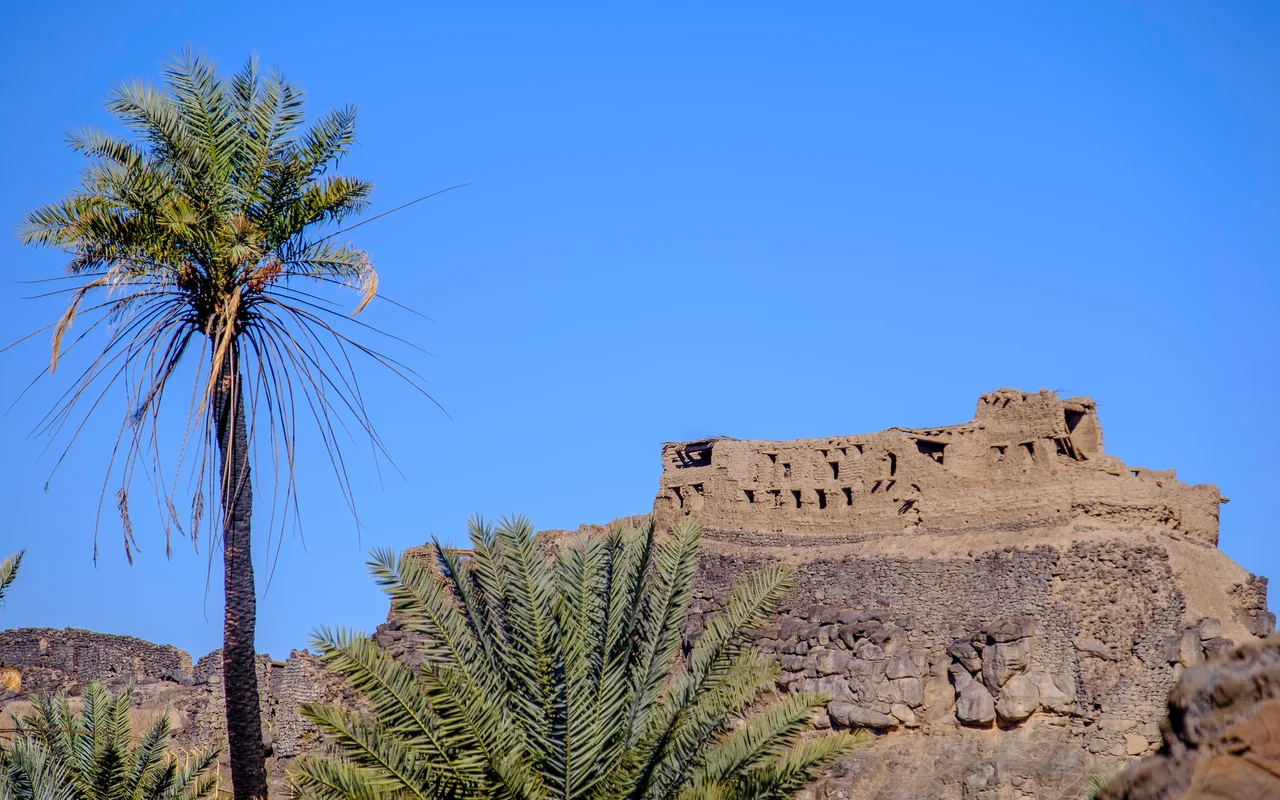
Khaybar in the seventh century was a prosperous Jewish settlement, its wealth built on dense date palms and a brisk trade in cloth, weapons, and luxury goods. It was not one town but a constellation of fortified redoubts scattered across the oasis, strongholds with names like al-Qamus, Na'im, and al-Watih, each defended by its own families. Among its people were the Banu Nadir, a Jewish tribe exiled from Medina a few years earlier who had settled here and, by the accounts that survive, worked to organize Arab tribes against the growing Muslim community. The fortresses held a siege-engine and stockpiles of arms. Whether kept for defense or for sale, they signaled a community that was wealthy, well-armed, and bracing for trouble.
The Banner Goes to Ali
The siege did not yield easily. The defenders, secure behind thick walls, kept to their fortresses and fought mostly with arrows at a distance, shifting people and treasure between strongholds under cover of darkness. The Muslims went hungry; supplies ran so short they were reduced to slaughtering captured donkeys. Two of Muhammad's most senior companions, Abu Bakr and then Umar, led assaults that failed. That night, the tradition holds, Muhammad declared that the next morning he would give the banner to a man who loved God and His Messenger, and whom God loved in return. The choice fell on Ali ibn Abi Talib, the Prophet's cousin and son-in-law, who had been laid up with an eye ailment. He took the flag and advanced on the fort, and the long stalemate finally broke.
The Duel at al-Qamus
At the gate of the citadel of al-Qamus, by the most famous account, Ali was met by Marhab, a Jewish champion renowned for his skill in battle. Marhab strode out chanting a boast of his own prowess, that Khaybar knew well he was a warrior tested, who thrust with the spear and struck with the sword. Ali answered, and in the exchange Marhab fell, killed by a single stroke. In one celebrated telling, Ali lost his shield in the fighting and tore a heavy door from the fortress to use in its place, a feat so prodigious that it became, for the Shi'a, the very image of the hero. Historians record the duel in different forms, but the core is consistent across the early sources: with Marhab's death, the defenders' resistance crumbled, and they sent word to negotiate.
Surrender and Aftermath
The terms ended the fighting. The people of Khaybar surrendered their wealth, and those who wished to remain were allowed to keep working their orchards in exchange for handing over half their produce to the Muslims, an arrangement that let the oasis go on much as before. The human costs were real and personal. Among the captives was Safiyya, a young woman of seventeen, daughter of the slain Nadir chief and widow of the oasis treasurer Kenana; Muhammad offered her freedom, and she chose to convert and marry him, becoming one of the Mothers of the Believers. The early chronicles also preserve darker episodes, including the killing of Kenana over hidden treasure and a Jewish woman's attempt to poison Muhammad in revenge for her kin, accounts that some later Muslim scholars themselves questioned. The victory swelled Muhammad's standing and his army, and within eighteen months he would enter Mecca. The Jews of Khaybar lived on at the oasis until the caliph Umar expelled them years later.
From the Air
The oasis of Khaybar lies at about 25.70 degrees N, 39.29 degrees E in Medina Province, roughly 150 km northwest of Medina in the Hejaz. From the air the setting is unmistakable: a band of green palm groves and old fortress mounds set against the black basalt expanse of the Harrat Khaybar lava field, a stark dark-and-light landscape unlike the surrounding pale desert. The nearest major airport is Medina's Prince Mohammad bin Abdulaziz International (ICAO OEMA) to the southeast; AlUla International (ICAO OEAO) lies to the northwest. The dry desert air usually gives excellent visibility, and the contrast between the volcanic harrah and the cultivated oasis makes the historic site easy to pick out from a cruising aircraft.
Nearby Stories
- Al-Ula 100 km away
- Medina 121 km away
- Hegra 138 km away
- Al Naslaa 149 km away
- Hejaz 249 km away
- Rock Art of Hail Province 249 km away
- Mahd Al-Dhahab 275 km away
- Zabargad Island 326 km away