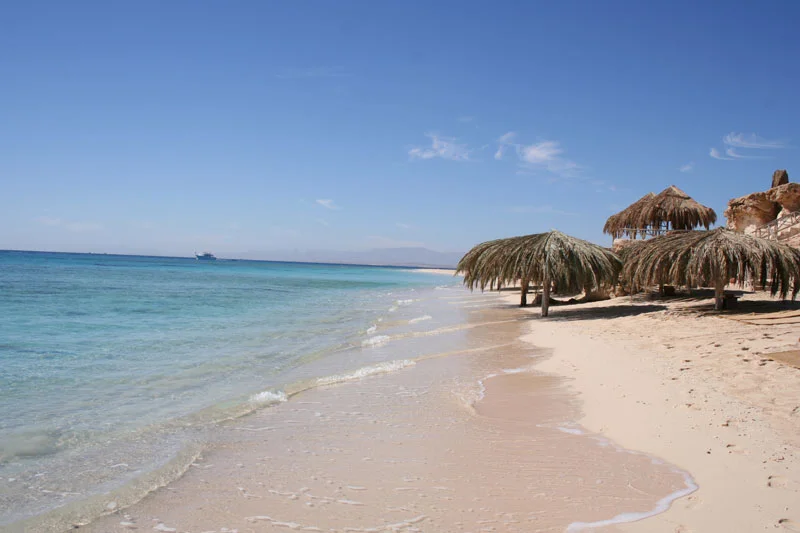

Hurghada
A century ago, the only sounds here were nets being hauled and water lapping against small wooden boats. Hurghada was a fishing village on a bare strip of the Red Sea coast, backed by desert and not much else. Then the world discovered what lay beneath the warm, clear water just offshore. Today more than a hundred hotels line the shoreline, charter flights stream in from across Europe, and the village is all but invisible beneath the resort - except in the old quarter to the north, where a little of the original Egypt still holds on.
From Nets to Neon
Hurghada's transformation is one of the Red Sea's most dramatic. A naval base went up here in 1905, the first thread of infrastructure stitched onto an otherwise empty coast. For decades the place stayed small. The civilian airport opened in 1982, foreign and Egyptian investment poured in through the 1980s, and the real boom arrived in the 1990s and 2000s. Hotels with private beaches sprawled along nearly forty kilometers of shoreline; bars, malls, and nightclubs filled in behind them. The town now draws budget travelers in huge numbers, especially from Europe and Russia, and its airport has grown into one of Egypt's busiest, rivaling Sharm El Sheikh for the number two spot behind Cairo. Not all of the growth aged gracefully - long stretches of half-finished concrete scar the coast, abandoned mid-dream.
The Reefs Are Offshore
Here is the quirk that shapes everything: unlike the Sinai resorts or Jordan, where coral hugs the shore, Hurghada's reefs sit several miles out to sea. To reach them you take a boat. Arid islands punctuate the water, the largest being Big Giftun, ringed by coral gardens and dotted with cellphone towers so the dive boats stay in signal. Out there the Red Sea delivers what people come for - walls of color, hundreds of species of tropical fish, and reef so accessible that complete beginners join in. You do not even need to know how to swim to take an introductory dive. Glass-bottom boats carry those who would rather stay dry while still glimpsing the world below.
A Base Camp for Egypt
Most visitors come for the sea, but Hurghada also works as a launchpad. The town has few monuments of its own; its value is partly in where it can take you. Long but rewarding day trips run inland to Luxor, with the temples of Karnak and the Valley of the Kings, and across the desert to Cairo for the Pyramids and the Sphinx at Giza. Closer to home, the desert itself becomes the attraction - quad bikes and beach buggies grinding into the Sahara, camel treks across the dunes, and tea with Bedouin hosts under an enormous sky. Modern developers, having largely moved on from Hurghada proper, built glossier resorts up and down the coast at El Gouna, Makadi Bay, and Safaga, all funneling through Hurghada's airport.
Wind, Water, and Tea
The climate is relentlessly dry, rain a rare event. Summer days are scorching and the nights stay hot; winters are warm by day but can turn surprisingly cold by night, especially when the Shamal wind blows down hard from the northeast. That same wind makes the coast a kitesurfing magnet, with shallow lagoons and dedicated kite stations strung along the shore. After a day on or in the water, the town offers its gentler pleasures: karkaday, the deep-red hibiscus tea served hot or cold, and chi in a small glass, often accompanied by the bubbling of a sheesha pipe. Haggling is a way of life in the bazaars of the old el-Dahar quarter and the Sigala strip - sport as much as commerce, and part of the texture of the place.
From the Air
Hurghada sits on Egypt's Red Sea coast at 27.258 N, 33.812 E, a long resort strip stretching roughly 40 km along the shoreline, backed by open desert. From the air the dense coastal development, marina, and offshore islands - Big Giftun the most prominent - make it easy to identify. Hurghada International Airport (ICAO HEGN, IATA HRG) lies about 8 km inland, west of the resort strip, and is among the busiest in Egypt, handling over 12 million passengers annually. Recommended viewing altitude 3,000-6,000 ft for the coastline, islands, and offshore reefs. Conditions are clear and dry nearly year-round with excellent visibility; the main hazard is the strong northeasterly Shamal wind, which can kick up blowing sand and reduce visibility along the coast.
Nearby Stories
- SS Thistlegorm 24 km away
- Tiran Island 41 km away
- Mersa Gawasis 58 km away
- Neom 105 km away
- Dendera Temple complex 126 km away
- Naqada culture 168 km away
- Royal Tomb of Akhenaten 238 km away
- Wadi El Gemal National Park 308 km away