
SS Thistlegorm
It was half past one in the morning on 6 October 1941 when two bombs found her. The Thistlegorm lay at anchor in the Red Sea, a British merchant steamship waiting out a delay, her holds packed with the machinery of war. A German bomber, hunting a troop carrier it never found, spotted the largest ship in the anchorage and struck. The explosion tore her open near the stern and sent her to the bottom in minutes. Nine men did not get off. Today divers descend to her in calm blue water, and the first thing worth remembering, before the trucks and the motorcycles and the fame, is that this is a grave.
The Men Aboard
The Thistlegorm sailed under Captain William Ellis, her merchant crew supplemented by nine Royal Navy personnel sent to work the ship's machine gun and anti-aircraft gun - the last line of defense for a vessel carrying munitions through a war zone. These were not soldiers storming a beach; they were sailors and gunners doing the unglamorous, dangerous work of keeping supplies moving. When the bombs hit hold 4 in the dark, the blast and the sinking claimed nine of them. They have names and they had families waiting in a Britain three years into the war. The wreck that draws tens of thousands of divers is, for them, the place where their war ended. Visitors are asked, rightly, to treat it with the respect a war grave deserves.
A Ship and Her War
She was built for work, not glory. J.L. Thompson and Sons launched her at Sunderland in April 1940, a cargo steamship driven by a triple-expansion engine. In her short life she made three successful voyages - to the United States for steel rails and aircraft parts, to Argentina for grain, to the West Indies for rum. Her fourth would be her last. She left Glasgow on 2 June 1941 bound for Alexandria, but with the Mediterranean a battleground, her convoy took the long way around - south past Cape Town, up the east coast of Africa, into the Red Sea. A collision had blocked the Suez Canal ahead, so the convoy moored to wait at a spot designated Safe Anchorage F. The name would prove bitterly ironic.
Cargo for a Desert War
What she carried tells the story of an army on the move. Bound for the Allied forces in Egypt - then the Western Desert Force, soon to become the Eighth Army - her holds held Bedford trucks, Universal Carrier armored vehicles, Norton and BSA motorcycles, Bren guns, rifles, and cases of ammunition, along with radio gear, aircraft parts, and even Wellington boots. Lashed to her deck were two heavy steam locomotives, LMS Stanier Class 8F engines bound for Egyptian National Railways, complete with their coal and water tenders. The bomb that struck hold 4 blew much of this into the sea. One locomotive was hurled off the port side, the other off the starboard - and they still rest there, on the seabed, where the explosion threw them more than eighty years ago.
A Museum Eighty Feet Down
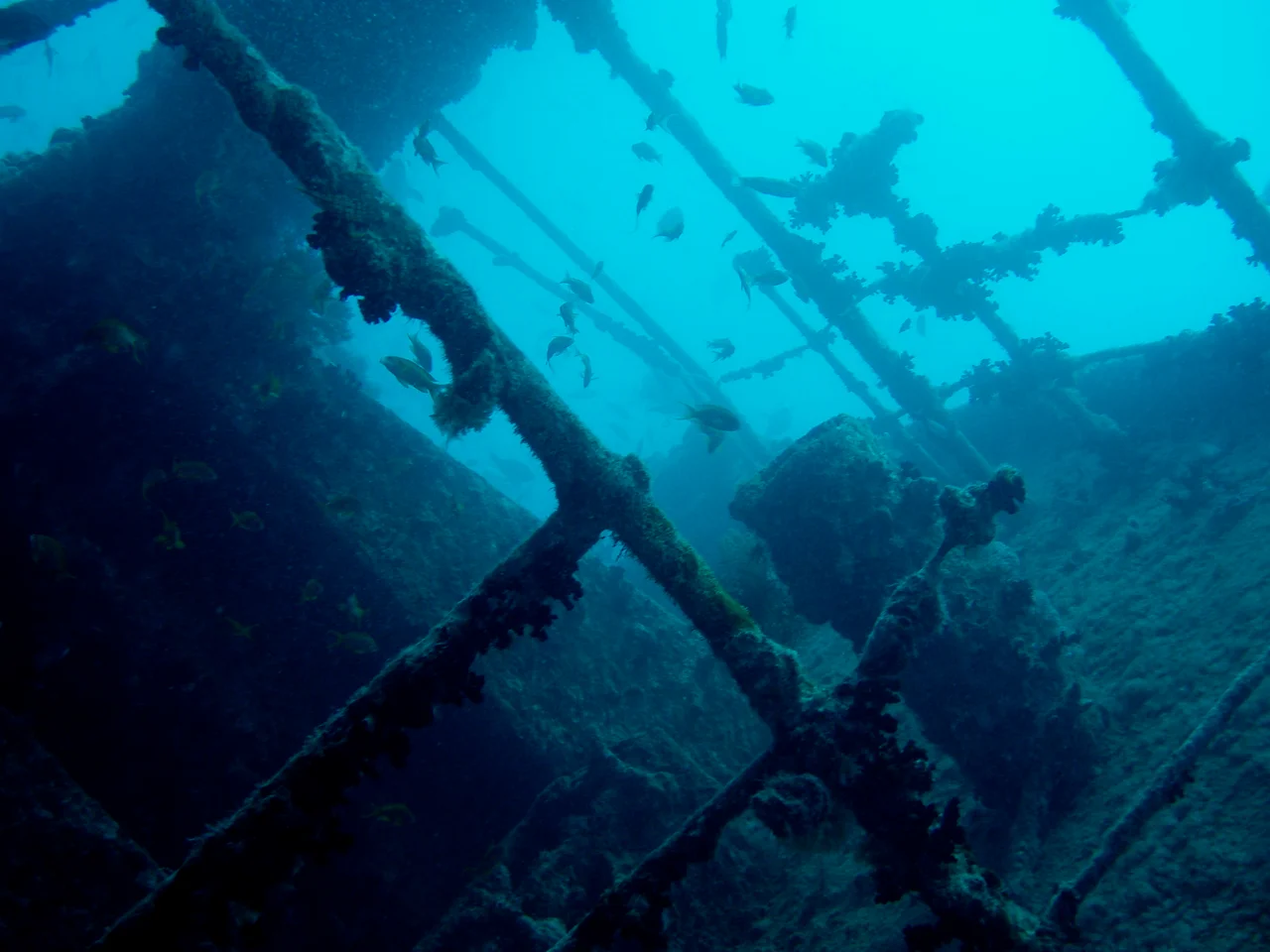
Because the blast carried away her midships superstructure, the wreck opened up - and at around 30 meters at its deepest, it sits within reach of recreational divers. Swimming her holds is like moving through a flooded warehouse of 1941: motorcycles still racked in rows, trucks lined up in the gloom, rifles and boots and the strange tailplanes of Bristol Blenheim bombers. Tuna, barracuda, lionfish, moray eels, and sea turtles have made the steel their home. But the Thistlegorm is dying a second time - rust is steadily collapsing her, and dive boats mooring to fragile sections hasten the damage. Conservation efforts have come and gone. In 2021 a photographer named Simon Brown stitched 15,005 frames into a single orthophoto of the whole wreck, an attempt to preserve in pixels what the sea is slowly reclaiming.
From the Air
The wreck of the SS Thistlegorm lies in the Strait of Gubal, northern Red Sea, at approximately 27.814 N, 33.920 E, off the coast near Ras Muhammad National Park. It rests on the seabed at about 30 m depth and is not visible from the air, but the anchorage area is marked by clustering dive boats by day and sits within a heavily transited shipping corridor at the mouth of the Gulf of Suez. The nearest airports are Sharm El Sheikh International (ICAO HESH, IATA SSH) to the east and Hurghada International (ICAO HEGN, IATA HRG) to the southwest, both roughly 40 km away. Surface conditions are typically clear with good visibility; the area is known for strong currents below the surface, and the Strait of Gubal carries steady commercial ship traffic worth noting for low-level navigation.
Nearby Stories
- Tiran Island 15 km away
- Hurghada 39 km away
- Saint Catherine's Monastery 48 km away
- Dendera Temple complex 177 km away
- Wadi Rum 187 km away
- Naqada culture 223 km away
- 2021 Suez Canal Obstruction 225 km away
- Hegra 356 km away