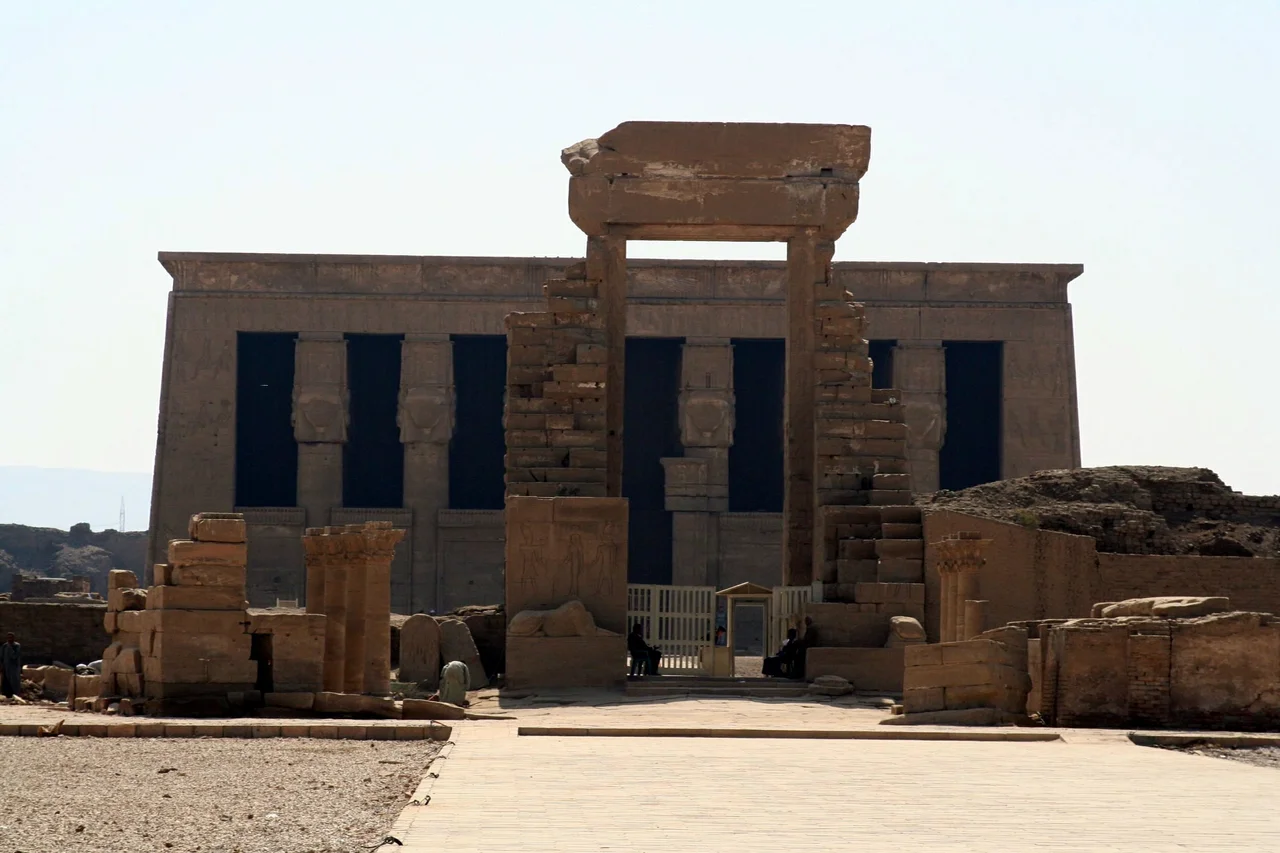

Dendera Temple complex
For nearly two thousand years, soot from cooking fires and the smoke of later squatters coated the ceiling of the great temple at Dendera, hiding it under a grimy black skin. Then, beginning in the 2000s, conservators with solvent gels began to lift the centuries away - and the ceiling came back to life. Deep blue skies, golden stars, the goddess Nut arched across the heavens swallowing the sun each dusk and giving birth to it each dawn: the colors were as fresh as the day they were painted. Dendera is one of the best-preserved temple complexes in all of Egypt, and the cleaning revealed that beneath the grime it had never lost its brilliance at all.
A House for Hathor
The temple was built for Hathor - goddess of love, music, joy, and motherhood, often shown as a woman with a cow's ears or crowned with horns and a sun disc. People had worshipped on this spot for a very long time; there is evidence of a building here around 2250 BC, in the age of the Old Kingdom king Pepi I, and another in the Eighteenth Dynasty a thousand years later. But the great temple that survives is comparatively young by Egyptian standards. Its construction began around 54 BC, in the last years of the Ptolemaic dynasty, and the work of carving and decorating ran on into the Roman period under emperors like Tiberius and Trajan. On the rear outer wall, larger than life, are carved Cleopatra VII - the famous Cleopatra - and her son Caesarion, whose father was Julius Caesar.
The Zodiac That Went to Paris
Set into a ceiling in one of the temple's upper chapels was a circular star map known as the Dendera zodiac, carved in the first century BC. It is one of the most complete representations of the ancient sky ever found, mixing Egyptian constellations with figures we still recognize - the bull of Taurus, the scales of Libra. Napoleon's scholars sketched it. Then, in 1820 and 1821, a French antiquities dealer named Sebastien-Louis Saulnier hired an engineer, Claude Lelorrain, to take it. Using saws and gunpowder charges, Lelorrain cut the heavy slab out of the temple roof and shipped it down the Nile to France. It reached Paris and was eventually installed in the Louvre, where the original remains today. A plaster copy now fills the gap in the Dendera ceiling. It was Jean-Francois Champollion, the man who cracked hieroglyphs, who correctly dated the relief to the Ptolemaic age.
The So-Called Dendera Light
In the temple's crypts, narrow chambers carved beneath the floor, is a relief that has launched a thousand internet theories. It shows a snake emerging from a lotus flower, the whole scene enclosed in a large oval that looks - to a modern eye primed by science fiction - uncannily like a light bulb. A fringe of writers have seized on it as proof that the ancient Egyptians had electricity. The reading does not survive contact with the actual evidence. The accompanying hieroglyphs explain the scene plainly: it depicts the god Harsomtus, a form of Horus, being born as a serpent from the lotus of creation. The oval is a hen vessel, associated with the womb of the sky goddess Nut. Egyptologists note the obvious problem with the light-bulb theory too - in a civilization this well documented, not one wire, socket, or shard of a bulb has ever been found.
From Crypts to Roof
What makes Dendera unforgettable is that you can walk almost all of it. Few ancient Egyptian temples are this accessible, from the subterranean crypts to the roof itself. A processional staircase climbs to the top, its steps so worn and overgrown with mineral accretion that visitors have nicknamed them the melted stairs - the literal erosion of thousands of priests' feet over millennia, rendered in stone. On the roof, chapels once hosted the festival of the New Year, when Hathor's statue was carried up to be touched by the rays of the rising sun. The Supreme Council of Antiquities has been restoring the complex in phases since 2005, cleaning the great pillared hall and reviving its painted scenes. The work goes on. Slowly, Dendera is being returned to the way its builders meant it to be seen - blazing with color, under a painted sky.
From the Air
The Dendera Temple complex sits at 26.142°N, 32.670°E, on the west bank of the Nile about 2.5 km from the modern town of Dendera and across the river from the city of Qena in Upper Egypt. From the air it is unmistakable: a large rectangular enclosure ringed by a massive mudbrick wall, set at the desert edge where cultivation ends, with the Nile looping nearby to the east. Best viewed at 2,000-4,000 feet AGL in clear morning light, when low sun rakes across the temple roof and walls. The nearest airport is Luxor International (ICAO HELX), roughly 60 km to the south-southeast; Sohag International (HEMK) lies to the north.
Nearby Stories
- Temple of Seti I (Abydos) 12 km away
- Tomb of Tutankhamun 14 km away
- White Monastery 39 km away
- Red Monastery 92 km away
- Mersa Gawasis 101 km away
- Hurghada 149 km away
- Kharga Oasis 159 km away
- Wadi El Gemal National Park 261 km away