
White Monastery
From a distance it looks less like a church than a fortress, or even a pharaoh's temple: a long block of pale limestone with sloping outer walls, standing at the desert edge near Sohag in Upper Egypt. The slope is no accident. When the monks of the fifth century raised this building, they cut their stone from the ruins of ancient Egyptian temples nearby and borrowed their architects' instincts too, battering the walls inward exactly as the old pagan builders had. The result is the White Monastery, named for the colour of those walls, and one of the most important monuments of Coptic Christianity anywhere.
The Abbot Who Built an Empire of Faith
The monastery owes its greatness to Shenoute, a towering and famously severe abbot who led it through the fifth century. His uncle Pjol had founded the community as a modest settlement; under Shenoute it became something closer to a small state. The numbers recorded for his time are staggering: a community said to have grown from thirty monks to more than two thousand monks and nearly two thousand nuns, farming an estate that stretched across thousands of acres of cells, kitchens, and storehouses. Shenoute ruled it all with an iron discipline and a writer's gift, and he insisted that everyone under his care learn to read. That single demand, a literacy campaign in the Egyptian desert sixteen centuries ago, would shape the monastery's most enduring legacy.
A Library Scattered to the Winds
Because Shenoute's monks could read and many could write, the White Monastery assembled one of the greatest libraries of Christian Egypt, perhaps a thousand codices, each running two or three hundred pages. They held scripture, the lives of saints and martyrs, the great theological writings of the early church, and above all the works of Shenoute himself, composed in a polished Sahidic Coptic he helped perfect as a literary language. Only about a tenth of that library survives, and it survives in pieces. Over the past two centuries the codices were broken up, their pages sold and scattered, so that a single dismembered book might now have leaves in Cairo, Vienna, Paris, London, and New York at once. Scholars in Rome and elsewhere have spent decades trying to reunite these orphaned folios, page by page, in photographs, reassembling a library that exists today only as a worldwide diaspora of fragments.
Sixteen Centuries of Survival
The White Monastery has been attacked, taxed into decline, and rebuilt more times than its records can count. After the Muslim conquest of Egypt in 641, heavy taxes slowly emptied the great monasteries, and this one began a long contraction. In the eleventh and twelfth centuries it sheltered Armenian monks, whose inscriptions still survive in the apse. It was sacked in 1168, restored in the thirteenth century, and by then largely in ruins, with only the church still in use. In 1798 it was burned by Mamluk troops; a French traveler arrived the day after and recorded the wreckage. Yet it never quite died. The church was rebuilt under Muhammad Ali in the early nineteenth century, repaired again and again, and it remains a working place of Coptic worship, its sanctuary divided among altars to Saint Shenoute, the Virgin Mary, and Saint George.
Stone Borrowed from the Gods
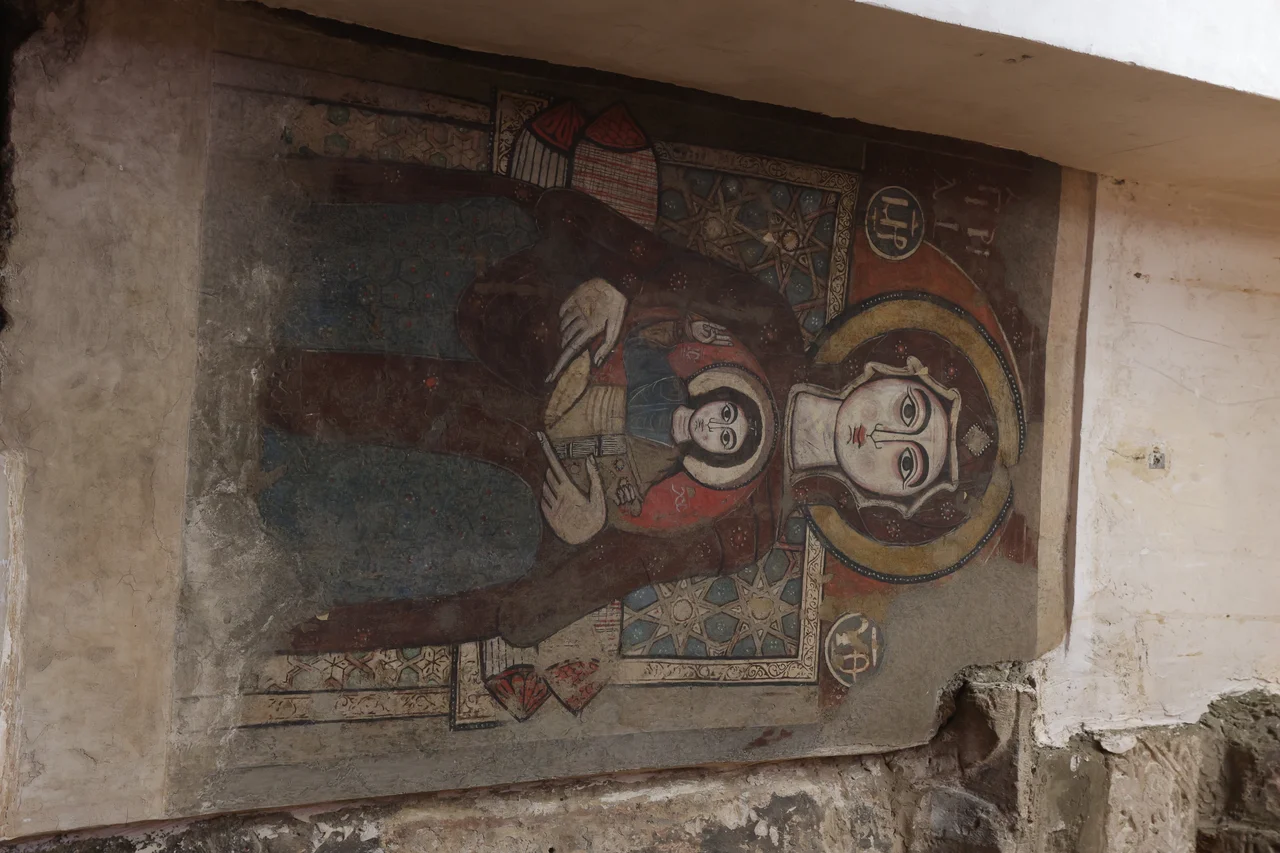
Inside, the building is a palimpsest of its own long history. The original fifth-century basilica was huge, an open court more than 170 feet long, lined with rows of marble and granite columns and crowned by a trefoil sanctuary of three apses still painted with Christ in glory and the Virgin's dormition. Look closely at the stonework and the deeper past shows through. The limestone, the granite doorjambs, even blocks carrying faint hieroglyphs were quarried from older temples, including, scholars believe, sites as far afield as Abydos and the nearby temple of Repit at Atripe. Shenoute, who waged a fierce campaign against the old gods, helped dismantle their sanctuaries both figuratively and literally, then reassembled their stones into a house of his own faith. The White Monastery is, quite physically, ancient Egypt rebuilt into Christian Egypt.
From the Air
The White Monastery, or Deir al-Abyad, lies at about 26.53 degrees N, 31.65 degrees E on the western edge of the Nile valley near Sohag and the town of Tahta, a short distance southeast of its sister Red Monastery. From the air it appears as a pale rectangular enclosure where cultivation gives way to desert. Sohag International Airport (HESG) is the closest field, only about 15 to 20 km to the east-southeast; Asyut (HEAT) lies roughly 90 km north. Morning or late-afternoon light best reveals the texture of the white limestone walls. Skies over this stretch of the valley are generally clear, with occasional dust during spring khamsin winds.
Nearby Stories
- Temple of Seti I (Abydos) 10 km away
- Dendera Temple complex 33 km away
- Naqada culture 68 km away
- Royal Tomb of Akhenaten 105 km away
- Kharga Oasis 128 km away
- Amarna 138 km away
- Italian Invasion of Egypt 138 km away
- Hurghada 157 km away