
Amarna
A pharaoh stood on the east bank of the Nile, on ground no city had ever occupied, and declared that here - and nowhere else - he would build his capital. The year was around 1346 BC. The king was Akhenaten, and the place where the cliffs parted in a shape that echoed the hieroglyph for "horizon" became Akhetaten, "the Horizon of the Aten." Within a few short years a whole city of mudbrick palaces, temples, and suburbs rose from bare sand. Within a few short years after his death, it was empty again. Almost nobody lived here afterward, which is precisely why we can still read its streets so clearly today.
A King's Revolution
Akhenaten did something no Egyptian ruler had dared. He swept aside the crowded pantheon his people had worshipped for millennia and elevated a single deity: the Aten, the visible disc of the sun, its rays ending in tiny hands that offered life. To worship this god properly, he abandoned Thebes and its powerful priesthood of Amun and founded a clean capital where the old gods held no claim. He raised it fast - construction began around Year 5 of his reign and was largely finished by Year 9 - so most of it was built of whitewashed mudbrick, with only the most important structures faced in stone. At its heart stood the Great Temple of the Aten, open to the sky rather than shut in darkness like the old sanctuaries, designed so that sunlight itself poured down onto the altars.
The Woman in the Workshop
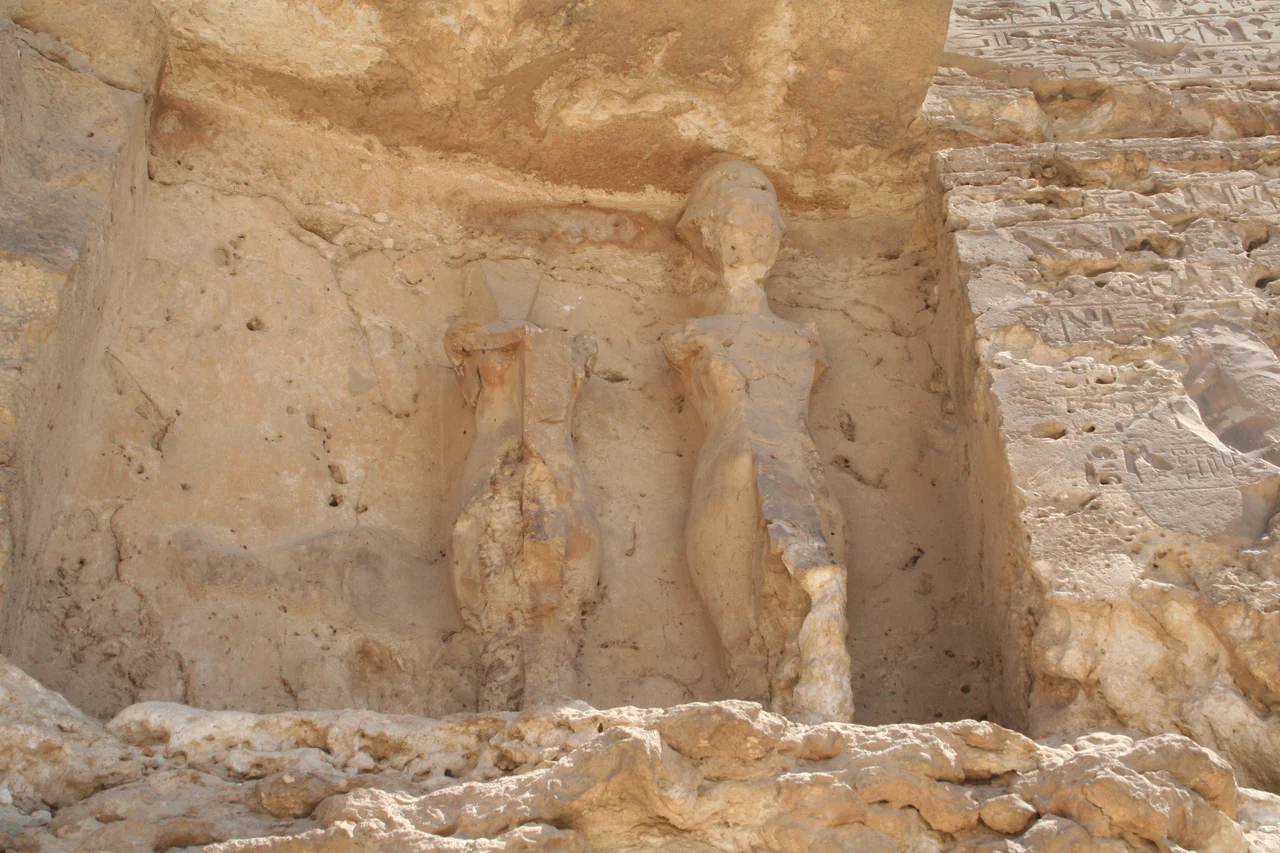
Among the houses of the southern suburb stood the studio of a sculptor named Thutmose. When German archaeologists dug there in 1912, they uncovered, lying in the ruins of his workshop, one of the most recognized faces in human history: the painted limestone bust of Queen Nefertiti, Akhenaten's great royal wife. Slender-necked, serene, one eye left unfinished, it had apparently served as a master model for other portraits. Nefertiti was no ornament. She appears constantly at the king's side in Amarna's art, sharing in the worship of the Aten and depicted with a prominence rarely granted an Egyptian queen. The art of her city broke every rule: where earlier pharaohs were shown as flawless and ageless, the Amarna style rendered the royal family with startling intimacy - the king and queen lounging with their daughters, cradling them, kissing them beneath the sun's outstretched rays.
Letters in Clay
In 1887 a local woman digging in the ruins for sebakh - the crumbled mudbrick that Egyptians spread on their fields as fertilizer - struck a buried cache of clay tablets. They turned out to be one of the great finds in the study of the ancient world: nearly four hundred cuneiform tablets, the diplomatic correspondence of the Egyptian crown. Most were written not in Egyptian but in Akkadian, the international language of Late Bronze Age diplomacy, and they preserve letters exchanged with the kings of Babylon, Assyria, Mittani, and the Hittites, alongside frantic appeals from Egypt's own vassals in Canaan. The Amarna Letters opened a window onto a connected ancient Near East - a world of alliances, gold shipments, marriage negotiations, and complaints - that no other source captures so vividly. They came from the Bureau of Correspondence, the records office behind the royal residence.
Erased and Rediscovered
The revolution did not outlive its author. After Akhenaten died around 1336 BC, the boy-king Tutankhamun - very likely his son - abandoned Akhetaten and returned the court to Thebes, restoring the old gods. Later pharaohs went further, branding the whole episode the "Amarna heresy," hacking Akhenaten's name from monuments and quarrying his city for building stone. The desert took back the rest. That erasure, ironically, preserved it. Because almost no one resettled the site, Amarna is the one ancient Egyptian capital whose full city plan survives - palaces, temples, workers' villages, and all. Excavators have worked here since Napoleon's scholars mapped the ruins in 1798, through Flinders Petrie and the German and British expeditions, down to the Amarna Project that digs here still, slowly recovering the lives of the ordinary people who built a city for the sun and then walked away.
From the Air
Amarna sits on the east bank of the Nile at roughly 27.66°N, 30.91°E, in Egypt's Minya Governorate, about 58 km south of al-Minya and some 312 km south of Cairo. From the air it reads as a broad arc of desert pinned between the river's green floodplain and a curving wall of low cliffs - the natural amphitheater that drew Akhenaten to the spot. Modern villages such as et-Till and el-Hagg Qandil edge the ancient ground; the royal tomb lies hidden in a wadi cut into the eastern hills. The nearest airport is El Minya (ICAO HEMN) to the north, with Asyut International (HEAT) farther south. Visibility over Middle Egypt is usually excellent, sharpest in the long light of early morning and late afternoon, when the low sun rakes across the ruins and the cliff faces stand out in relief - though spring khamsin winds can fill the valley with dust.
Nearby Stories
- Red Monastery 102 km away
- White Monastery 132 km away
- Valley of the Golden Mummies 144 km away
- Italian Invasion of Egypt 160 km away
- Abydos, Egypt 178 km away
- White Desert National Park 206 km away
- 1992 Cairo Earthquake 207 km away
- Assassination of Anwar Sadat 235 km away