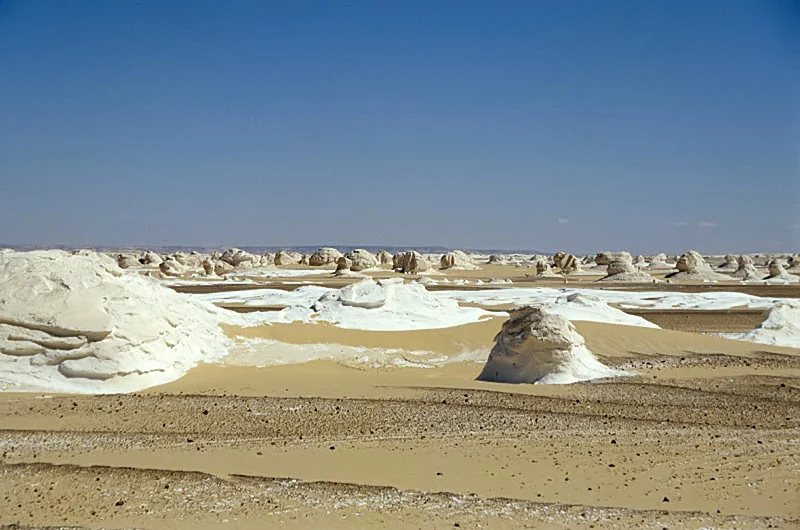

White Desert National Park
At dusk the chalk glows pink, then violet, then a cold blue-white under the moon, and the desert floor looks less like Earth than like the surface of some quieter planet. Scattered across the sand north of the Farafra depression stand hundreds of white pinnacles - some shaped like mushrooms, some like crouching animals, some like nothing at all - carved by wind out of soft limestone over countless centuries. Travelers pitch their tents among them and watch desert foxes pad between the formations after dark. This is the White Desert, one of the strangest landscapes in Egypt, and it began at the bottom of a sea.
The Seabed in the Sky
Tens of millions of years ago, during the Cretaceous, a shallow ocean covered this part of North Africa. Generation upon generation of tiny marine organisms lived, died, and drifted to the seafloor, their shells piling up into thick beds of chalk and limestone. When the sea finally withdrew, it left those soft white layers exposed to a relentless sculptor: the wind. Sand-laden gusts scour the rock from below, eating away at its base faster than its harder cap, and over time the stone is whittled into top-heavy pillars - the famous "mushrooms" balanced on slender stems. Harder and softer layers erode at different rates, so the desert is studded with towers, fingers, and shapes that catch the imagination. With a little squinting you can find camels, sphinxes, and seated dogs in the white stone.
Not as Dry as It Looks
The name conjures lifeless sterility, but the park is not entirely dead. Three springs rise within it - Ain Khadra among them - and around their water grow palms, tamarisk, and acacia, small green refuges in the chalk. Patient visitors who keep still and quiet may be rewarded: Dorcas gazelles, fennec and other desert foxes, geckos, and small rodents all make a living here, most of them moving at dawn, dusk, or in the cool of night to escape the day's heat. The contrast is part of the desert's strange appeal - blinding white rock by day, a sky thick with stars by night, and the occasional flash of a fox or the silhouette of a gazelle against the pale ground.
Crystal Mountain and the Hidden Valley
The protected landscape holds more than the white formations. To the north, beside the road that links the Bahariya and Farafra oases, rises Crystal Mountain - not really a mountain but a ridge of rock glittering with barite and calcite crystals, pierced by a natural arch. Off in the western reaches lie quieter wonders: a sheltered basin known as the Hidden Valley, and the el-Ubeiyid Cave, where archaeologists have found traces of people who lived here during the Holocene, roughly six to seven thousand years ago, when the Sahara was greener and these dunes were not yet desert. The land remembers a wetter past, written in stone tools and faded rock.
A Fragile Spectacle
The White Desert was declared a protected area in 2002, and not a moment too soon. Tens of thousands of visitors now come each year, most over the Christmas and Easter holidays, drawn by the chance to camp beneath the formations. That popularity is a threat as much as a tribute. Chalk is soft; a careless tire track can scar the surface for years, and graffiti carved into the towers cannot be undone. The simplest rules carry the most weight here - keep to the marked tracks, camp only at designated sites, and carry every scrap of rubbish back out. The formations took ages to make and break easily. The desert's whole magic depends on leaving it as untouched as it was found.
From the Air
White Desert National Park lies at roughly 27.28°N, 28.20°E, in Egypt's New Valley Governorate, about 45 km (28 mi) north of the town of Qasr al-Farafra. From the air the park is unmistakable against the surrounding tan desert: a broad zone of brilliant white chalk, dotted with pale formations and crossed by the single paved road running north toward Bahariya. The reserve covers roughly 3,010 square kilometres. There is no airfield at the park itself; the nearest options are El Kharga (ICAO HEKG) far to the southeast and Asyut International (HEAT) in the Nile Valley to the east. Skies are typically clear with superb visibility - the white ground is dazzling under direct sun - though spring khamsin sandstorms can erase the landscape in a wall of dust. Low morning or late-afternoon light makes the formations cast their longest, most dramatic shadows.
Nearby Stories
- Valley of the Golden Mummies 96 km away
- Italian Invasion of Egypt 167 km away
- Dakhla Oasis 193 km away
- Amarna 205 km away
- Royal Tomb of Akhenaten 215 km away
- Lady Be Good (aircraft) 374 km away
- Rommel Museum, Mersa Matruh 422 km away
- Gilf Kebir National Park 444 km away