
Abydos, Egypt
Walk a mile west from the green ribbon of the Nile, past the last cultivated field, and the desert begins. Out on that pale plain lies a low rise littered with millions of broken pots. The Arabs named it Umm el-Qa'ab, the Mother of Pots, and the shards are the residue of devotion: votive jars left by pilgrims over thousands of years. Beneath them sleep the first kings of Egypt. This is Abydos, one of the oldest and holiest places a pharaoh could be buried, and for much of antiquity the most sacred ground in the land.
Where Kings Were First Buried
Before the pyramids, before Egypt was even fully one country, the rulers of the First Dynasty chose this stretch of desert for their graves. Narmer, the king credited with uniting Upper and Lower Egypt around 3100 BC, lies here, and so does his successor Aha. Their tombs began as brick-lined pits roofed with timber and matting, then grew into sprawling underground complexes ringed by smaller graves. Those satellite pits hold a darker truth: in the earliest reigns, servants were buried alongside their king, sacrificed to attend him in the next world. The tomb of Queen Merneith was surrounded by more than a hundred such burials. Within a few generations the Egyptians abandoned the practice, replacing the dead with carved and modeled stand-ins. The shift marks one of the first times we can watch a civilization decide that human life was worth more than ritual.
The God Who Rose Again
Abydos owed its long fame to a single idea. By the end of the Old Kingdom, the cult of Osiris, god of the dead and of resurrection, had taken root here, and Egyptians came to believe that the ancient tomb of King Djer was in fact the burial place of Osiris himself. Suddenly this was not just a royal cemetery but the grave of a god who had conquered death. To be buried near Osiris, or simply to leave a memorial stone in his shadow, was to share in his promise of rebirth. Tomb paintings across Egypt show wealthy families making the pilgrimage to Abydos, their coffins carried by boat toward the holy city. Those who could not come in life arranged to be brought after death, if only symbolically, so that they too might stand in the presence of the resurrected lord.
Nine Temples, One Sacred Spot
The Egyptians rebuilt at Abydos for nearly three thousand years, raising temple upon temple on the same patch of ground. From the First Dynasty to the Twenty-sixth, nine or ten successive sanctuaries rose, fell, and were rebuilt, each king adding to or replacing the work of his predecessors. Pepi I enlarged the Great Temple of Osiris in the Sixth Dynasty; Mentuhotep and Senusret expanded it again in the Middle Kingdom. When a chamber of old offerings was finally uncovered, it held some of the finest work of the early dynasties, including a tiny ivory statuette of Khufu, builder of the Great Pyramid, that is still the only known portrait of him. In 2021, archaeologists working here announced another first: what may be the world's oldest large-scale brewery, dating to the reign of Narmer and built to brew beer for royal funerary rites.
The Survivor in the South
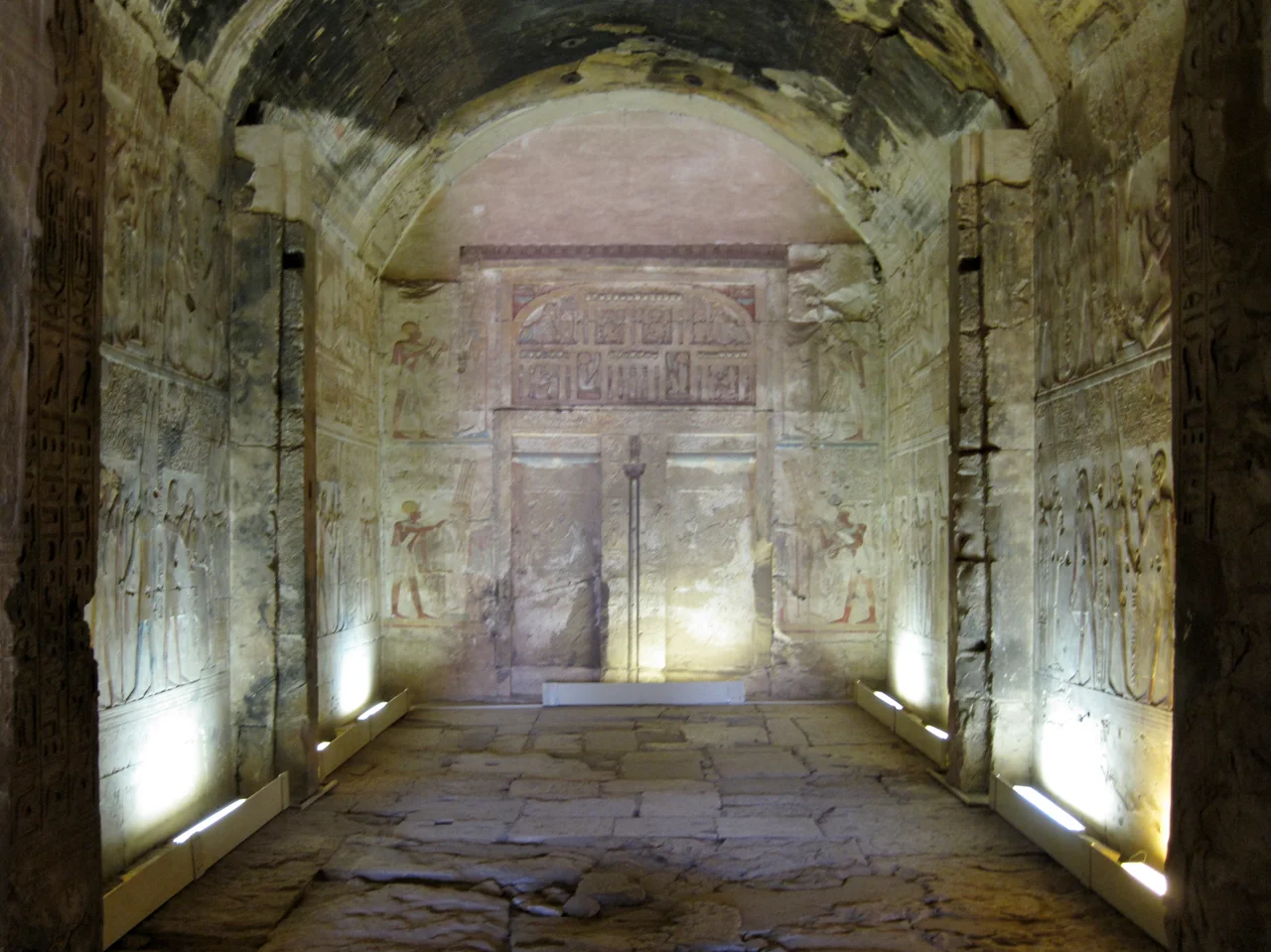
Most of ancient Abydos now lies buried beneath modern houses, its temples lost or destroyed. But half a mile to the south, one building survives nearly intact. Seti I raised it in the thirteenth century BC and his son Ramesses II finished it, an L-shaped temple of limestone honoring Osiris and the royal ancestors. On one of its inner walls runs the Abydos King List, a roll call of cartouches naming the legitimate pharaohs from Menes down to Seti himself, an inscription so valuable to historians it has been called a kind of Rosetta Stone for Egyptian chronology. Behind the temple lies the Osireion, a stark subterranean hall of massive granite pillars built to evoke a tomb and to stage the mysteries of Osiris. Today groundwater, raised by the Aswan Dam, pools across its floor, mirroring the granite in still dark water.
From the Air
Abydos sits at roughly 26.19 degrees N, 31.92 degrees E, about 11 km west of the Nile near the towns of El Balyana and El Araba El Madfuna in the Sohag Governorate of Upper Egypt. From the air, look for the sharp boundary where green floodplain meets tan desert; the temple of Seti I and the low desert rise of Umm el-Qa'ab lie just beyond that line. The nearest major airport is Sohag International (HESG), roughly 60 km to the north; Luxor International (HELX) lies about 150 km to the southeast. Best light is early morning, when low sun rakes the desert and throws the ruins into relief. Visibility over the valley is usually excellent, though spring khamsin winds can fill the air with dust.
Nearby Stories
- White Monastery 25 km away
- Valley of the Queens 28 km away
- Dendera Temple complex 33 km away
- Tomb of Nefertari 79 km away
- Kharga Oasis 99 km away
- Italian Invasion of Egypt 129 km away
- Royal Tomb of Akhenaten 143 km away
- Mersa Gawasis 170 km away