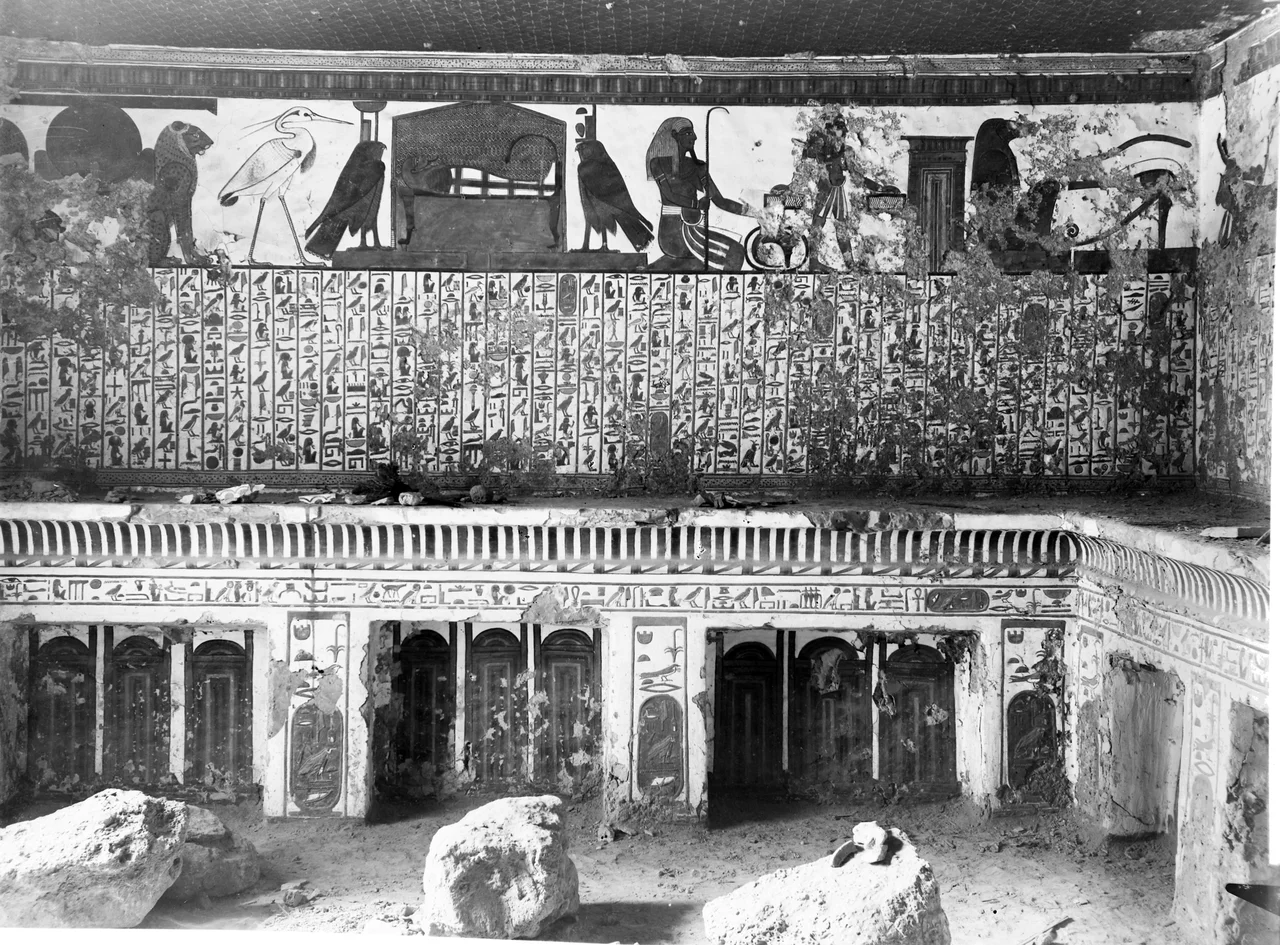

Tomb of Nefertari
A pharaoh who fathered scores of children and outlived most of them built only one tomb that reads like a love letter. Ramesses II ruled Egypt for sixty-six years, long enough to bury sons who had grown old waiting to succeed him, yet when he wanted to praise the woman he loved most, he reached past statues and obelisks for a brush. In his writings he called Nefertari "the one for whom the sun shines." Her name meant "the most beautiful one among them." Cut into the limestone hills west of the Nile, in the Valley of the Queens, the tomb labeled QV66 holds the proof: roughly 5,200 square feet of wall paintings, glowing in red, gold, blue and green, so finely worked that visitors and scholars alike have called the chamber the Sistine Chapel of ancient Egypt.
A Face Worth Painting
The artists who decorated QV66 lavished their best work on Nefertari herself. They shaped her eyes with care, blushed her cheeks, drew her eyebrows with deliberate elegance, and crowned her with a vulture headdress and a tall plumed cap. She appears again and again across the walls, gowned in translucent white linen, led by the hand of the gods through the stages of the afterlife. Horus guides her in one scene; Hathor takes her hand in another; she plays the board game senet, kneels in prayer, and offers to deities including Osiris, Atum, Ptah and Thoth. These were not generic figures swapped from a workshop pattern book. They were a portrait of one specific, beloved woman, and the paint that survives still carries the intention behind every line.
What the Looters Left
When the Italian archaeologist Ernesto Schiaparelli reached the tomb in 1904, the door stood open and the seals were gone. Robbers had emptied it, probably in antiquity. The pink granite sarcophagus survived only as scattered fragments of its lid. Of grave goods that must once have filled the chambers, his team recovered about thirty small servant figures called ushabti, pieces of a few vessels, and shards of furniture. Of Nefertari herself, only fragments of her mummified legs remained—pieces of the femur, kneecap, and shin—now kept in the Egyptian Museum in Turin. The thieves had taken nearly everything portable. What they could not carry was the decoration painted onto the walls, and so the very thing that made this tomb extraordinary is the only thing that endured.
A Ceiling Full of Stars
Descend the rock-cut stairs and the ceiling opens into a deep blue night scattered with golden five-pointed stars, a painted sky that follows the visitor from the antechamber down into the burial chamber itself. The walls draw on Chapter 17 of the Book of the Dead, the spells meant to carry the dead safely toward paradise. The effect is less a grave than a doorway. Egyptian tombs were machines for rebirth, and this one was built to launch a queen toward eternity in surroundings as radiant as the life she had lived. The painters understood that the underworld journey was frightening, and they answered the fear with beauty: a heaven you could read, walk beneath, and trust.
Saving the Sistine Chapel of the Desert
Beauty this fragile does not survive on its own. Flood water seeping into the limestone, salt crystallizing behind the plaster, bacteria, and even the humidity of human breath had all attacked the paintings by the twentieth century. Between 1986 and 1992 the Getty Conservation Institute and Egypt's antiquities authorities undertook a painstaking rescue, stabilizing the plaster, drawing out destructive salts, and setting up monitoring that continues today. Public access is tightly limited to protect what remains. The tomb closed entirely for urgent repairs in 2024. Standing inside, you sense the stakes: three thousand years after the brushes were laid down, the colors Ramesses commissioned for the woman he loved are still here, and a great deal of effort now goes into keeping them that way.
From the Air
QV66 lies in the Valley of the Queens on the west bank of the Nile near Luxor, at approximately 25.733 N, 32.600 E. The tomb itself is underground and invisible from the air, but the desert wadis of the Theban necropolis are a clear navigation feature, with the green ribbon of the Nile and the city of Luxor immediately to the east. Recommended viewing altitude is 3,000 to 6,000 feet AGL for the contrast between cultivated valley and barren limestone hills. The nearest airport is Luxor International (ICAO HELX, IATA LXR), about 10 km east on the opposite bank. Skies over Upper Egypt are typically clear with excellent visibility year-round; afternoon heat haze and occasional dust are the main limitations.
Nearby Stories
- Temple of Seti I (Abydos) 20 km away
- Dendera Temple complex 21 km away
- Esna 22 km away
- Abydos, Egypt 49 km away
- Mersa Gawasis 116 km away
- Kharga Oasis 147 km away
- Hurghada 184 km away
- Wadi El Gemal National Park 238 km away