
Esna
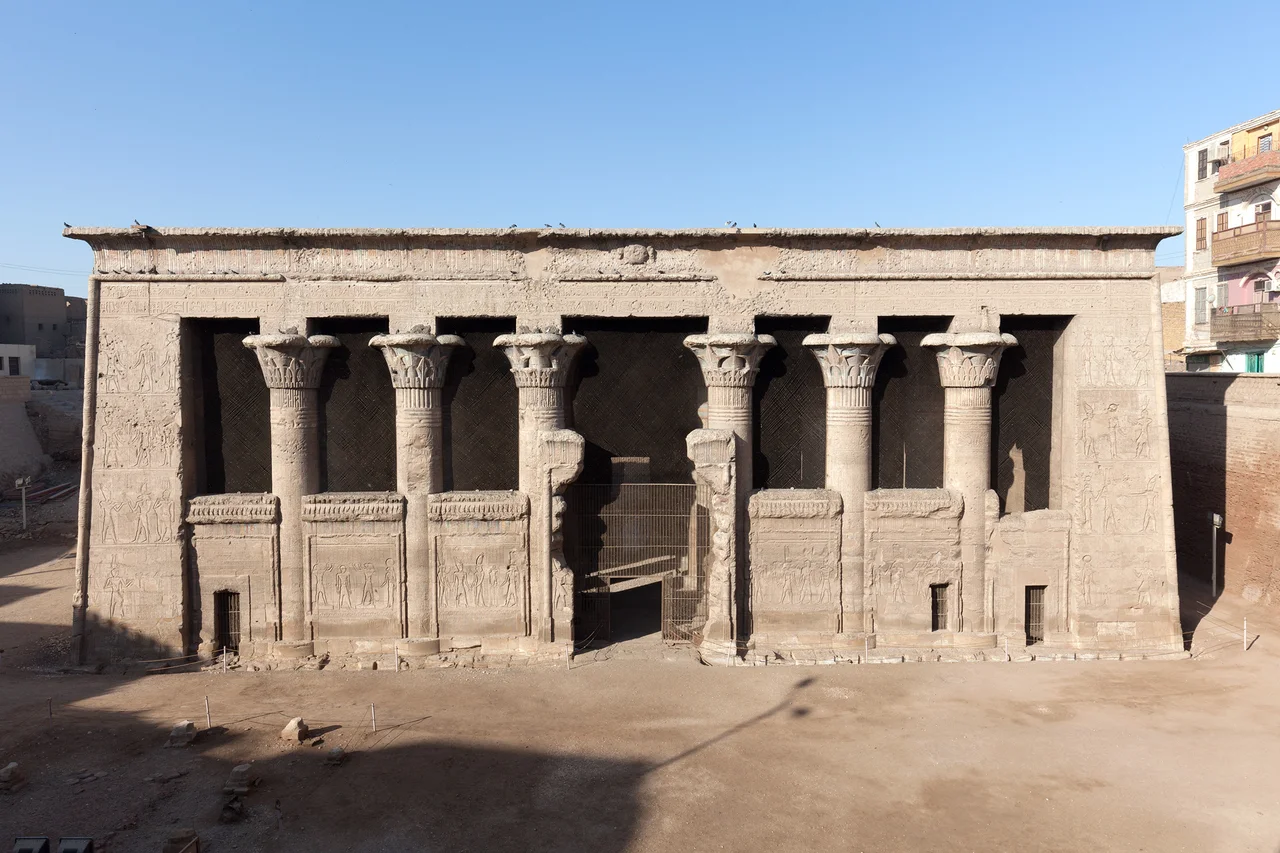
For nearly two thousand years, the ceiling of the Temple of Khnum at Esna was black. Generations of birds roosted in its hall; cooking fires and lamps left a thick crust of soot over everything. Visitors walked beneath it and saw only grime-darkened stone. Then, beginning in 2018, a team of Egyptian and German conservators climbed the scaffolding and started to clean - patiently, square by square, using nothing harsher than alcohol and distilled water. What emerged stopped them in their tracks: a painted sky in brilliant color, where vultures spread golden wings, the signs of the zodiac wheeled overhead, and Egyptian blue glowed as fresh as the day it was mixed.
A Heaven Rediscovered
The cleaning, a joint project of Egypt's Ministry of Tourism and Antiquities and the University of Tubingen, took about five years to transform the temple's great hypostyle hall. Under the soot lay one of the finest astronomical ceilings in Egypt. The full zodiac runs across it - all twelve signs from Aries to Pisces, arranged in order - alongside the planets Jupiter, Saturn, and Mars, constellations, and crowds of deities and fantastical creatures. Conservators recovered pigments many specialists had assumed were lost forever, including a rare and vivid Egyptian blue and a brilliant malachite green. The find proved something scholars had long suspected but rarely seen: these temples were never the bare sandstone we imagine today. They were technicolor. With its ceiling restored, Esna now stands beside the temple of Hathor at Dendera as the two best-preserved painted skies in Egypt.
The God of the Potter's Wheel
The temple belongs to Khnum, the ram-headed creator-god who, the Egyptians believed, fashioned each human being from clay on his potter's wheel and breathed life into them. Built largely in the Greco-Roman period, the structure visitors see today is mostly the hypostyle hall - a forest of twenty-four columns, each capital carved with a different arrangement of palm fronds, lotus, and papyrus. The rest of the temple still lies buried beneath the modern town. That burial is exactly why the painted ceiling survived: the hall sat below the level of the streets, sheltered from weather and reused as a foundation as Esna grew up around and over it across the centuries.
Layers of a Living Town
Esna wears its history in layers, and unusually, people still live in all of them. Around 300 BC it was the capital of the third nome, or province, of Upper Egypt. Its urban fabric stacks Ancient Egyptian, Greco-Roman, Coptic, Islamic, and modern Egypt one atop the next. Old 19th-century merchant houses, prized for their carved wooden balconies, stand beside a covered Ottoman-era market that has run for centuries. The Al-Qisariyya market, directly south of the temple, once traded fabrics, textiles, African ivory, and ostrich plumes carried up the Nile by caravan. Among its workshops survives the Bakkur oil press, built in 1897 and still worked by hand, pressing oil from lettuce, sesame, and arugula seed in a craft Esna has practiced since the ninth century.
City of Martyrs
To Egypt's Coptic Christians, Esna carries a heavier name: the City of Martyrs. Between roughly 303 and 311 AD, during the persecutions of the late Roman Empire, large numbers of local Christians were killed for their faith. The memory is preserved in a cluster of churches, shrines, and monasteries scattered through the town and the desert around it - among them the Monastery of the Martyrs and the Monastery of Saint Matthew the Potter. Nearby rises the Al-Amri minaret, almost a thousand years old, one of a small group built by the Fatimid vizier Badr al-Jamali across Upper Egypt in the eleventh century, and the last surviving piece of a long-vanished mosque. Faiths and centuries crowd together here within a few narrow streets.
Where the River Pauses
Esna sits on the west bank of the Nile, about 54 kilometers south of Luxor. For Nile cruise boats running between Luxor and Aswan, it is an unavoidable stop - not by choice, but because a lock system here controls the water levels, and vessels can wait hours for their turn to pass. The reason is the Esna Barrage, an engineering work completed in 1908 to regulate the river's flow for irrigation, its stone masonry still impressive a century on. The forced pause has become an accidental gift to the town: travelers who might have sailed straight past instead step ashore, climb into a tuk-tuk, and descend into the painted hall of Khnum, where a freshly uncovered heaven blazes overhead.
From the Air
Esna lies at 25.29 degrees N, 32.56 degrees E, on the west bank of the Nile roughly 54 km south of Luxor and 53 km north of Edfu. From altitude, look for the Esna Barrage spanning the river - a clear line of locks and gates where the Nile narrows - with the town's dense fabric clustered on the west bank just downstream of the temple. The cultivated green floodplain stands out sharply against the surrounding desert. The nearest major airport is Luxor International (ICAO HELX), about 50 km north; Aswan International (HESN) lies roughly 130 km south. The hot-desert climate (Koppen BWh) means consistently clear skies and long visibility, ideal for spotting the thin green river corridor cutting through tan terrain.
Nearby Stories
- Luxor 25 km away
- Temple of Seti I (Abydos) 78 km away
- Elephantine 104 km away
- Abydos, Egypt 107 km away
- Mersa Gawasis 155 km away
- Wadi El Gemal National Park 213 km away
- Hurghada 239 km away
- Qasr Ibrim 257 km away