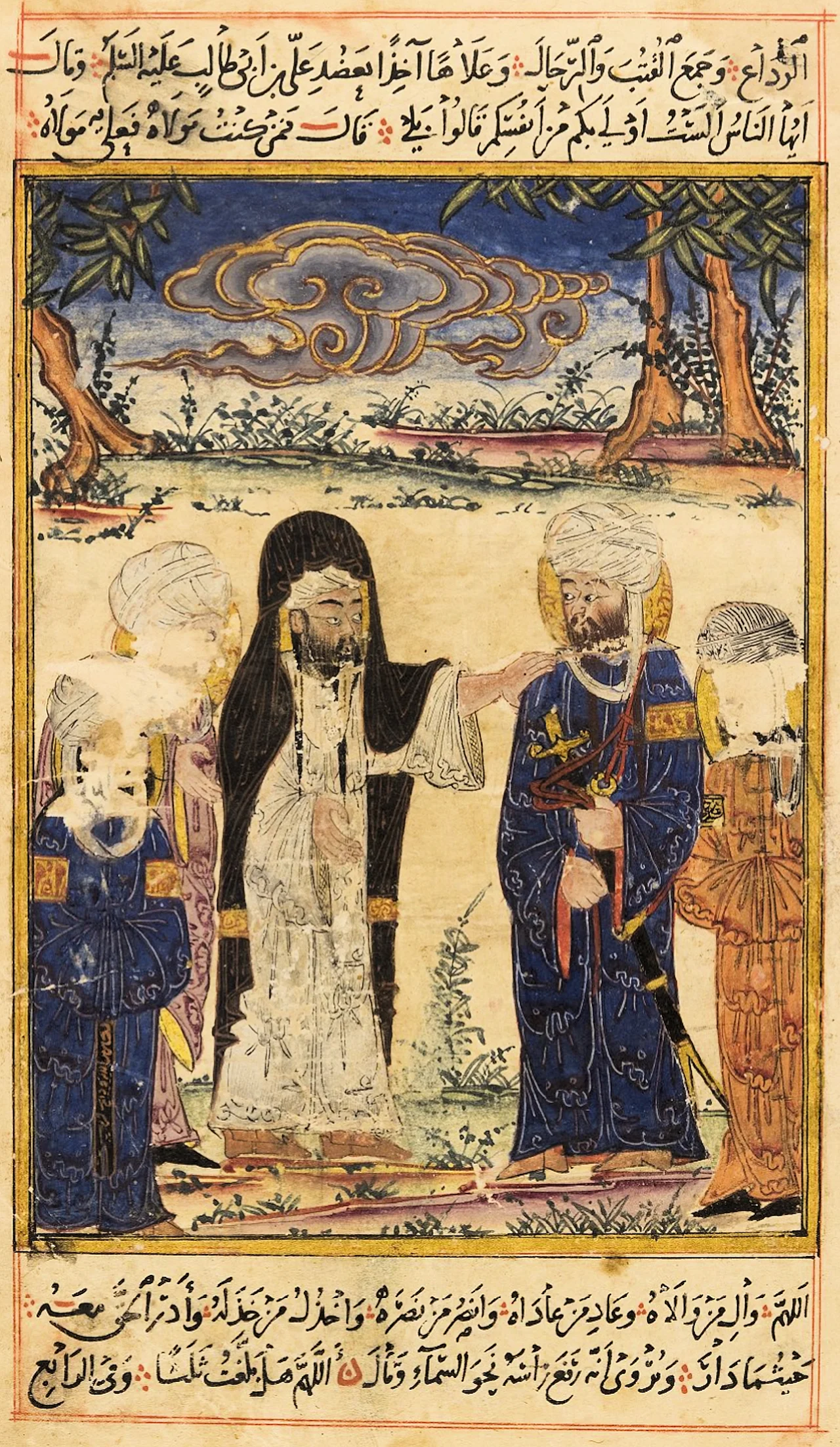

Ghadir Khumm
The water was bad. The pool at Khumm sat in a harsh, abandoned wadi between Mecca and Medina, its spring so saline that the tribes who once lived nearby had moved on. Yet it was here, in the heat of a March day in 632 CE, that the Prophet Muhammad halted the great caravan of Muslims returning from his Farewell Pilgrimage. He called for the noon prayer, asked that a platform be raised, and addressed the crowd before they scattered toward home. What he said about his cousin and son-in-law, Ali ibn Abi Talib, would be remembered, recorded, and revered across the Muslim world. How those words should be understood is one of the most respectfully debated questions in Islamic history.
The Gathering by the Pool
Muhammad had just completed the Hajj, the only pilgrimage of his life, and the journey back to Medina drew an immense company of believers, possibly numbering in the tens of thousands. The choice of this bleak crossroads was deliberate. Near the settlement of al-Juhfa, the routes toward Medina, Egypt, and Iraq diverged, so a pilgrim bound for any of them would still be present. To Shia Muslims, the very harshness of the place underscores the urgency of the moment: the Prophet stopped his people at the last point where all of them could hear him together, before the desert pulled them apart.
The Words Spoken
After the prayer, Muhammad spoke of the Qur'an and his family, urging the community to hold fast to both. Taking Ali by the hand, he asked whether he was not closer to the believers than they were to themselves, echoing a verse of the Qur'an. When they affirmed it, he declared, in the most widely transmitted form, "He whose mawla I am, Ali is his mawla." He is reported to have repeated it, and to have prayed, "O God, befriend the friend of Ali and be the enemy of his enemy." The companion Umar is said to have congratulated Ali afterward. This account survives in both Sunni and Shia collections, and its historicity is among the most thoroughly attested events in classical Islamic sources, scarcely disputed by anyone.
One Word, Many Meanings
Everything turns on a single Arabic word: mawla. Its root describes closeness between two people, and across history it has carried meanings as varied as master, leader, patron, guardian, helper, protector, beloved, and friend. That richness is exactly why the sermon can be read so differently. Shia scholarship understands mawla here in the sense of authority, leader and master and guardian, especially because Muhammad had just invoked his own nearness to the believers in the same breath. Many Sunni scholars read it as an expression of love and esteem, a public affirmation of the bond between the Prophet and Ali. The word itself does not settle the matter; context must, and the context is precisely what the two traditions weigh differently.
The Shia Understanding
For Shia Muslims, Ghadir Khumm is the investiture of Ali, the Prophet's clearest and most public designation of his successor. They point to the sheer drama of the scene, thousands halted in the midday heat for an announcement, and argue that mere affection would not require such staging, since love and support are owed by every Muslim to every other. In their reading, the community later set this designation aside, and they note that other successions in early Islam were settled by appointment rather than acclaim. The day is honored as Eid al-Ghadir, the festival on which, in the words of a hadith they hold dear, the religion itself was completed. Many mark it with fasting and with pilgrimage to Karbala in Iraq.
The Sunni Understanding
For Sunni Muslims, Ghadir Khumm does not concern the succession at all. They often connect it to Ali's recent return from a campaign in Yemen, where his strict handling of the distribution of spoils had upset some of the soldiers under him. In this reading, the Prophet spoke at Khumm to silence that grumbling and to make plain his love and respect for Ali. Sunni thought also finds it difficult to imagine that the Prophet's closest companions would have heard a clear appointment and then ignored it. Both traditions revere Ali deeply, the fourth caliph to Sunnis and the first Imam to Shia, and both preserve the memory of that day at the pool. They differ not over whether it happened, but over what it meant.
From the Air
Ghadir Khumm lay near the historic settlement of al-Juhfa, in the area of modern Rabigh on the western coastal plain of Saudi Arabia, roughly at 22.82°N, 39.08°E, between Mecca to the southeast and Medina to the north. The terrain is arid coastal lowland a short distance inland from the Red Sea, historically a junction of caravan routes. Nearest major airport is King Abdulaziz International (OEJN/JED) at Jeddah, about 150 km south; Prince Mohammad bin Abdulaziz International (OEMA/MED) at Medina lies to the north. Note that Mecca and Medina, and the immediate sacred precincts, are restricted; this is offered as geographic and historical context only. Recommended viewing altitude 3,000-6,000 ft over the coastal plain; skies are typically clear with strong daytime heat.
Nearby Stories
- Jeddah Tower 86 km away
- Red Sea 89 km away
- Battle of Badr 90 km away
- Jabal al-Nour 117 km away
- Hejaz 127 km away
- Mahd Al-Dhahab 142 km away
- Red Sea Rift 208 km away
- Zabargad Island 261 km away