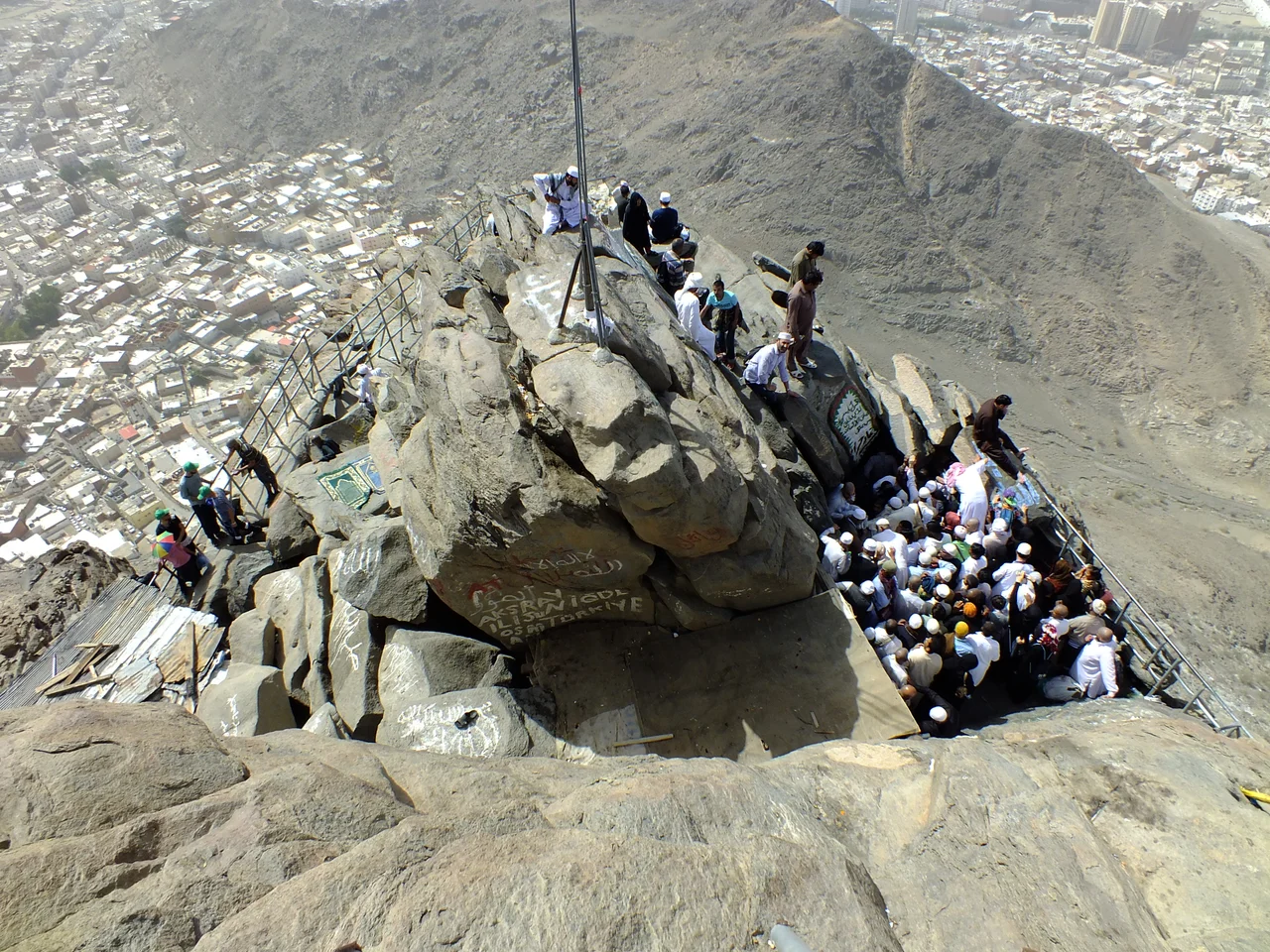

Jabal al-Nour
One thousand seven hundred and fifty steps. That is what it takes to reach the Cave of Hira, a cleft in the rock barely twelve feet long and five feet wide, tucked near the summit of Jabal al-Nour. Pilgrims climb in the dark before dawn, in sandals that slip on Precambrian granite nearly six hundred million years old. They are not climbing for the view, though the view is extraordinary: the spreading lights of Mecca below, the Great Mosque glowing in the valley, the desert mountains folding away toward the Red Sea. They climb because on one night in roughly August of 610 AD, a man named Muhammad retreated into this cave for solitude and came out, according to Islamic tradition, with the first verses of the Quran.
The Mountain of Light
Jabal al-Nour means Mountain of Light, and the name was given for what happened here rather than for anything you can see. Geologically, it is an unassuming peak, rising only about 640 meters above the desert floor, topped by an oddly shaped summit that looks almost like two mountains stacked on each other. The rock is hornblende tonalite and granodiorite, dense igneous stone pushed up from the deep crust an unimaginable span of time before any human walked on it. There is no water here. There is almost no vegetation, only a few thorns clinging in the cracks. Before Islam, the mountain was a place where people sometimes went to be alone. Its name, Hira, comes from an Arabic word for jewels, but what it offered was emptiness.
The Cave and the Night of Power
Muhammad was about forty years old and already known in Mecca as a trustworthy merchant when he began withdrawing here for a month each year, a practice the Arabs called tahannuth: seclusion, meditation, the feeding of any poor wanderers who passed by. He would take provisions up, stay until they ran out, then descend to circumambulate the Kaaba seven times before resupplying. On what Muslims call Laylat al-Qadr, the Night of Power in the last ten nights of Ramadan, Islamic tradition holds that the angel Jibril, known to Christians and Jews as Gabriel, appeared in the cave and commanded him to recite. The five verses that followed, the opening of Surah Al-Alaq, begin with a single word: Read. For Muslims, everything that came afterward, more than a billion lives lived in submission to that revelation, began in this narrow hollow in the rock.
The Climb
Today, during Hajj, an estimated five thousand pilgrims climb to the cave every day. The path is steep, the heat brutal in summer, and for many elderly pilgrims the ascent takes three hours. There are no ropes, no cable cars, no guardrails worthy of the word. Pilgrims carry water and pause often on the rocks to rest. The cave itself is oriented toward the Kaaba, which sits in the valley some four kilometers away, so that someone sitting inside Hira faces the direction Muslims worldwide face in prayer. Sitting in that small dark space with the city of Mecca spread out below is, for many pilgrims, the most personal moment of a journey that is otherwise experienced alongside millions.
Looking Down on Mecca
What the first worshippers saw from the mountain was silence and rock and the distant smudge of the valley. What pilgrims see today is a different world entirely. The white marble of the Masjid al-Haram glows below. The Abraj Al Bait clock tower, for a time one of the tallest buildings on Earth, presides over the skyline. Roads loop around the base of Jabal al-Nour, and neighborhoods climb its lower slopes. The Saudi government has discouraged veneration of the cave itself, concerned about practices that might stray into something resembling idolatry, but the pilgrims come anyway. They come because the story of this mountain is not really about the mountain. It is about a man alone in a cave, and a moment that altered the course of human history.
Stillness at the Summit
Jabal al-Nour is crowned by a steep, slippery peak that Muhammad and his companions once climbed together, according to tradition. Those who make the hike today say the stillness at the top is unlike anything in the city below. The wind moves through the rocks, the call to prayer drifts up faintly from the valley, and for a few minutes, the noise of the twenty-first century falls away. Then the climb down begins. Seventeen hundred and fifty steps, gravity now working in your favor, and the modern city waiting below with its traffic and its crowds and its air conditioning. Muslims who make this climb often say they descend a little changed. That is, in the end, what pilgrimage is for.
From the Air
Jabal al-Nour rises about 640 m (2,100 ft) above the desert at 21.458°N, 39.861°E, approximately 4 km northeast of the Masjid al-Haram in Mecca. The nearest airport is King Abdulaziz International Airport (OEJN) in Jeddah, about 75 km west. Recommended viewing altitude 7,000 to 10,000 ft AGL during daylight; the distinctive double-peaked summit is the key visual marker. Note that Mecca's airspace is restricted for non-Muslims, and the city itself is closed to non-Muslim visitors.
Nearby Stories
- Jeddah International Airport (closed 1981) 18 km away
- Siege of Ta'if 53 km away
- Ghadir Khumm 118 km away
- Battle of Turubah 122 km away
- Red Sea Rift 146 km away
- Hejaz 195 km away
- Red Sea 198 km away
- Al-Baha 201 km away