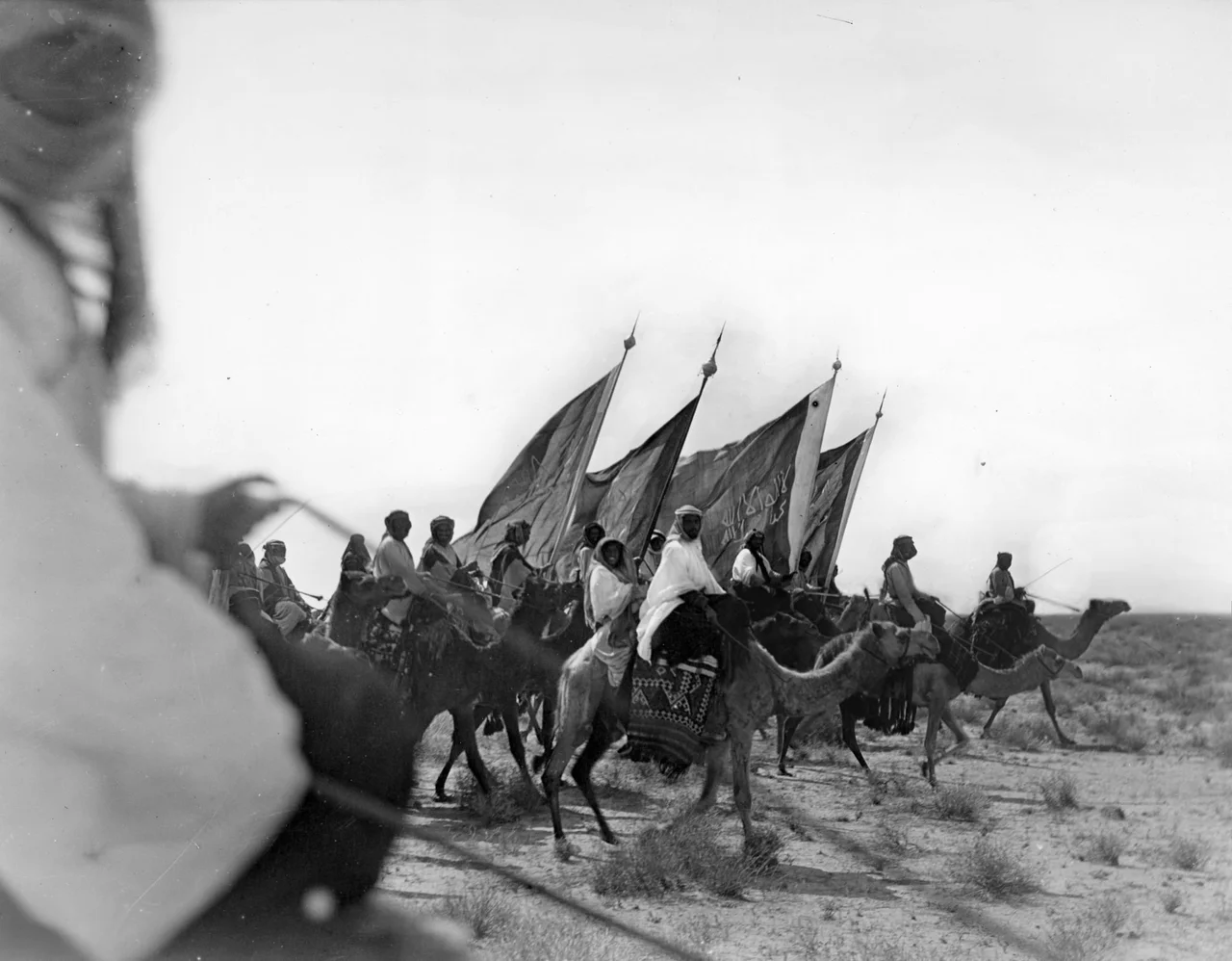

Battle of Turubah
Abdullah bin al-Hussein was nearly killed that night. His father's army had been caught in camp, unprepared, and the Ikhwan warriors of Ibn Saud cut it to pieces in the darkness. What saved the future king of Jordan was not tactics or courage but a man named Zeid Ibn Shakir - father of a general yet to be born - who gave him a horse and a camel and told him to ride. That was 26 May 1919. Within a year, Ibn Saud had taken Mecca and Jeddah. Within two, he had declared himself King of the Hejaz. Within nine, his expanding kingdom would be renamed Saudi Arabia. The Battle of Turubah, fought in a wadi far from any capital, is the hinge on which modern Arabia turned.
A King of Delusions
Hussein bin Ali, Sharif of Mecca and King of the Hejaz, had trouble seeing the world as it actually was. He believed every Arab supported him. He claimed his interpretation of the Quran superseded all clerical opinion. He dreamed of reviving a great Arab caliphate under his own leadership. The dreams did not match the finances. Postwar British subsidies - the payments that had underwritten his Arab Revolt against the Ottomans - began to shrink. Hussein responded by taxing merchants and meddling in urban commerce. The Bedouin fighters he had once paid now turned to raiding caravans and setting up improvised tolls on the roads around Mecca, Medina, Jeddah, and Taif. When an attack on Iraqi pilgrims killed 40, Hussein compensated the families - and stretched his treasury further. His eldest son Ali bin Hussein would rule in the Hejaz after his father fled. Another son, Abdullah, would become the first King of Jordan. A third, Faisal, would be installed as King of Iraq by the British. But all of that was before 1924.
The Quarrel at Taif
In 1918 - while the Arab Revolt was still officially allied with Britain - Abdullah picked a fight with Khalid ibn Luai, the ruler of Taif. The disagreement escalated. Ibn Luai turned for support to Ibn Saud in neighboring Najd, and in the process embraced Wahhabism. Hussein committed forces to secure Taif and punish Ibn Luai - and by extension, to push back against Ibn Saud's growing influence. In 1919, Hussein's army took over the Ottoman arsenal at Medina, giving him artillery, machine guns, ammunition, and rifles on a scale he had never previously possessed. On paper, the Hejaz looked strong. The Hashemites had international recognition. Hussein's sons held thrones across the new Arab world. Ibn Saud had a dusty inland kingdom and a corps of tribal warriors. On paper.
A Night in a Wadi
The fighting at Turubah was brief and decisive. The Hashemite force under Abdullah was caught essentially unprepared. The Ikhwan - Ibn Saud's religiously motivated Bedouin fighters - struck at night. The Hashemite camp was overrun. Hundreds died. Abdullah's escape on a borrowed horse and camel became the kind of story that gets told in capitals. The victory sent shockwaves through Mecca, Medina, Jeddah, London, and Cairo. The British consul general in Jeddah sent a stiff note to Ibn Saud demanding he withdraw from Turubah and Khurmah back to Najd. They threatened to void their agreements with him if he invaded the Hejaz proper. General Edmund Allenby, the high commissioner in Cairo, had six biplanes shipped to Jeddah to defend the Hejaz. An advisor warned him that captured British pilots in Ibn Saud's territory would be cut to pieces. The biplanes stayed crated.
Hussein's Unraveling
The effect on Hussein was worse than the effect on Abdullah. He fell ill. He blamed his son. He became obsessed with revenge on Ibn Saud - and also, in a final flourish of the delusions that had characterized his reign, demanded from T. E. Lawrence that the British grant him complete control of Iraq, Palestine, and Transjordan. The British, tiring of him, declined. They also began, quietly, to lose interest in stopping Ibn Saud. Princess Modah, Ibn Saud's granddaughter, later remarked with some bitterness that the British had asked her grandfather to stop fighting after Turubah, but now were the source of his warlike power in money and weapons. Hussein fled the Hejaz in October 1924. Ali bin Hussein tried to rule in his place. Ibn Saud launched his offensive the following year. Mecca fell in October 1924. Jeddah fell in December 1925 after a long siege. In 1926 Ibn Saud declared himself King of the Hejaz, unifying his new territories with Najd. Turubah itself is a small town in Mecca Province today, known mainly for agriculture and - quietly - for the battle that happened in its wadi exactly one hundred years ago this year.
Who Fell and Who Rose
The men who died at Turubah deserve to be remembered as individuals, not as units of a defeat. Hussein's army was drawn from the Hejaz and from levies across his shrinking kingdom. Many of the Ikhwan who killed them were tribesmen whose families had fought the Hashemites for generations over water, grazing, and trade routes. The battle was not a clash of abstract forces but of specific people, most of them unnamed in the histories, all of them real. Hussein would spend his final years in exile, dying in Amman in 1931. Abdullah, who had barely survived Turubah, would be assassinated at the Al-Aqsa Mosque in Jerusalem in 1951 - his grandson Hussein bin Talal watching from close enough to remember it forever. The house that lost at Turubah would not vanish. It would give rise to the Hashemite Kingdom of Jordan, which still exists, still ruled by direct descendants of the king who fell that night.
From the Air
Turubah is a small town in eastern Mecca Province, Saudi Arabia, at approximately 21.17 N, 41.60 E. The nearest major airport is Taif International (OETF) well to the northwest; Bisha Airport (OEBH) lies to the southeast. Terrain is arid highlands of the northern Asir uplands, between the Sarawat escarpment to the west and Najd desert to the east. Visibility is typically excellent. Note airspace near Mecca is restricted; verify current regulations before flight planning. The battlefield site itself is not preserved as a specific landmark - the wadi where the fighting occurred is now within ordinary agricultural and rangeland terrain.
Nearby Stories
- Siege of Ta'if 75 km away
- Al-Baha 103 km away
- Jabal al-Nour 132 km away
- Battle of Fakhkh 192 km away
- Battle of Kunfuda Bay 198 km away
- Asir 230 km away
- Qaryat al-Faw 346 km away
- Najd 348 km away